
I’m sure this will both come equally as a shock and just another norm to other folks, but both the side version of Weiss Schwarz Blau and the alternative game, Rebirth, have both announced their EoS (end of service) dates following the latest Weiss Schwarz announcements.




For those who are unaware, Blau, and now its cousin, Rose, are alternative versions of Weiss Schwarz with their own properties that play with the same fundamental rules as Weiss Schwarz but greatly weakened and simplified cards. These two versions are distinct not simply based on the properties exhibited but also their visual design with Blau having a signature blue back and Rose carrying the same Weiss Schwarz logo but with the addition of the Rose word in pink sketched on top.
As for those who view the death of these games (Rose is still alive at the time of this posting) as the norm, they’ve likely been playing Bushiroad games for quite a long while. You see, if you aren’t aware or haven’t known, Bushiroad has a long history and graveyard of dead games. It isn’t particularly uncommon for a company to have a string of dead games, but the general amount of dead games that Bushiroad has might make the average player give at least a glance. Here’s just a short list of some from a quick search (there may be more):
- Jewelpet Trading Card Game (2009)
- ChaosTCG (2009-2019)
- Victory Spark (2009-2014)
- AlicexCross (2009-2011)
- Five Qross (2013-2015)
- Future Card Buddyfight (2014-2020)
- Luck&Logic (2016-2018)
- Dragoborne -Rise to Supremacy-* (English Exclusive) (2017-2018)
Before we head deeper into this subject, I do want to explain a little more about these games. This is quite a lot of dead games for a single company that’s produced card games for over two decades to really share. Each of these games obviously has their own circumstances to consider. Generally, from my own experience, and talking to others, there is generally some common trends that do lead to the death of some of these TCGs. I will get to Blau and Rebirth eventually, but that will be closer to the end of this post because I feel players need to fundamentally understand the general lifeline of Bushiroad card games.
Ignoring Jewelpet, which I have very little experience with and the fact that it is one of Bushiroad’s first card games, and, as with all card games and emerging companies, I’d expect a few rough patches and better experience gained over game development eventually leading to the game’s retirement. Five Qross is also a very strange game because the game was less of a physical card game and more of some pseudo online mix that never really caught on as far as I know.
But aside from these two examples, I want to share about the similarities of ChaosTCG, Victory Spark, Alice X Cross, and that of Weiss Schwarz. At one point, all these games existed within the same time frame. However, there’s one big issue with four different anime cards games that exist to feature different anime series. Yes, if you haven’t figured it out with that last sentence, all four were basically competing with one another for IP access and also the same playerbase. Initially, all four had different distinct goals at attracting specific audiences, but these goals were rather arbitrary to begin with.

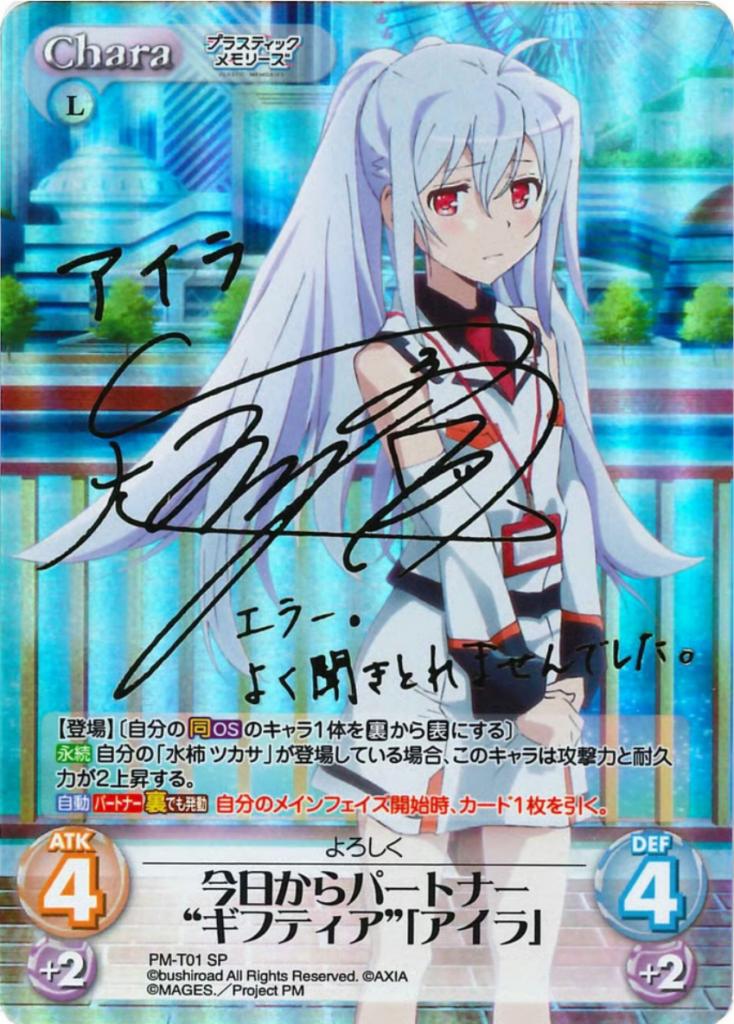
For instance, Alice X Cross wanted to bring in female fans whereas Victory Spark was heavily focused on more ecchi and light novel anime series. ChaosTCG was a game that had a mix of various series, but even that audience was rather all over the place given the series that it depicted. Weiss Schwarz was merely a catch-all with both it’s initial goals at depicting softer animes and games in its already rather arbitrary separations between Weiss and Schwarz titles (yes, that is a thing). These separations or dividers between audiences, while distinct, share titles that don’t exactly conform to just one or two of these groups. In fact, the reality is that most anime fans were more than likely to jump in-between these games based on titles they enjoyed, something that still happens to this very day.
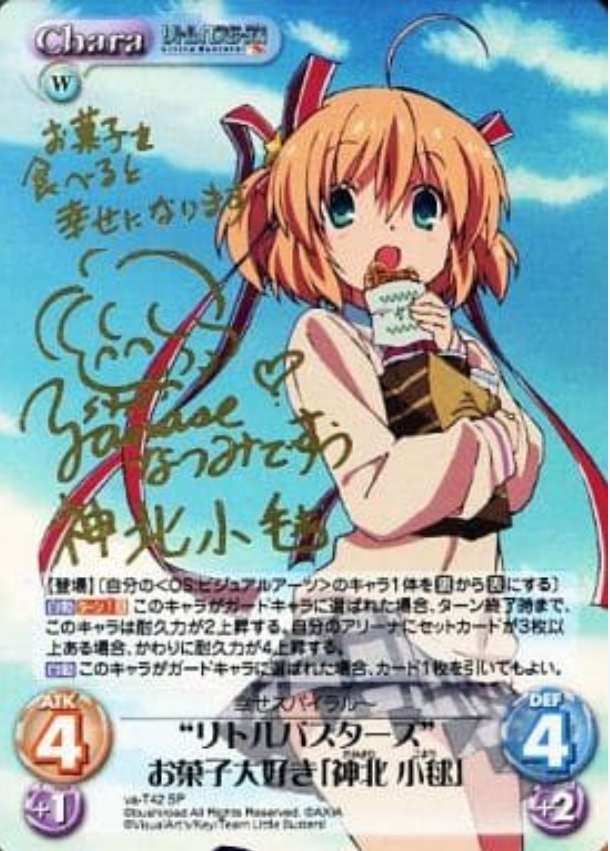

Additionally, something that became a somewhat common theme were that IPs began to be shared among the different games. This created a rift between players as they had to make a decision to choose between which game they wanted to play featuring their favourite series. To be honest as well, these playerbases were also not equal by any measure. As a statement to this, Weiss Schwarz eventually gained an English variant, something none of those other games were ever able to achieve. Now, I can’t say anything much about the gameplay of those other games that may have lead to Weiss Schwarz succeeding, but Weiss Schwarz’ strength lay in its rather simplified gameplay and relatively larger lifespan. The clock system and cancelling made it difficult to powercreep in a sense to create lockouts for either player in game.


Bushiroad wasn’t the only company on the block producing vast anime series games that were pitted against one another. Competition was frequent and abundant. As for how some of those other series retired, I cannot tell you the full truth. However, there is a common sentiment that is much observed from Bushiroad’s other “hit” series that still remains to this day: Cardfight Vanguard.

Vanguard, an original anime series from Bushiroad themselves, was supposedly originally meant to be in Weiss Schwarz, but they branched it off into another game entirely. Now, what separates Vanguard and Weiss lies very heavily within its intended playerbase. Vanguard is first and foremost a game for children. The market audience is kids who are entering or slightly past their first double digits in age like preteens. It’s also very obvious when you watch the show itself as themes are light and heavily adventurous much like many other kid shows. Weiss Schwarz, on the flip-side, is intended for young adults and older as evidenced by the many series on the cards themselves. Thus, with their split audiences, the community between both is generally divided, although many will more than likely transition to Weiss as they age.
Vanguard has a huge problem. And this problem has been echoed by its community several times over, at least from what I hear in the West. If you didn’t know, Vanguard has been reset twice. And what I mean by that is that the game has been rebooted in its entirety twice. Unlike Weiss, which exists mainly in its eternal format in Neo-Standard where every card can be used through all of the game’s history, Vanguard is divided on multiple formats. And the reason for these formats have been heavily hinted to be due to powercrept designs. They have repeatedly revamped the game with newer mechanics that supersede ancient and old rules to some amount of discord within the communities themselves.
And given that in mind, that was part of a rumour that I had heard in the past that killed Weiss’ main direct competitor in the Bushiroad space, ChaosTCG. Furthermore, Weiss was always generally grabbing more series and more popular series than that other game.
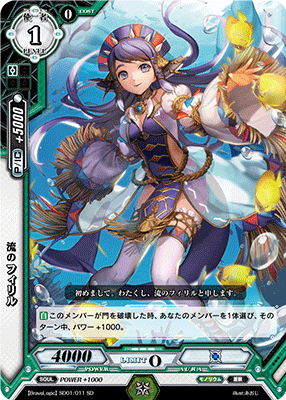
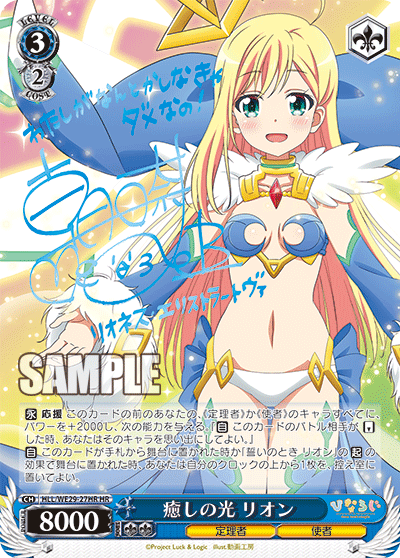
Luck and Logic, one of the more rarer outliers to Bushiroad’s products, came as an independent product that was not based upon any anime series, an original similar to Vanguard. However, at least in the West, it suffered heavily from distribution problems at its launch. Furthermore, the gate system and trigger system respectively from the gates was extremely RNG dependent and could heavily swing games in either player’s side. This product never really lasted in the West and would survive a few more years in Japan. In the latter’s case, my expectation is that other games had originally beaten it out in terms of competition.
Furthermore, as you can tell from a recurring pattern, the Luck and Logic side project anime series, Hina Logic, was then incorporated in to Weiss directly as evidenced above. But this also came with another issue as the set itself also pushed the button for powercreep, but that is a different story. The main conclusion here is that Bushiroad games have always had this struggle with trying to balance themselves and have lead to points that either lead to the rare reboot such as in Vanguard or to retirement like most of the other games. But this isn’t the only factor that needs to be discussed. Furthermore, this isn’t inherently an issue that solely Bushiroad faces as a card game developer.



Blau, as a conceptual design, is in an awkward space. The reason for Blau’s existence was to reach out to a lesser targeted audience, the same as in AlicexCross, using female targeted IPs to attract women to the game. Another part of its key design was to simplify Weiss and make a version that was easier to play and understand with slower and weakened mechanics.
I’m not going into gender dynamics here, and to be fair, Blau did have several series that were female-oriented or generally were more favourable supposedly to women like Sanrio and Chikuwa. The problem was that the later series down the road such as those above have a much more diverse attraction. With series like Blue Lock! and Hitman Reborn!, you were looking at shounen series that usually gather heavy male audiences due to fighting scenes or hype anime moments. The Apothecary Diaries, while popular among females, was also highly receptive to men as well. As such, the targeting demographic became very blurred and the message confusing. This is also ignoring the fact that physical card games, as a whole, have been generally marketed towards male appeal and are more so historically male-dominated (due to advertising and media depictions) to begin with.
They had some introductory events, but the problem with Blau, was Blau was never its own game nor did it come into mainstream prominence. I don’t think that was its target, but after four years of development, similar to Rebirth as well in this case, you would think to have the game be its own or have some amount of dominant share in the market. That never came true. Blau and Rebirth remained on the sidelines for almost all eternity. It did attract female audiences, but I would also presume, they would start in Blau and then potentially be more attracted as they played more to the more advanced mechanics and larger series pool within the main game. Blau was essentially permanently overshadowed by its predecessor and original version, Weiss Schwarz.


Now, I don’t know how aware you are of Bushiroad’s “projects”, but Bushiroad has long expanded past card games. This isn’t a fault of theirs and is quite common. Bushiroad has been pushing for several projects in directions far beyond that of card games solely. And the reason I want to bring this up is to showcase a little bit of their other products and the general reception based on these products themselves. This is not to hate on the IPs or creative output, but largely, many of the problems I am about to discuss can be heavily linked to management.
Starting with the first, we have Bang Dream! Girls Band Party! which is a mobile game produced by Bushiroad. However, this is not the only mobile game produced by Bushiroad. In fact, Bushiroad has a graveyard full of these mobile games including that of Love Live! School Idol Festival, Love Live! School Idol Festival All Stars, Love Live! School Idol Festival 2 Miracle Live (which was even more a mockery to English fans as they released the game for three months in English and also made a set for it), Revue Starlight Re:LIVE, Cardfight!! Vanguard ZERO, Symphogear XD Unlimited, and their list of Argonavis games. Bushiroad has always appeared to take fairly odd care of their own individual IPs, and they own a lot such as Milky Holmes that many may not even remember.
Their products come in and out, but more often than anything, they supersede their own IPs with new variants or an entirely new project. For instance, Bang Dream! has just been getting a new group every iteration of its design while giving minor support to the rest of the previous groups. Revue Starlight originally began with a main cast but was quickly expanded to include a gacha universe that was hardly commented on and shown briefly in cards within Weiss Schwarz. D4DJ remains untouched since it’s last set in almost half a decade. Milky Holmes hasn’t even had a mention in years. Did you even know that Weiss Schwarz had a terrible anime with its own mascots in Weiss Survive?

Bushiroad video games are an entirely different matter altogether. Keep in mind that Bushiroad mainly produces these games in conjunction with other companies. Their games have relatively poor feedback to mixed at best, often citing low quality productions and generic gameplay. One of their own originals, Rear Sekai (changed in name in English to Elrentaros Wanderings) released with middling and disappointing reviews on average. You can look at the reviews for Vanguard: Dear Days 2 by yourself. As such, I would not be surprised if players who know about this company are not very hyped for the new online client coming out soon.
While Bushiroad has also owned a large stake in the New Japan Wrestling Association for years now, its sudden selling of all its shares to Cyberagent is an alarming call to question, considering that they have a set announced at the beginning of next year to celebrate the wresting association to begin with. And there is likely severe drama going on with that situation.
And the reason I’m ending this post on that note is to really give an image of what Bushiroad is based on its actions, decisions, and the legacy of its games in the last nearly two decades that I’ve known them. Now, if you are a fan of Blau and/or Rebirth, my condolences to you, and hopefully, the game may remain in your heart as a keepsake that you can bring out from time to time with your friends. It’s always a shame to hear games enter retirement. And furthermore, and I know this probably true if you are a fan of Rose and worry about the same actions being taken within a year or two as was the current announcements to Blau. I just wish for everyone to at least get part of an image to understand a bit more of what is going on from behind the curtain.
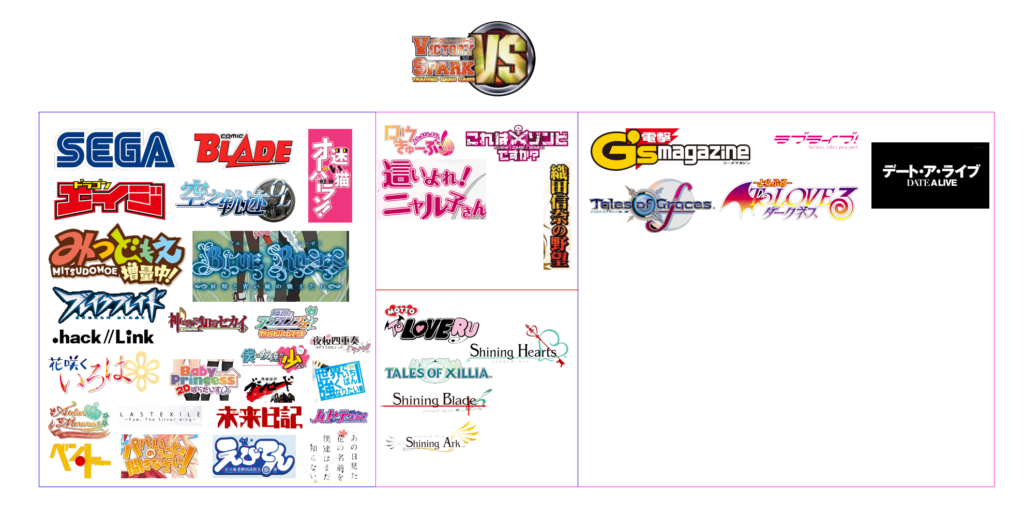
As a bit of an extra showcase, I’ve compiled images from series from Bushiroad’s dead games, only that of Victory Spark and ChaOS TCG to highlight shared series and distinct series between them. Do note that this does not include series that were imported to Blau or Rose. For Victory Spark above, the left side are independent titles that have not been ported over, and the right are shared and found directly within Weiss Schwarz. The top-center are series that are imported into bunko sets (compilation sets) but lack direct and distinct separate independent sets. The bottom-center are series that have been partially incorporated in some sense in Weiss Schwarz as well but likely either through a sequel series or some other alternative title. Information was gathered from LittleAkiba.
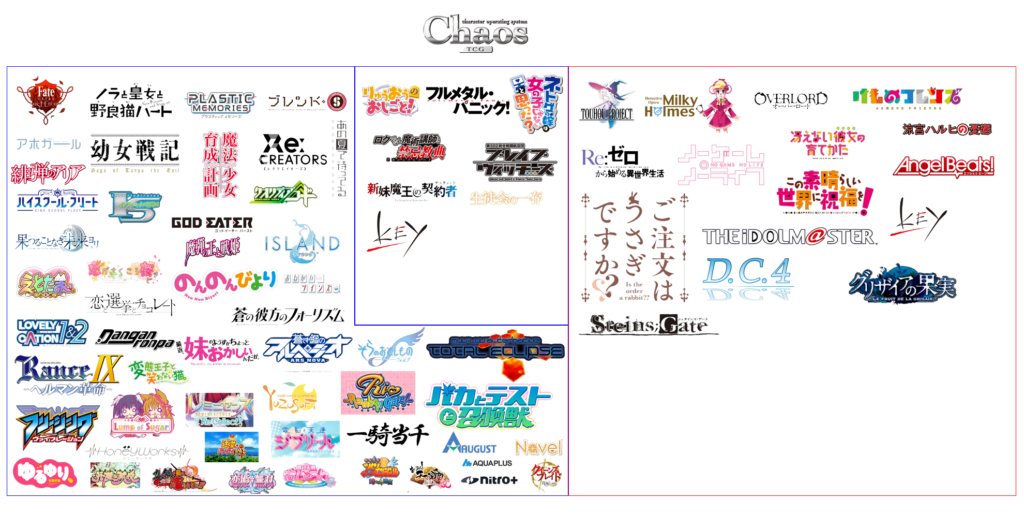
ChaOS TCG’s image above depicts the left with series that have never been imported. The center highlights titles within bunko sets (compilation sets) whereas the right depicts series that have their own independent sets within Weiss Schwarz. Titles and data was gathered from Yuyutei.jp. As a disclaimer, accuracy for both pictures above were compiled to the best of my own ability and some series reflect an umbrella of series underneath the studio or title depicted rather than individual IPs.