
There’s been a few new players showing up at my local community, and for them, as I would think for many new players, deck-building is a monumental task to perform. While the more experienced player can probably skim read the general effects of a card and probably determine how it may best fit their deck design in mind, new players may not even have the concept of a deck design.



MKI/W126-T13SP-SP 八奈見杏菜 (center)
Srd/W123-T11TD 思い出の場所 マーシャ (right)
While the trial deck gives a very decent barebone example of how a deck should be structured, trial decks often lack the flair and unique identity that comes with building your own deck by diving into the main booster set pool. This is further increased in difficulty when the supplemental product also includes multiple sets and potential unique promotional cards as well.
As far as the trial deck experience goes, it provides a fairly decent introductory sample to the game. Combos are often very simple with two main combos, an early advantage combo and an endgame finisher. The early advantage combo usually has power and some way to grab hand while the finisher has a singular instance of additional damage. What is often missing is the lack of substantial filter and alternative advantage generation. Many cards are essentially vanilla in function, being cards with high power value and not much more.
As such, this “guide” will be more of a list of simple guidelines to help with designing a deck for any beginner. These are not the only tips you should follow, but they are a set of ideas to help you with thinking about how to build your first deck.

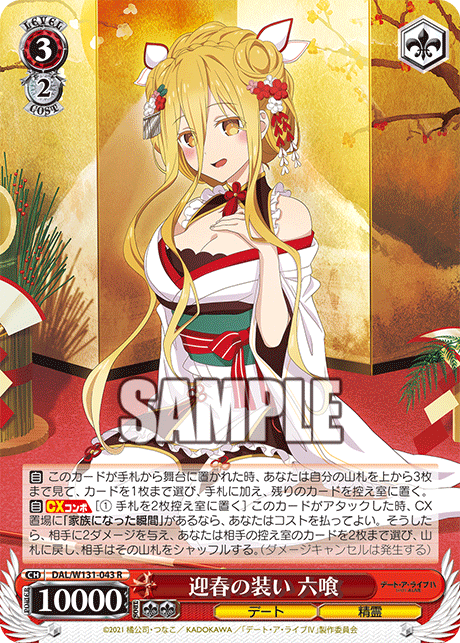

DAL/W131-043S-SR 迎春の装い 六喰 (center)
TL/W42-032RR “朝のお目覚め”唯 (right)
Step 1.) Decide upon your endgame/theme
Since Weiss is so concentrated on that final turn where you reach the climax of the game with your strongest cards, you should think about which finisher you think best suits what you want to accomplish. Finishers shape the way you build your deck since you’ll be looking for cards that best work in tandem with their requirements to get their finishing effect to fire.
Alternatively, you can also decide upon a theme. Whether that be only blonde girls or characters in a sub-unit, that’s up to you. This is relatively easier to accomplish to be honest, especially if you are a big fan of the series you’ve chosen to build. Weiss generally makes callbacks to the series it depicts, so you may find several commonalities which will be seen within the cards.
In my experience, adding restrictions to builds actually makes building more concise and simpler. With the former, due to the restricted card pool that you’ve placed upon yourself, the choices of what you include in your deck will have a much stronger impact given that there is a focused card pool to choose from. For the latter, since the card pool is smaller, you won’t need to look at too many cards at once.


DAL/W131-005SP-SP 仲良し姉妹 夕弦 (center)
AMG/W121-038U 縁結びの組紐 (right)
Step 2.) Look for direct synergies
Are there cards that directly work with your finisher? Are these cards essential requirements? If they are requirements, well, that’s a no-brainer, you’ve got to find them and put them into your deck. That’s just how it works. As for direct support, more than often, it is very likely that you should include them in your deck. Now that’s not always the case, but, since these cards are designed to work in tandem with your finisher, you may as well put them in since they’ll share a stronger synergy, provide usually a more powerful effect, and/or add to consistency.


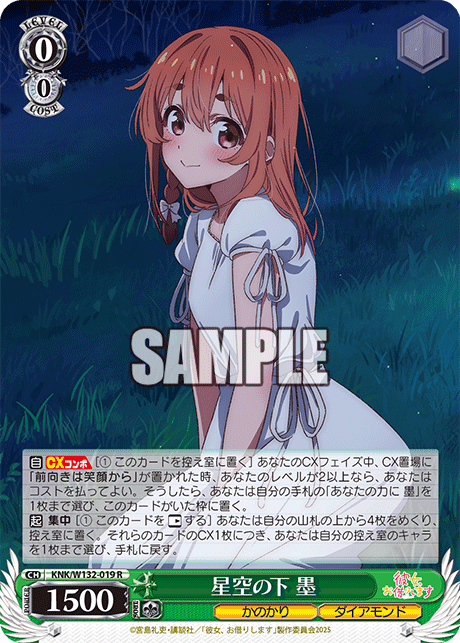
UMA/W119-012U 託された願い ジャングルポケット (center)
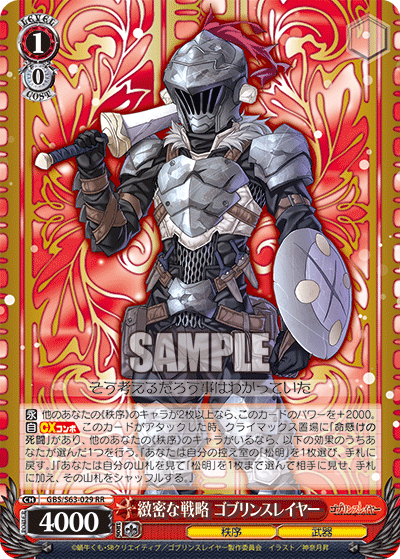
GBS/S63-029RR 緻密な戦略 ゴブリンスレイヤー (right)
Step 3.) Deciding upon an early combo
Unlike other games where there are key linchpin cards that set-up the rest of your game, Weiss has a sort of pre-built option in the sense of the early advantage combo. It’s been long standardized in the game (not a set rule) that they’re usually around level one. And they’re all usually accompanying your other four climaxes outside of your main finisher. Similar to your trial deck, we’re going to be looking for our own.
Now, none of this is to say that you can’t use your trial deck cards by any measure. You can use the early game combo there and/or the finisher and just add cards in the main booster and whatnot to help enhance your experience. The world is your oyster.
Combos should be tailored to your deck. Most often, you’ll be looking for one that grabs you hand since the early game’s struggles are often centred there. But that may not always be the case either. Maybe your deck is quite stock hungry; then, in that case, you’d want a combo that generates you more stock. Maybe there’s some utility with another card that’s within the same theme. That may call for another more specific combo. There’s a lot of choices to be made here. Especially, remember that at level one going forward, you also have to start caring about colours in your level and clock to play higher level cards. You can also forgo all of this and just play characters you like with their associated combo.



GIM/W124-045S-SR 君と出会い、夢に翔ける 花海咲季 (center)
GRI/S112-077S-SR 情報担当 クリス (right)
Step 4.) Important Cards to Your Game Plan**
I decided to tie an asterisk here because this step is sort of mixed with a following step after. Now is where you want to look for cards that help facilitate your game plan. Think of these cards as the meat and potatoes of your deck after the crucial ingredients have already been put in. These cards are not essential in the fact that your deck will still function without them, but they can help enhance the experience or help with alleviating certain costs and requirements.
They may not be so direct at first glance. You always want to coordinate these choices with the needs of your deck and finisher which will require you to ask and evaluate the design choices placed in your deck so far. An obvious example is putting stock chargers in a deck whose finisher needs a large amount of stock. But it can be a bit more nuanced than that such as using Serika from Blue Archive (left card) from above to filter potential random cards from your early game combo into something more useful for your next few turns.

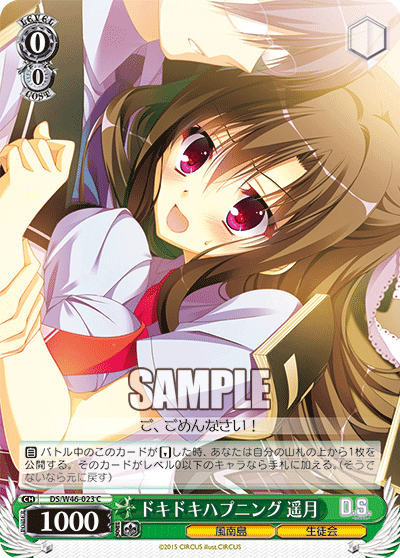

DS/W46-023C ドキドキハプニング 遥月 (center)
GU/W88-095C “ガレット・デ・ロワ” チノ (right)
Step 5.) The Spice
As they say, “variety is the spice of life”, you can also add cards that you think are just cool or that you think would be fun to mess around with. Pet cards, signed cards that you just want to showcase, whatever fits your fancy, just put it in. It’s your deck. Bonus points if the cards you put it synergize with other cards either from theme or by synchronizing in effects.

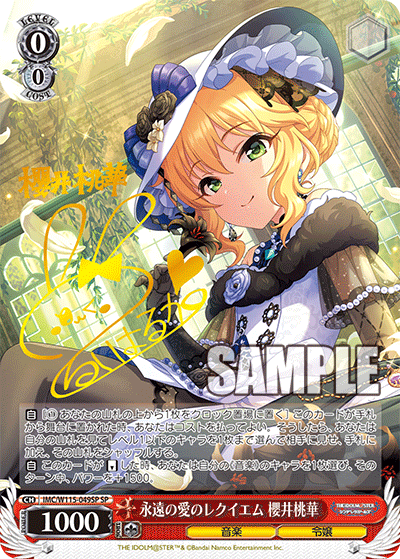

IMC/W115-049SP-SP 永遠の愛のレクイエム 櫻井桃華 (center)
IMC/W41-002RR 赤城 みりあ (right)
Step 6.) The Consistency Cards**
This is the point where you can see where the other asterisks lie. The reason for this is because, sometimes, these cards may already synchronize with your deck’s theme by its core design. Cards can fulfill multiple roles.
Often called staples, these are the cards that “staple” your deck together, keeping it flowing and working together. Contrary to popular opinion, these aren’t solely a small set within the available card pool to choose from. There are some generally very much wanted effects which you can check out from my profile series here. No profile is exactly “better” than other profiles. They all exist to perform different niches. Furthermore, even the same “profile” may have multiple variants. This is most effectively shown above with the three cards from the Idolm@ster Cinderella Girls series. All three cards are technically part of the Riki profile but just by scanning over their texts and even raw base power, you can already tell they have slight variances in function. While many staples are considered universal, you should always be looking to tailor the specific staples to your deck. A deck doesn’t need to run all the staples. You may even want to skip out on certain staples. You don’t want to run into the opposite design where your deck becomes overshadowed by staples and the utility they provide rather than being a deck that shines through the addition of staples.
People are interested in the pages of a book, not the glue that’s keeping it together.
Step 7.) Arguably the most important step
Go outside and play your deck against others. Consider their opinions, make changes as needed, and return to this process again and again. As for ratios, I have my shorthanded guide here.
1 –> Niche
2 –> Okay, want to see it once a game maybe
3 –> Important
4 –> If I don’t see it, I cry
And hey, remember that a single game is not indicative of the overall experience or quality of the deck. Weiss is prone to much variance due to the general nature of its damage systems and shifting cards in every zone (cards move quite a lot in this game). While there’s no real “exact” number of test games that you should have, give the deck a few chances before ultimately making decisions on changes.
And for those that are wondering why I don’t just point new players into the direction of netdecking, my genuine question is why would you be bothering to read this piece to begin with?