
At first, I was going to put a title like the “powercreep that redefined Weiss Schwarz” and stick the image of Akatsuki into the social media display, but after watching a video about the brief history of Commander in Magic the Gathering, I decided to change up the message a little bit. The idea for this post won’t change, but I think the title is a bit more suiting to begin a conversation on the breakdown of existing and historical powercreep and talk about the future of Weiss Schwarz as a whole.
I know I’ve spoken at length about powercreep in this game; if you haven’t already, please feel free to check out these articles as well: Powercreep that I despise the most and Generalization and Powercreep. Today’s focus is more on powercreep in a general sense, not necessarily zooming in on specific cards and mechanics; although, some will be mentioned as examples.


As is with the title of this post, we are going all the way back to 2014 with the debut and release of the titular Akatsuki shown above. I’m not going into the history here of this card. A simplification of the story is that this card was a powerhouse and a genuine staple in any deck in its series, Kantai Collection. As a level zero card, you could bypass all colour requirements, and given that it checked the universal trait of the series, it worked with pretty much every single card in the series. Now that we’ve established and defined Akatsuki, let’s move on to discussing the main bulk of this article.
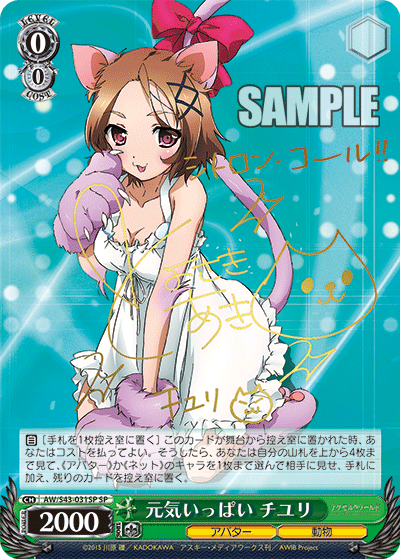
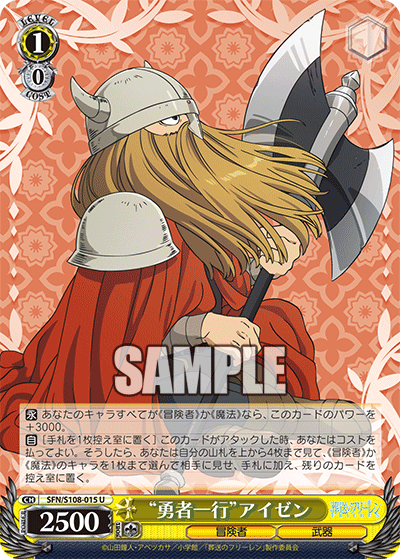
SFN/S108-015U “勇者一行”アイゼン (center)
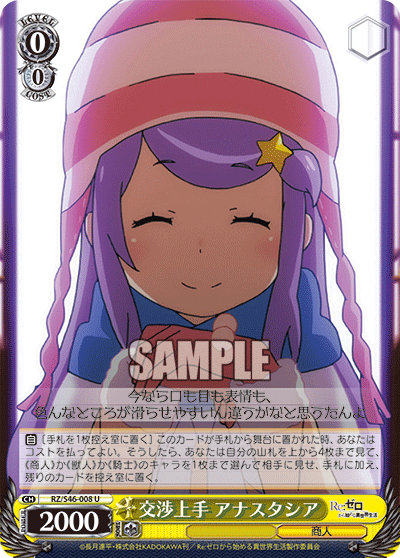
RZ/S46-008U 交渉上手 アナスタシア (right)
While Akatsuki has never really ever returned to the game in its full glory, many alternative clones of it exists in the current game with many showing up from time to time. The most common form is that of Chiyuri on the left (the namesake for the same effect) where it is Akatsuki’s effect but the timing takes place when the card enters the waiting room. Eisen is a newer form where you can perform the Akatsuki effect earlier than Chiyuri but on attack instead. There’s also been a few niche forms with cards like Anastasia on the right requiring that you meet and select only very specific targets.
Ultimately, what can and have we learned from this? To put it simply, as of the time of this writing, Bushiroad still considers this effect far too strong for the game. You can have alternatives of the same ability, but that exact card will probably never be printed again. And in Akatsuki’s case, this is likely especially true due to the fact that her effect is on-play rather than later, allowing you to easily use her to facilitate even more plays comparatively (which is exceptionally powerful given today’s cards and utility profiles).


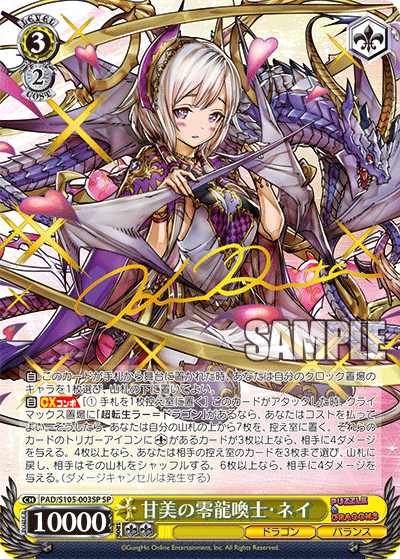
HOL/W104-113SP-SP 未来へと踏み出す一歩 がうる・ぐら (center)
PAD/S105-003SP-SP 甘美の零龍喚士・ネイ (right)
While not the same as Akatsuki, many generally unfun or overpowered designs have popped up in the game time and time again, usually ending up on either the ban list in one capacity or another. Most recently, there are fewer direct bans and more limitations on number of copies or choice restrictions, allowing these cards to still exist in various builds. What that does mean is that these problematic play designs and patterns do still show up but are just less likely. This doesn’t actually eradicate the problem but only reduces the likelihood of encountering them and overall consistency for these designs. Similar to Akatsuki, their designs then continue to perpetuate in the game; albeit, with slight changes to modify them to be less overpowering or oppressive.
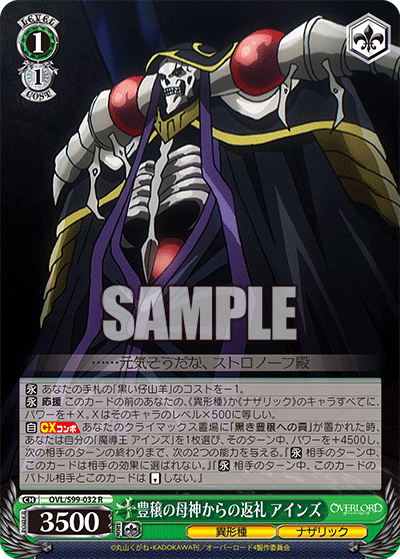
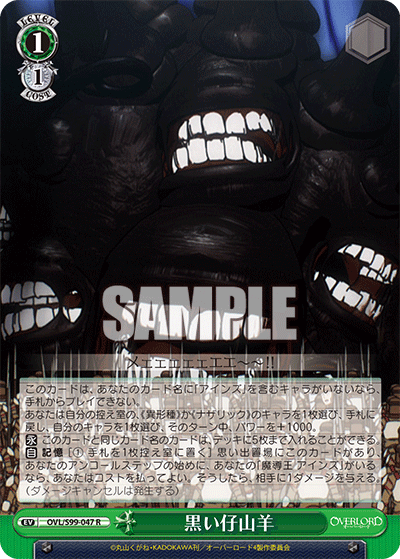
OVL/S99-047R 黒い仔山羊 (top-right)
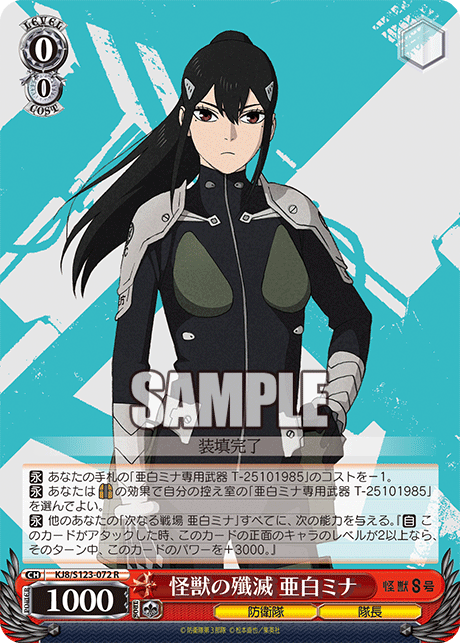
KJ8/S123-072R 怪獣の殲滅 亜白ミナ (bottom-left)
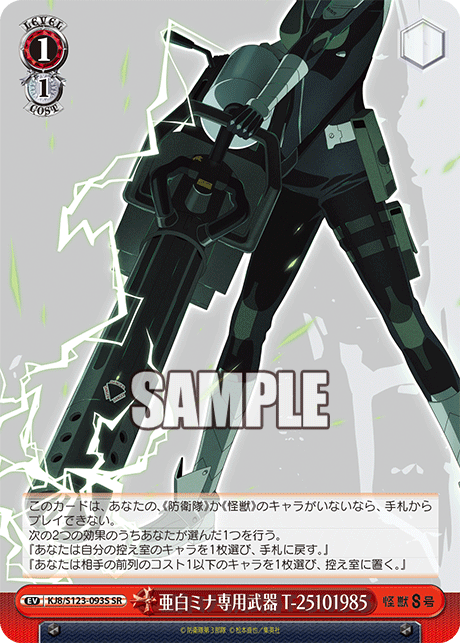
KJ8/S123-093S-SR 亜白ミナ専用武器 T-25101985 (bottom-right)
Goodbye Ainz. Hello again, “Ainz.”
Part of the problem with designs are looking at these powerful cards as not only a basis but also more of a “threshold” for by which you can design up to. What that means is that you can replicate certain play patterns to some extent as long as they don’t reach that same power level of cards that have existed historically or are currently on the ban list.
And with that kind of design philosophy, you can probably predict how powercreep can so readily get out of hand.
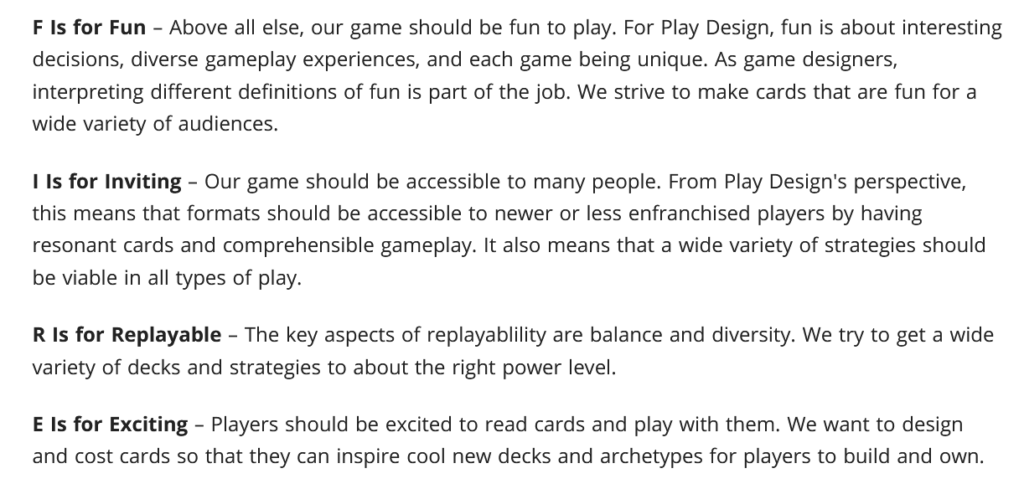
Taking a page from Wizards of the Coast and their design philosophy shift in Magic all the way back in 2019, I’d like to argue that many other companies have also been pushing their products to reflect similar principles. To put it in simple words, to compete with the modern array of card games on the market, cards now have to be “flashier”, “powerful”, and “immediately impactful” to appeal and capture consumer interests. In their playbooks, my beliefs are that they think that the main way to keep players anchored into the game is to continually create stronger cards that come closer to breaking that thin line of balance but never actually crossing it.
In Weiss terms, this is reflected in the following trends:
- Cards get higher power values which are almost all exclusively on-play now or during your own turn.
- Cards can ignore traditional requirements of both level and colour.
- Soul triggers are added to cards to ensure additional value even when not on board.
- The threshold for checking abilities continue to scale upwards (check beyond four cards).
- Finishers all carry, at minimum, two damaging abilities.
- Cards are littered with paragraphs of text and/or multiple abilities (at least two on each card).
In theory, this is fun. The idea is simple. Cards are able to do more, so, with more actions available, players will equate that to more engagement, which, in turn, equals more fun. Peskily having to think about and consider elements such as your opponent’s board become rather pointless as cards nowadays out-scale other cards offensively compared to defensive support. Your singular finisher can probably dominate the field and complete the mission of ending your opponent nearly on its own. For the turn player, it’s always a fun time while the receiving end feels as if you’re just tapping the table and waiting for the inevitable.
Now keep in mind, what I’m saying isn’t exactly exclusive to Weiss Schwarz by any measure. I’m sure the sentiments shared by this article can be argued and seen in other card games as well. However, Weiss Schwarz does have and carry one major tenet that other games may not have. Weiss Schwarz has a singular eternal format. Cards never really rotate out.


HOL/W91-T100TD 爆弾処理班 天音かなた (center)
UMA/W119-066U プランA アグネスタキオン (right)
What that means is cards that produce either frustrating game patterns continue to remain in the format indefinitely. These specific designs, similar to Akatsuki again, will probably not be reprinted, with alternative clones in place at best. These cards will be considered rare relics where, if you want that specific ability, you’ll be forced to play it in a “legacy” series, the only one that balances it out since it is limited to the card pool for that series. This makes it incredibly difficult, I’d imagine, for the design teams to come up with new support for these series in fear that future interactions with newer cards could bring about more balance issues. Even so, justifying that the card or design is locked behind a “legacy” series doesn’t remove the unfun aspect of said card or design.
Similar to how other companies normally handle some amount of powercreep, Bushiroad’s main solution just seems to be powercreep away the problem. With newer designs becoming more powerful and potentially egregious, this takes away the spotlight from these older cards, which, when you think about this post and the ideas before, clearly contributed to the designs of its ancestors. The idea is that these poor design decisions will eventually fade away from the limelight and players will probably forget or give a quick laugh before moving on to buying the newest series on the block.
All-in-all, what can be done? I’d like to say I can propose a perfect solution, but this is not the case. This problem is difficult because modern designs have dug such a deep hole in powercreep that it may take years to even consider unravelling the nonsense scattered across the myriad of series released. Furthermore, given Weiss’ increased release schedules, it’s difficult to even keep track of modern sets as is. This site used to try and make at least a single deck profile for each upcoming series, but even that is a hard call. If it were for me, I would like to move away from the F.I.R.E. design philosophies that Wizards of the Coast had proposed back in 2019. I think moving the game back to a slower form, not undoing the game, but just slowing down on the constant releases and spending more time in R&D, evaluating and balancing the quality of cards would be a first good step. As for these older cards that remain, unfortunately, I don’t think much can be done. Due to Weiss being an eternal format, they’ll always be in the equation when it comes to deck construction. The very best thing you can probably do is talk with your friends and opt out of using such designs based on your own conversations.
This is to remind players that this is not a dooming post. Despite the title, I do wish for this game to continue, grow, and expand, adding more series to its repertoire and bringing more anime/game hobby fans together.