
I will say, without any holding back, this is completely biased. Listen, I wanted to update my old Flower Stand deck and was hoping for at least some tech cards that I could put in to liven up the experience; however, reveal after reveal left me with disappointment.
This is probably the most generic set I’ve seen released in a long time. And when I say that, I truly mean it. The card effects are uninspiring, and there’s little callback to anything flavour-wise to my knowledge.



IAS/SE55-56N おもちゃたちの脱走劇! ver.RA 秋月律子 (center)
IMS/SE55-28N ココロ☆エクササイズ 高坂海美 (right)
Generic is the best word to really describe how I feel about this booster. None of the effects feel especially interesting by any measure. The set doesn’t have many callbacks to any older cards, instead being solely built upon itself. This is a bummer, especially if you were looking to update older strategies. The one exception to this is the brainstorm transformer for the old level three Kotoha. Some other more generic, yet restrictive design is apparent but few and far in between such as Arisa’s mill card or Momoko’s ping backup.
These cards are the living definition of generic. Most of the cards don’t relate to any other card whatsoever and only synergize with very loose and highly open strategies. These cards are just highly universal effects, effects we’ve seen multiple times on other cards that already exist, and add nothing new to the table. Some of these are incredibly niche such as that of Ritsuko above, a random large 2/0 beatstick with a memory flush effect for some odd reason.
Now you may counter with saying that this is the same for the old Idolm@ster premium boosters. Within Shiny Colours, there was trait-lock in place that would recommend and push designs towards certain directions. There were also several callbacks to previously existing cards. For Cinderella Girls, the finishers of that series and several other cards had definitive requirements, suggesting that you build in certain ways. This booster has many cards that just perform their own thing with little regard, even by Weiss’ standards, for any other card within this very own set or before it.
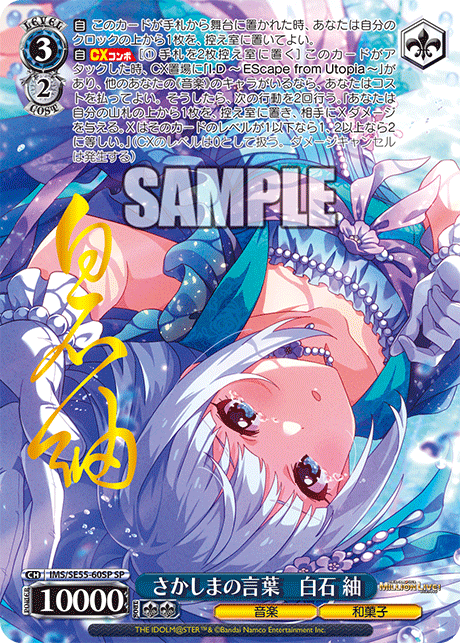
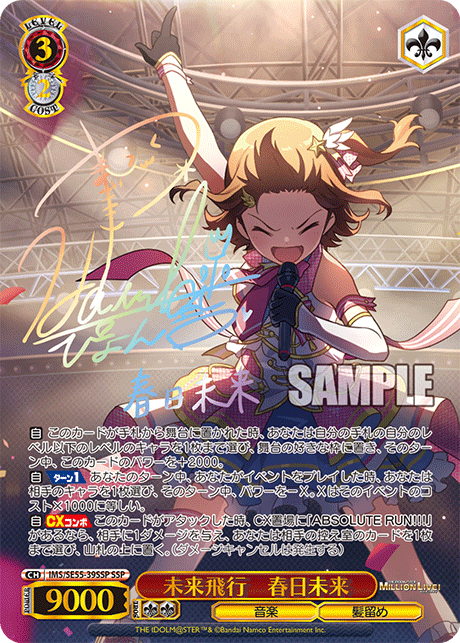
So, let’s kind of breakdown the reasons for why this booster may be designed in the way that it is. Firstly, a premium booster, if you are not aware, is a very small set that has performed mostly to provide a small subset of support for older series as a whole. They are very limited in this regard in a physical sense. I’m not saying this as a defence for how these boosters are made. The set designers have made multiple great premium booster sets and some more lacklustre ones in general regardless of this limitation.
One of the big problems for Million Live is how big the previous sets for this series were. This isn’t the first time that Million Live has gotten support. Million Live has gotten a trial deck with two full boosters and, not to mention, some support from the previous Idolm@ster 765 premium booster (this series is very unique due to its affiliation to original Idolm@ster). In fact, this would be technically Million Live’s second access to a premium booster. That means that Million Live has a much larger card pool than many other sets and a much more updated one than most (765’s came out last year).
Accommodation of the vast number of previous existing strategies and cards can be very difficult, especially if you don’t want to break anything balance-wise. I think that is why the only direct callback to the older cards is the singular Kotoha brainstorm. However, the direction that this premium booster took only added to the already inflated card pool. There are multiple new combos that exist solely in this singular booster which function independently of any older cards. To put it simply, for combos such as Tsumugi and Mirai above, you are stuck and dependent on this booster alone, which may contribute to improving sales to some extent (I’m no financial expert).


IMS/SE55-06BNP-BNP Happy Darling 望月杏奈 (right)
What this does mean, in terms of design, is that many cards will have to make-up for this in this specific booster to support these new combos and finishers. These supports will have to make up for older cards by being as generic as possible to have some loose connection to older cards while being more fitted to support newer cards.
The second issue to consider is that of Million Live’s original designs which is a series that has never had very strong definitive thematic cores. Many of Million Live’s original cards have very loose callbacks with one another, but this isn’t really something that is unique to Million Live. But relating back to the previous point, cards have to be designed and pushed especially to accommodate the new string of combos. While Million Live had some amount of events, there was no direct design that forced the use of events. Konomi here is an especially hard event support which is key to note since they introduced an entire new set of events just for this booster. Similarly, Anna has also been refitted to also include events in her check-five Riki effect which is likely incredibly important to some of these event requiring finishers.
The bottom line is that you end up with a booster that very much solely supports itself with very minimal inclusion or thought for previous cards. Keep in mind that this is further compacted by the fact that this booster also has to accommodate Idolm@ster 765 since they do share part of the card pool.

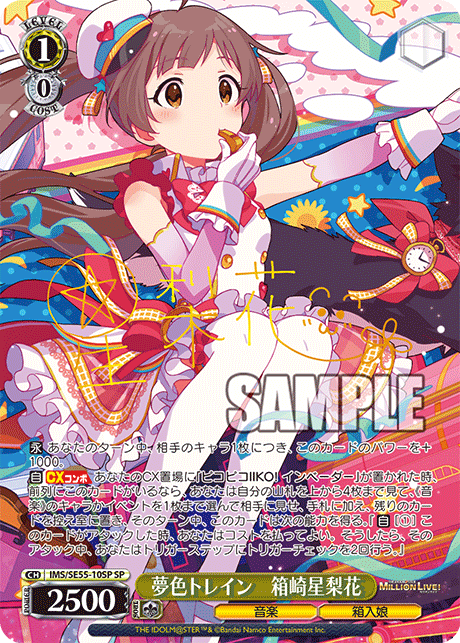

IMS/SE55-10SP-SP 夢色トレイン 箱崎星梨花 (center)
IMS/SE55-17BNP-BNP Believe my change! 伊吹 翼 (right)
The worst part of this and strangest design choice may have to be the inclusion of an entirely new trigger that is limited to this specific booster. This is insane to consider when the general card pool of a premium booster is already premium (limited) to begin with. How do you fit all this support for a completely new climax trigger in a booster that already has to consider such a variety of strategies from previous sets?
Still, this became a conscious and adopted decision. We have the new focus trigger which is limited to just this series for now. It has no prior support whatsoever and only a handful of cards that do anything with this trigger specifically.



IMS/SE55-73BNP-BNP 超々∞MUGENDAI 七尾百合子 (center)
IMS/SE55-81BNP-BNP 超々∞MUGENDAI 所 恵美 (right)
Also, to add to the already limited pool, we also have the addition of some functional reprints of some popular older cards, which I won’t really complain about (reprints are always good for players). Even if the older print arts are superior.
I don’t think there’s really much defence for why and how this set ended up the way it is. We’ve seen the highs that Bushiroad is able to achieve in design, and this just isn’t it. And the premium booster excuse only works for so long.
So, ultimately, what is my rating for this booster? I dislike it in general. The reasons for this are the odd design choices and overly open effects and restrictions. Everything feels very generic. You are just jamming cards together and they’ll probably work because nothing on the cards stop you from doing so or encourage you otherwise. Mainly, I think the biggest problem is how chaotic and unfocused (ironic) the general plan was for this booster. Cards are literally everywhere and in every direction, and that’s probably the biggest cause of my frustration here. I’m severely disappointed. I know the kids may say: “let them cook”, but this really is a set that is a cake half-baked, falling apart at the seams within the oven.
Art-wise, like many of other Idolm@ster sets, is gorgeous, using beautiful game assets. Tsumugi’s event is really cute and I need four copies in foil.