
I would like to say, while researching the builds for Tamamo Cross and Oguri Cap’s decks, I came to appreciate the new experience mechanics that they had specifically made for that particular set, Cinderella Gray. Now before we continue, I want to give a bit of an introduction to Uma as a whole. Uma debuted with a new mechanic on its own that hasn’t been replicated outside of the recently released Summer Pockets.

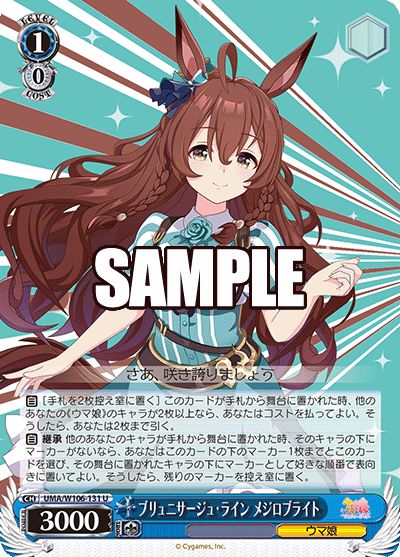

UMA/W106-131U ブリュニサージュ・ライン メジロブライト (center)
UMA/W106-096U すくらんぶる☆ゾーン マヤノトップガン (right)
The inheritance mechanic is one where you simply stack cards over each other, overlaying them into a single pile for specific effects. This is pretty much an Uma exclusive thing beyond the recently released Summer Pockets set, and even for the latter, it only appears on some specific cards.
At this article’s debut time, there are only three sets for Uma with the first being heavily filled with inheritance and based thematically on the phone game itself with obvious hints from the visual assets of the cards. For the second set, it was based on the movie: Beginning of a New Era, which focused on the story of Jungle Pocket and their friends. This series was odd. I have a full article on a Jungle Pocket deck profile if you are interested there. Jungle Pocket was the star of that booster for obvious reasons, but mechanically speaking, the set did not introduce anything particularly new as many of the cards were already dedicated towards Jungle Pocket.
However, the third set, the most recently released set, Cinderella Gray, brought back a single mechanic that has added a lot more nuance to deck-building: experience.
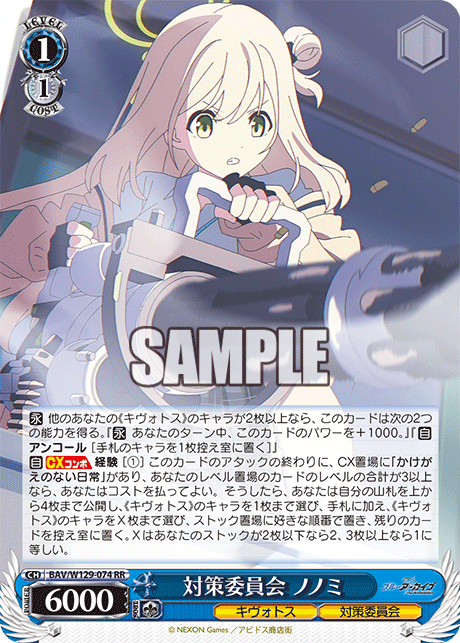

BAV/W129-074RR 対策委員会 ノノミ (center)
UMA/W134-051U “トレーナー”小宮山 勝美 (right)
Experience was, and to some extent still is, considered one of the most free mechanics and conditions in the game. Unlike most other field conditions or requiring certain cards in other zones, experience often just requires having high level cards in your level zone, something that you’re going to have an abundance of in general deck building.
However, Uma expands on something that was underutilized for some time. I doubt Uma was the first to do this with experience. Rather than using experience as solely a field condition, experience takes on a more active role in design here. And when I say that, the experience mechanic isn’t just transforming itself or replacing higher level experience such as this Memcho card from Oshi no Ko to fulfill conditions either.

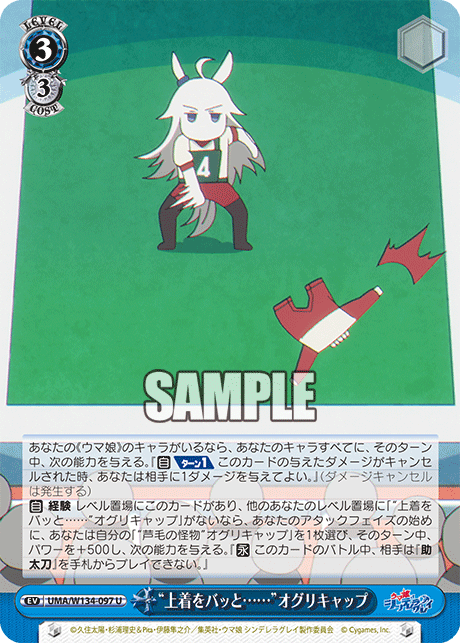
UMA/W134-097U “上着をバッと……”オグリキャップ (right)
What I think makes Uma’s experience mechanic unique is that their experience cards are genuinely there to reward you for building in certain paths rather than generic ways. They also aren’t just vanilla cards on board either. They have multi-functional effects both either on stage or in the level zone. The specificity of many of the cards really make a callback to the series that is depicted. For instance, many of Masami’s cards exist to only support her horse, Tamamo Cross. Similarly, Oguri is supported by her respective trainers as well.
These effects, I’d argue, aren’t exactly game warping either, and the balance team has generally placed some safeguards in check. Many of the effects have very subtle but useful utility such as Masami’s 3/0 event giving any Tamamo Cross a potential free hand plus on reverse of opposing cards. The safeguards prevent you from stacking these effects, preventing the effect at all if there are multiple copies within the level zone. This is a very good way of making sure that there is no potential abuse later down the road.
I will argue again, restrictive design is a good thing (to some extent), obviously not to the point where player agency is fully removed. Restrictive design should be like this and give players an incentive to build in a certain direction but not enough to push for generic builds and transforming certain synergies into one-time powerful effects or arguably my most hated system for a game like Weiss: generic engines. When a combination of cards transforms into a self-powering engine, you take away the individuality and thematic design of these cards, turning them into a generic advantage self-perpetuating pile. It robs the identity away from the cards, and furthermore, in a game like Weiss, generic engines are not needed since the modern design for cards already provides many self-designed advantage cards within each thematic core for the most part.
Bottom line: I like this and it’s cool. Designs should be like this and have some genuine restrictions with rewards granted to players for building in a certain direction while not being too open to be used as generic tools for just any deck build.