
Historically, the Exodia combo was considered to be something of an innovation, a design where a player could pursue an arduous and nearly impossible task for the pay-off of an alternative win condition. Even the iconic scene from where the term comes from in Yu-gi-oh! gives an epic visualization and demonstration of the general feeling of achieving such a challenge.
For those who are uninitiated, the combo simply makes you pair up five distinct cards in either your hand or on board, and when you do so, you win the game outright. This is an even harder task, considering that after initial changes, all Exodia combo pieces are limited to one, meaning you have only a single copy of each part in your decks. Best of luck!
In the context of Weiss, the general stipulation of what defines an “Exodia” deck is one where you are expected to meet very difficult conditions to reach a high-strung reward of equal measure. I want to put a point of distinction here between a difficult combo and that of achieving an Exodia combo. A difficult combo requires a number of extended resources whereas an Exodia combo requires a very specific condition. More often than not, the Exodia combo can only be fielded once due to its heavy restrictions.



PI/SE18-17SP-SP “Kaleidoscope”イリヤ (center)
Srd/W123-103SP-SP 時々ボソッとロシア語でデレる隣のアーリャさん (right)
For example, none of the above would be decks that I consider to be an Exodia combo. They are hard to achieve and take multiple steps, but the key part is that you can accomplish their abilities partially and still reap somewhat of a reward. Exodia decks are usually strict and inflexible. Think of them like do-or-nothing situation. You either get it off or you get nothing.
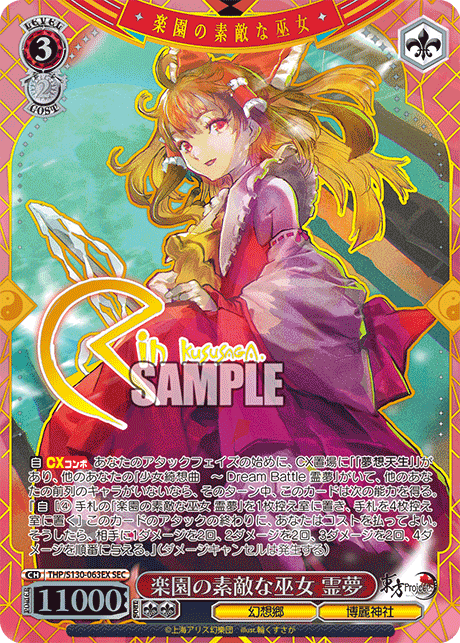


ISC/S110-040R プリティ・スイート 園田智代子 (center)
5HY/W90-096S-SR かけがえのない絆 中野 二乃 (right)
Combos like the above are ones where I would consider to be true Exodia combos. All of them have strict requirements and certain conditions that make the combo as a do-or-nothing design. Keep in mind, some parts of an Exodia combo can function on their own but to a lesser degree such as that of Chiyoko and Nino above, but overall, if you want the full power, you need to meet every listed requirement.

This post isn’t necessarily here to define the lines between what an Exodia is and isn’t; its focus is to talk about the onslaught of continuous “Exodia” designs that Bushiroad is seemingly pushing in many new series and sets.
While the goals of an Exodia deck, outlined by its conditions and requirements, make it very easy to streamline the end result, often, the buildup to that moment where you combo is, more or less, relatively miserable to mediocre. Furthermore, if the early game engine provides you an overextension of resources whereas the finisher uses little to none of that, it feels like you’ve performed several game actions with a dislocated payoff.


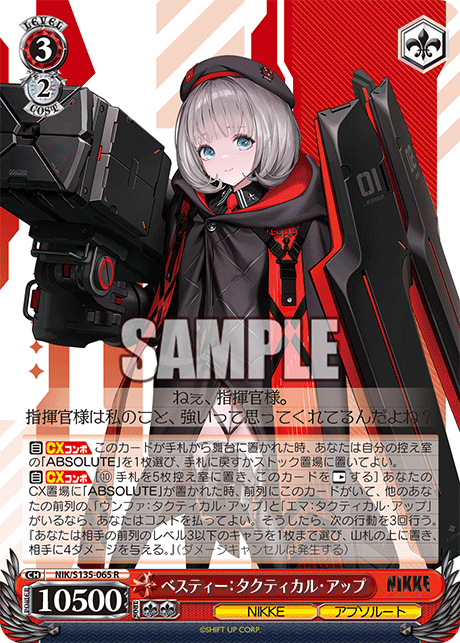
NIK/S135-063SP-SP ウンファ:タクティカル・アップ (center)
NIK/S135-065R ベスティー:タクティカル・アップ (right)
The other main issue is that Exodia decks don’t have a ceiling or a floor most of the time. They have exactly one plan to execute and if that plan is foiled, you have no fallback. It’s purely kaput, but more so on that topic, I want to talk about a set’s design and the problems of building around an Exodia deck to begin with. With Exodia decks in particular, there are certain pieces of support that are usually printed for that deck specifically, and this is more of a problem for decks that require reaching a specific deck state.
Now, I want to repeat, not all Exodia decks are the same and function in the same capacity by any measure. The problem with some of these decks can be highlighted above. Normally, for most decks, your late game consists of maybe a singular finisher that has a condition with one other card on your board. For Exodia decks, depending on their unique needs, you may need a number of specific cards on board, which makes it so that you’ll have to run multiple copies of each individual card, clogging up deck space that could be better used to filter out and provide other forms of advantage.



SPY/S106-059RR〈いばら姫〉 ヨル (center)
SPY/S106-003SEC-SEC おそろいのキーホルダー アーニャ (right)
This building restraint is extremely punishing and cannot be ignored either. As said before, you either do the full combo or get little to nothing back. The other key problem lies in the designs and card slots within a set. With these Exodia cards, you’ve dedicated several blocks of your potential card pool solely to these effects. And with some versions of Exodia, these cards are virtually dead outside of the Exodia design.
For example, in the SpyxFamily Family deck that you can see here, all three members of the family are virtually unplayable bricks since the deck does not run their respective climaxes. You can only employ them through the combo, and they are effectively dead in hand until you reach your turn where you can deploy them through the event. This is a fundamental part of the experience for these decks.
Sure, while most sets do have leeway with a few cards that are directly related and only serviceable to the final combos themselves, the slots that are dedicated to these combos can often also lie in conflict with other card designs within a set itself.
Sample Deck Profile: SpyxFamily Family
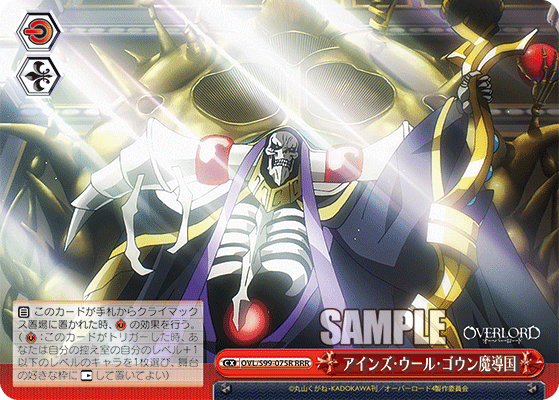

When paired with designs that are fairly parasitic by nature, meaning that they only work exclusively with cards of their own designs, you can heavily limit a card pool in terms of flexibility. While Weiss doesn’t have keyword designations or limitations, there are certain designs that are generally well fit or clearly share certain synergies. Standby is an inherent design in almost every series going forward, and this type of design forces many cards in the red colour to be pushed for its own deck-building constraints. While I’ve long argued that decks should be limited within a certain pool based on a theme or archetype, standby takes it to an extreme that I’m not a particular fan of. Profiles like large beatsticks with encore or cards that bounce back to hand on climax play are some effective cards that pretty much only see play in standby-styled decks. Sets already have to connote and dedicate part of their card pools just to support that singular archetype.
Swarm decks, in my humble opinion, are just a branch of Exodia decks that function on a more casual and simpler basis. But they generally meet the same requirements in the fact that you’re locked onto a certain game path with pieces that are forced as part of your deck space. And these cards only function when paired together, taking more slots of card allocations within a series. That’s not to say that these two designs “ruin” design space for a set, but if design slots are limited, it is worth considering that these two will take up a partition which could be designated to more free-flow cards that have more agency in a larger variety of builds.


While the occasional design is cool, thematic, and interesting, one common theme I’ve been noticing with more recent Exodia combos is the hard limitation of one copy on stage. In all fairness, at the end of the day, most Exodia combos boil down to performing the same amount or one-or-two added damage points compared to fielding three finishers, but there is this sense of ubiquity and general bland association with many modern versions.
Since most Exodia combos are unable to be interacted with, and part of this is baked into the design on purpose, the game becomes more of a show-and-tell rather than an interactive back and forth. Even as limited as Weiss is in direct interaction, many Exodia decks exploit that even further. On the receiving end, you’re simply sitting there watching your opponent employ as many game actions as possible in hopes of actually getting their effect off. Whether they do so, you just have to sit and pray you survive, and if they fail, it’s about equally as disappointing.
And virtually, due to the requirements of these combos, you’ll be seeing pretty much exactly the same decklist over and over with almost no variation due to the explained factors above. Even for the Exodia player, they may be feeling thoughts of boredom as the exact same game plays out round after round. The game always just boils down to assembling the pieces and praying that it works out. And granted that most Exodia combos are a do-or-die system, should your opponent survive, you’re just a sitting duck with almost guaranteed certainty that you’ll lose.
Sample Deck Profile: Stardust Crusaders

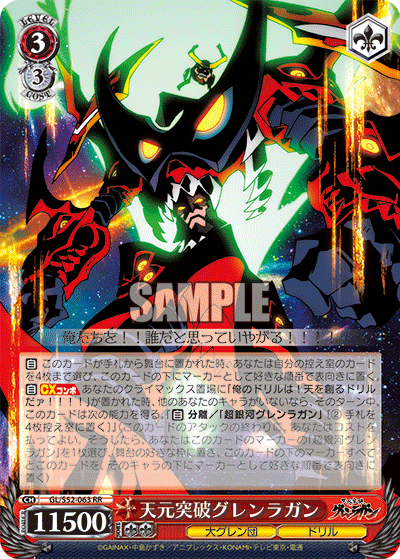

GL/S52-063RR 天元突破グレンラガン (center)
GL/S52-074U 貫き通す想い シモン&ニア (right)
And don’t get me wrong here. I do think some of these combos are very cool and thematic. For Jojo: Stardust Crusaders, Jotaro combines the memories and stories of his brethren for a climatic finale against the devious DIO. In Gurren Lagann, Simon and his friends detach from the final robot, breaking down piece after piece in a final gambit to save the universe. I’m not saying that Exodia combos should be gotten rid of, but I think there needs to be more consideration taken when designing them into sets. I think Exodia combos should be a logical aftermath of decisions made, something that flows smoothly into rather than solely a large mothball effect on your final turn. The gears should be spinning, the clockwork ticking, and visual and gameplay designs both indicating and building up to that finisher.
There needs to be more variation, some spice to keep things a little more interesting. Less of the uninterruptible showcases that just seem to define the modern Exodia combo today.