
As you’ve probably heard and probably understood from an overview of my site, I am much more amenable of archetype and theme decks, and surely, with a set that’s designed to encompass multiple small themes, NIKKE Vol. 2 must carry my most desired deck designs. However, that is not necessarily true. While I do appreciate the “locked” approach of many of the cards and archetypes that exist, there are persistent issues from a gameplay perspective that I want to speak about.
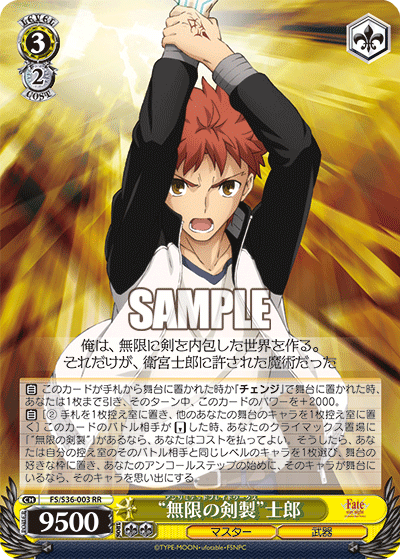
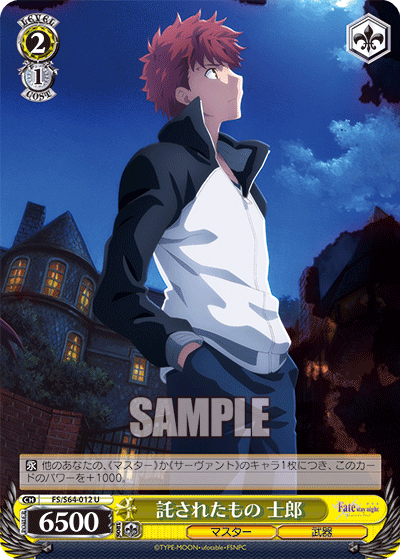
FS/S64-012U 託されたもの 士郎 (center)
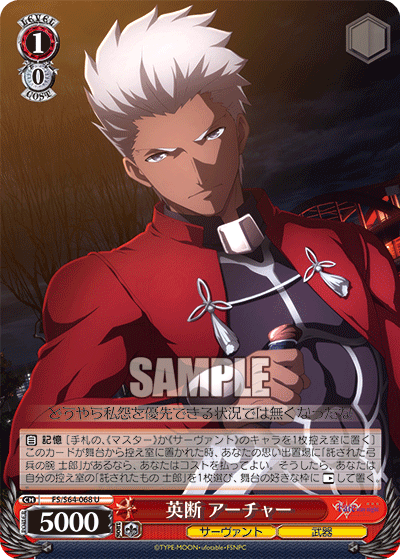
FS/S64-068U 英断 アーチャー (right)
I really enjoy theme decks because they, to me, embody the spirit or soul of the game. You are playing an anime or game series where the cards depict scenes or give slight nod-offs and mentions of its original material. That to me is what Weiss is all about, showcasing and exhibiting your fandom in card game form. However, there’s a point, even to me, when the synergies and design space becomes far too limited, and that is my main complaint about NIKKE Vol. 2.
Sample Deck Profile: Fate – Unlimited Blade Works
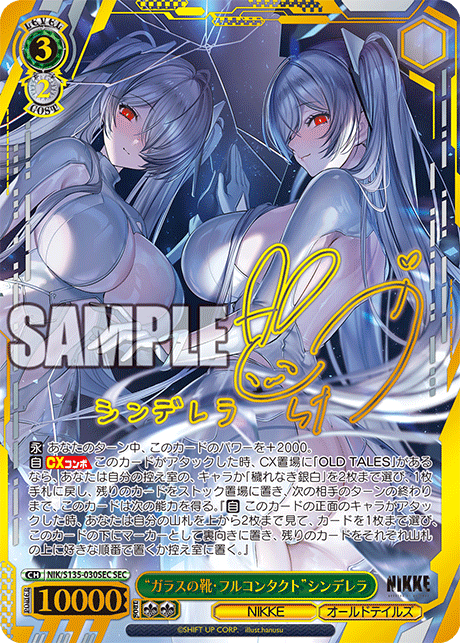
NIK/S135-030SEC-SEC “ガラスの靴・フルコンタクト”シンデレラ (right)
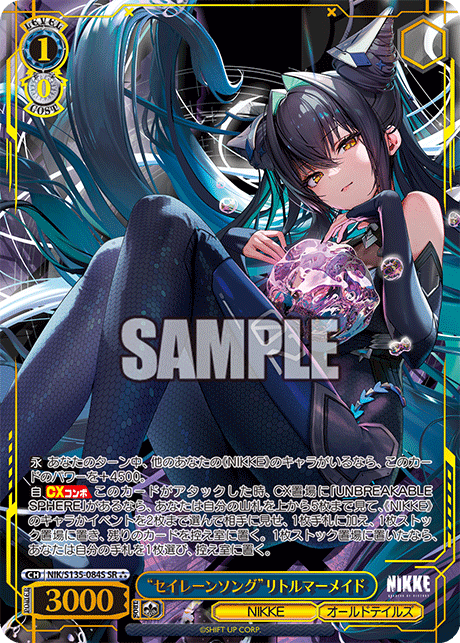
From the very onset of the set’s debut, its reveals were already telltale signs that there was a certain direction that the cards were pivoting to. However, I didn’t expect this extreme of a tangent. Mermaid and Cinderella exist within a deck that is pretty parasitic in terms of design. You can run either or, without one another, but these two have increased synergy and named synergy on top of that. The deck basically comprises of assembling Cinderella early and netting her event to hand. Oh hey, look at that, Mermaid can coincidentally add events to hand from her check ability.
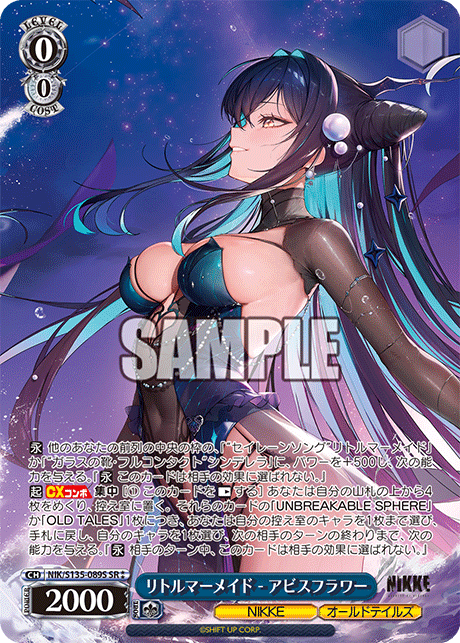
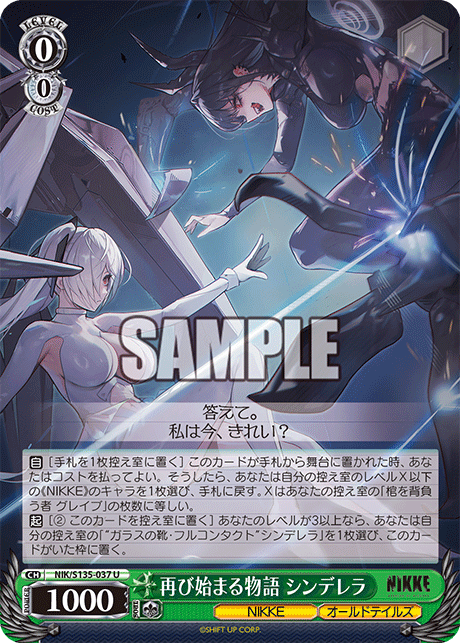
NIK/S135-037U 再び始まる物語 シンデレラ (center)
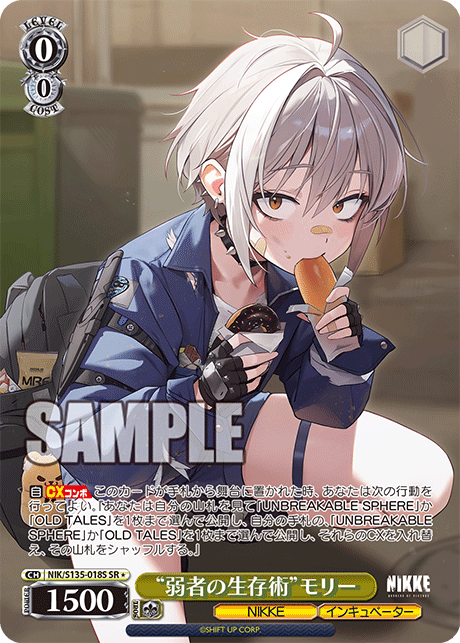
NIK/S135-018S-SR+ “弱者の生存術”モリー (right)
Oh look, there’s an arsenal of exclusive support for the above archetype. And this isn’t solely the only deck that has this type of approach either. The set itself is locked onto very specific archetypes that lack much flexibility, usually only opening some slots for random generic support. And even these spots are relatively limited. You could exclude the above and run generic options, but why would you when these cards already perform very generic functions that you would want anyways.
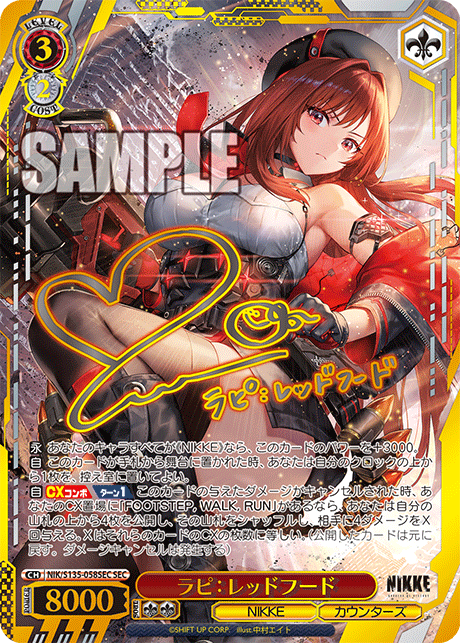
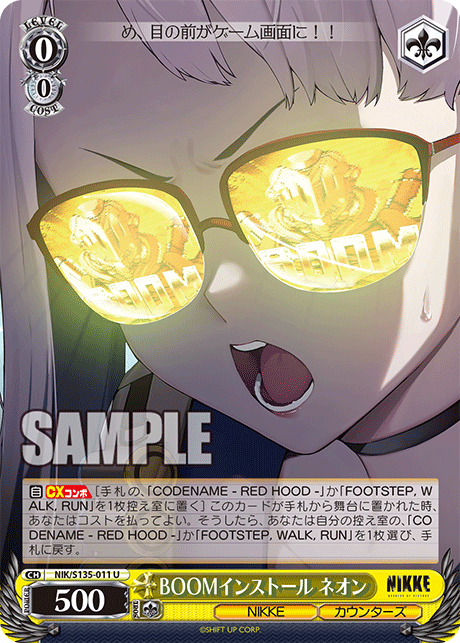
NIK/S135-011U BOOMインストール ネオン (center)
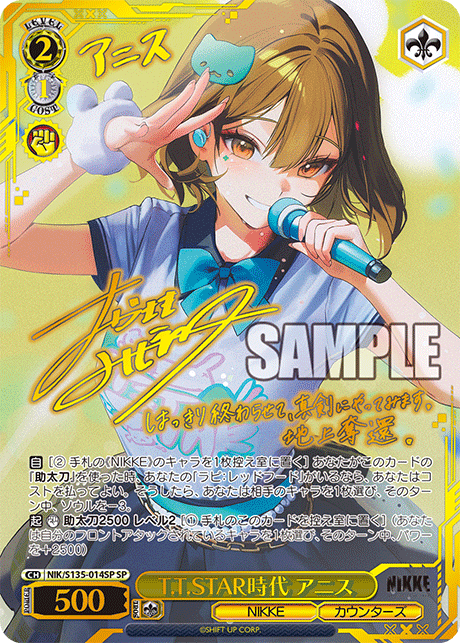
NIK/S135-014SP-SP T.T.STAR時代 アニス (right)
As evidenced above, here is another deck profile that is already partially built for you. The strict requirements on the Rapi event that is crucial to the deck already hard limits what you can put into your deck to begin with.
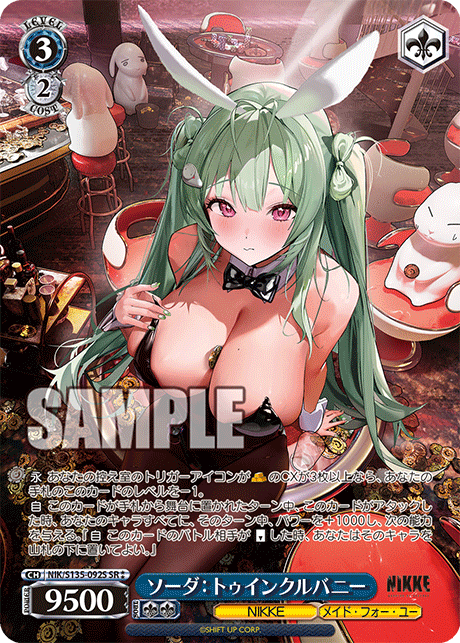
I will say, there are some generic designs that have specific archetypes they can be slotted in, but for the most part, these designs are quite limited to the design space of this set specifically. While Soda above is an early play for any bar deck, the restrictive clause of her being a blue card also goes against what the typical bar deck’s colour identity would be.
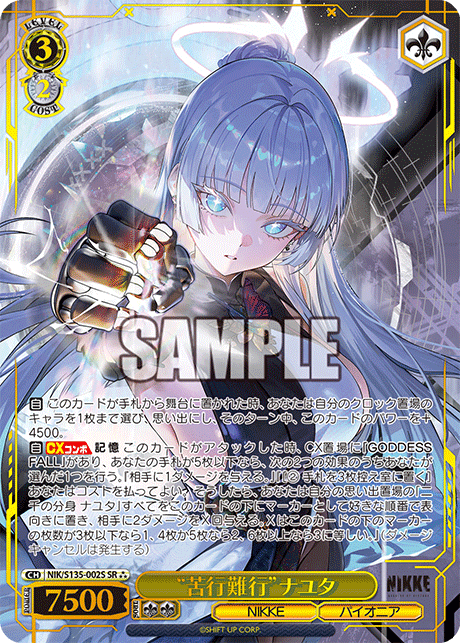
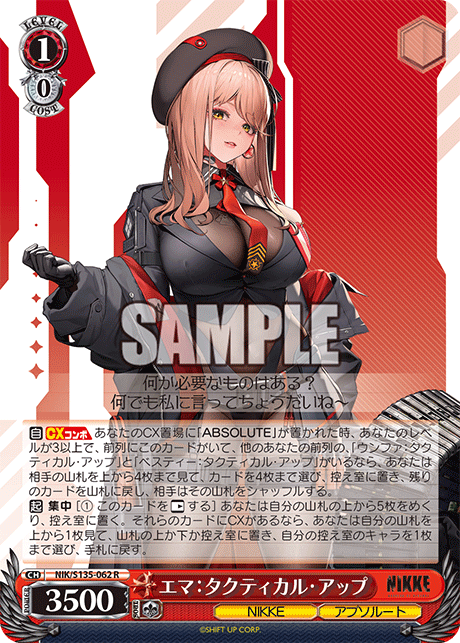
On top of the existing archetypes, we also have the addition of a swarm-based deck and an Exodia style deck, taking up even more slots in the overall set. Most of the cards in these two decks are anti-synergistic with anything else outside of their shell. While you can argue that you can run these cards for their vanilla effects, you can make the same argument for a more generic option that exists in those colours or needs less requirements overall. In essence, many of the deck designs for Vol. 2 are already preset with only a few spots open for any form of player agency.
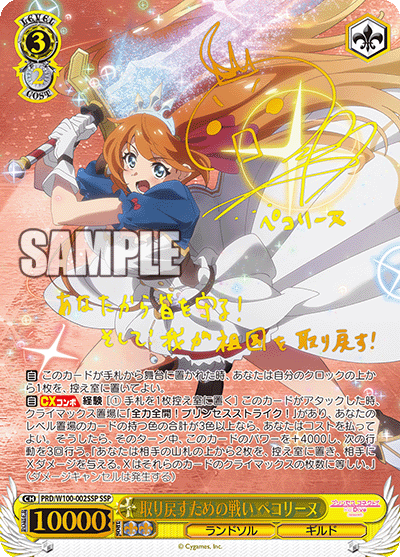
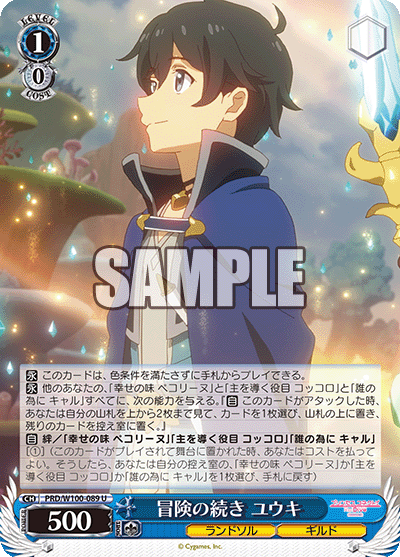
PRD/W100-089U 冒険の続き ユウキ (center)
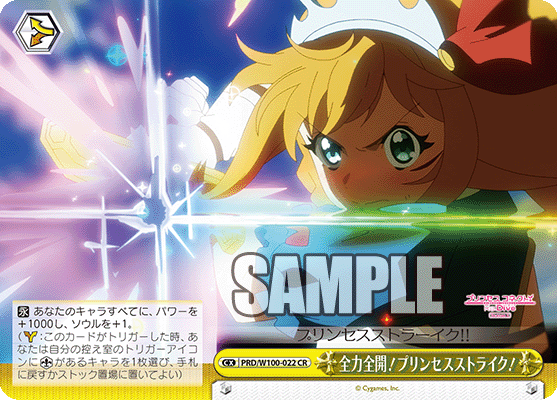
PRD/W100-022CR 全力全開!プリンセスストライク!(right)
Take Princess Connect’s Bishokuden archetype for example. Peco’s finisher requires exactly three different colours in your level zone, but this can be fulfilled by any of the four colours available in the series itself. You can run any assortment of blue, red, yellow, and green options, all of which enable a higher diversity and choice of card selection. Yuuki, the universal bonder, while a very definitive archetype card, gives you three options to choose from as he supports any of the original set (plus new 1/0 Pecorine) level one combos. You are locked within an archetype, but this card enables multiple choices for you to build your deck around in the early game.
Sample Deck Profile: Bishokuden
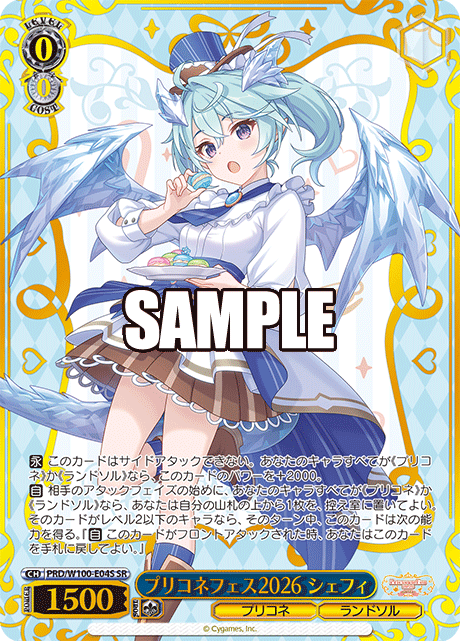
Blue is an odd colour for the deck since it only really encompasses that of Yuuki and his teacher, Labyrista (if you consider her a core member of the team). But with Sheffy above, we have another member that also greatly contributes to the deck’s overall colour needs while providing a nifty effect.
This doesn’t stop you from including non-Bishokuden members, much to my own chagrin. If that’s the choice you make, you’re free to do so, and while it would be off-theme, it still contributes to the overall requirements of the deck as long as you meet the colour experience requirements. But this isn’t the case for the new NIKKE Vol. 2 cards. The deck profiles are essentially partially or mostly filled in by the set’s intentional design. There’s no need for player expression or variance for the most part. And as a persistent deck builder, this dismays me.
And keep in mind, this has nothing to do with the power level of the set as a whole. If you read this whole article expecting that to be the case, I’m sorry to disappoint you. In my books, while some of the themes and nod-offs to the original IP are well done, the overall mechanical base for the cards are relatively lacklustre and generic. As an addendum to this post, I firmly believe that, in the future, restrictions should be in place to really encourage building in a direction rather than heavily funnelling players towards a singular design space. Bushiroad has done so many times in the past, and I am fully believing they are capable of doing so again.