
First off, I want to state that I am not a financial guru nor am I offering any financial advice. This post is just my own personal examination of the game from a financial perspective and offering my own analysis. There are some data points, but some of the derived data comes from personal talk with others and speculations.
Inspired by a video by MonkeyFightTCG, I’ve decided to do my own post where I analyze the costs for playing the game and acquiring product. For a brief history of my own experience, I generally do not buy direct product. I played the English format almost a decade ago and then dropped the game for the Japanese format entirely mainly due to costs and also quality assurance. There have been some financial moves that I see the English side has done which I disagree with, but that’s a topic for another time.
Looking at my local stores, namely that of 401Games, K-Os Collectibles, and Go For Game (at the time of this writing), the average cost for an English booster box is roughly anywhere from 80~ to 120$ CAD. For Japanese, the average is a little lower, roughly within the range of 90~ to 100$ CAD. For the sake of this post, we will market everything at an average of 100$ for an English booster box and around 95$ for a Japanese booster box.
So, let’s take a look at the general singles value of some of these cards that come from a booster. For reference, we will be taking a look at Oshi no Ko Vol. 2., which recently came out in English not too long ago. Now, if you are in my area, Toronto, ON, you’ll probably realize that there’s really not a lot of card shops to compare prices for the most part. Many shops don’t really offer singles and only sell product, but we’ll get to that reasoning shortly.
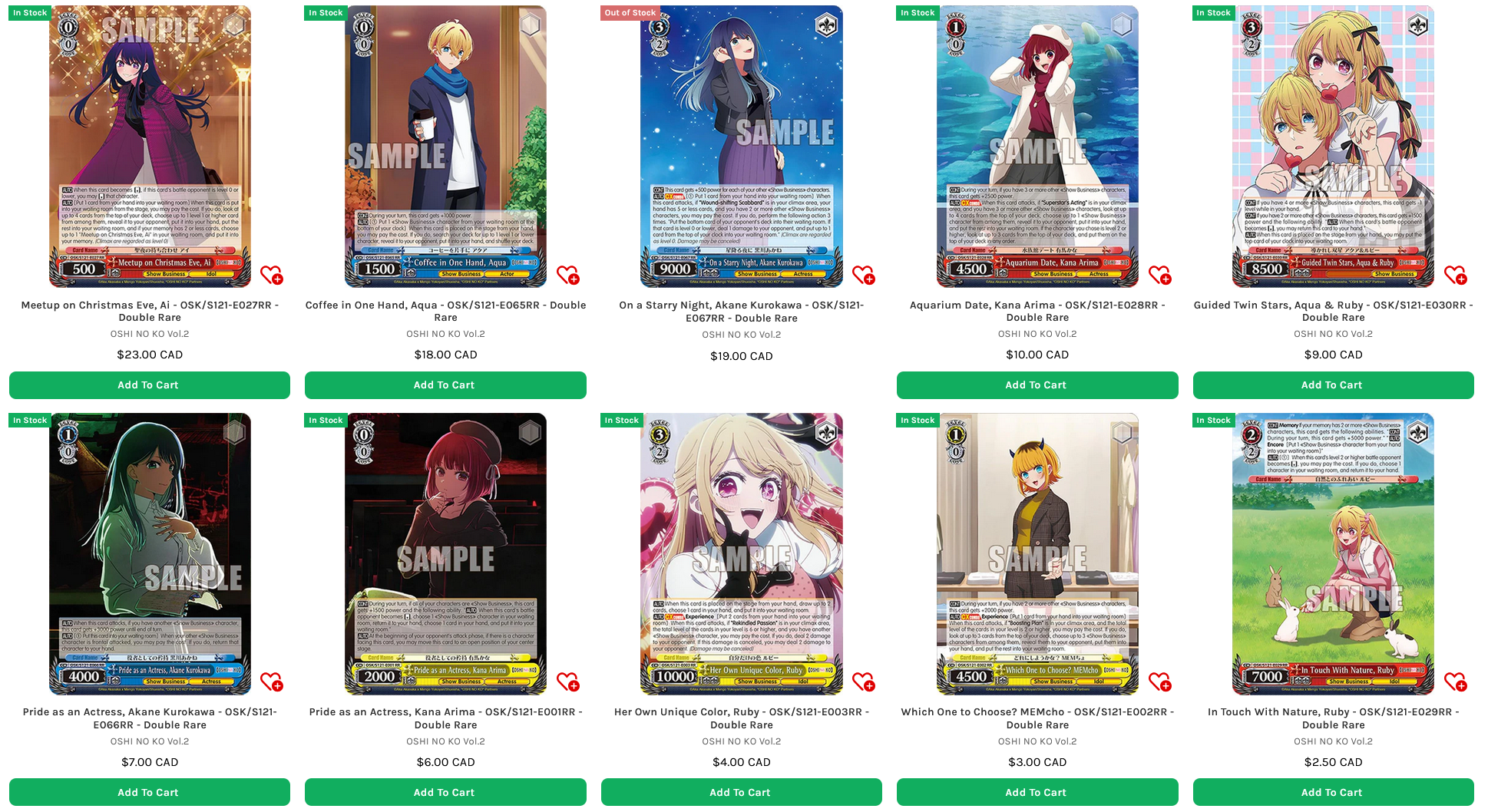
401Games is one of the few singles sellers for cards in my area. We will be using their pricing since it is available online, and they typically have a larger number of singles. So let’s have a discussion here about pricing and also the general ratios for boxes in English Weiss Schwarz. Similar to the Japanese side of product, the general box provides at least 4-5 RR cards and anywhere between two to three foils. Granted, the RRs given are random, and it’s unlikely for duplicates. Ignoring the foils for a moment due to the randomized nature of them, we’ll value the general box based solely off the highest base rarity cards, which are the RRs.
Looking at the above, the most expensive of your RRs are that of Meetup on Christmas Even, Ai (23$), On a Starry Night, Akane Kurokawa (19$ sold out), and Coffee in One Hand, Aqua (18$). Remember that a box rarely has duplicates of any RR, so at most, you will get a single copy of any of those listed above. At the cost that is sold on average, you need to make close to 100$ to compensate for the total value spent. If we were to add in all the most expensive RRs at the common rate of four, we will add up to a total of around 70$. This includes all the above RR mentioned including that of the Aquarium Date, Kana Arima (10$). That means a potential loss of around 30$ total (not including taxes). As a slight reminder, sold out cards should be considered to be even pricier due to lack of availability.
Now, that isn’t bad for a TCG with getting at least 70% of your value back on opening product, but that is heavily assuming that you are acquiring exactly the most expensive RRs. There are a total of ten RRs in this set, meaning that you have any chance of getting any of the four or five. If you were to get the lowest value RRs, you’d be getting a copy of In Touch with Nature, Ruby (2.5$), Which One to Choose? MEMcho (3$), Her Own Unique Color, Ruby (4$), and Pride of an Actress, Kana Arima (6$). You are looking at a total gain of 15.5$ total (not including taxes). That means, for your single box, you are making at worst, 16% rounded up of your total value spent. Like many other trading card games, the Rs and below don’t really count for much, so we’re not really going to include them into the calculation. The reality is that you’ll be generally getting a mix of RRs and neither the highest or the lowest, so if we do an average between the highest and lowest, you’ll be getting around 42.5$ or 43% rounded up of your value spent.
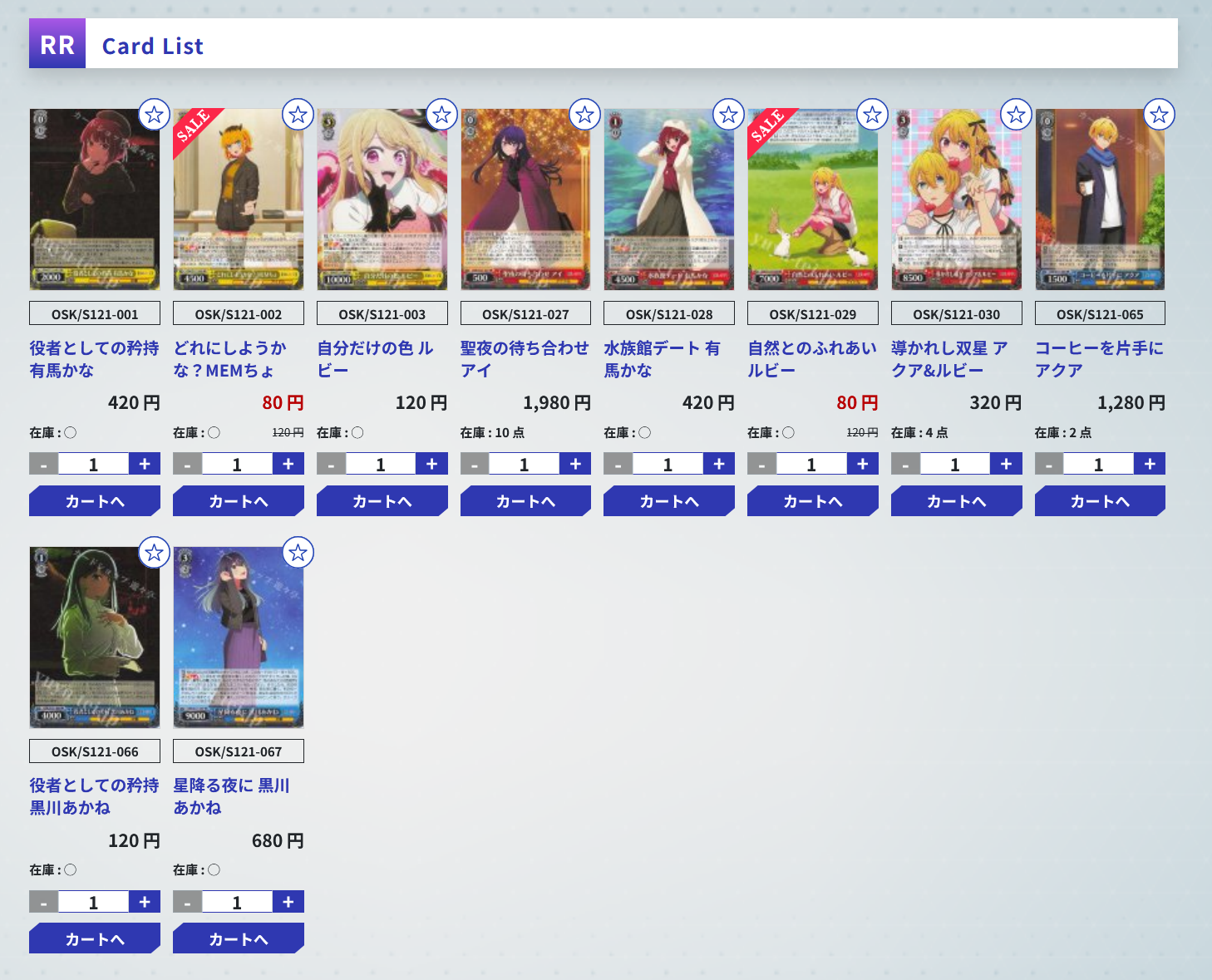
Looking at the Japanese version, we can see a huge dip in prices and totals. For accuracy, we’ll be using the Bank of Canada’s exchange rates (1:0.008740) at the time of this listing. If we take a look at the most expensive RRs, they haven’t really changed from the English counterpart much outside of Akane. Ai is at 1980 yen (17.31$), Akane is at 680 yen (5.94$), and Aqua is at 1280 yen (11.19$).
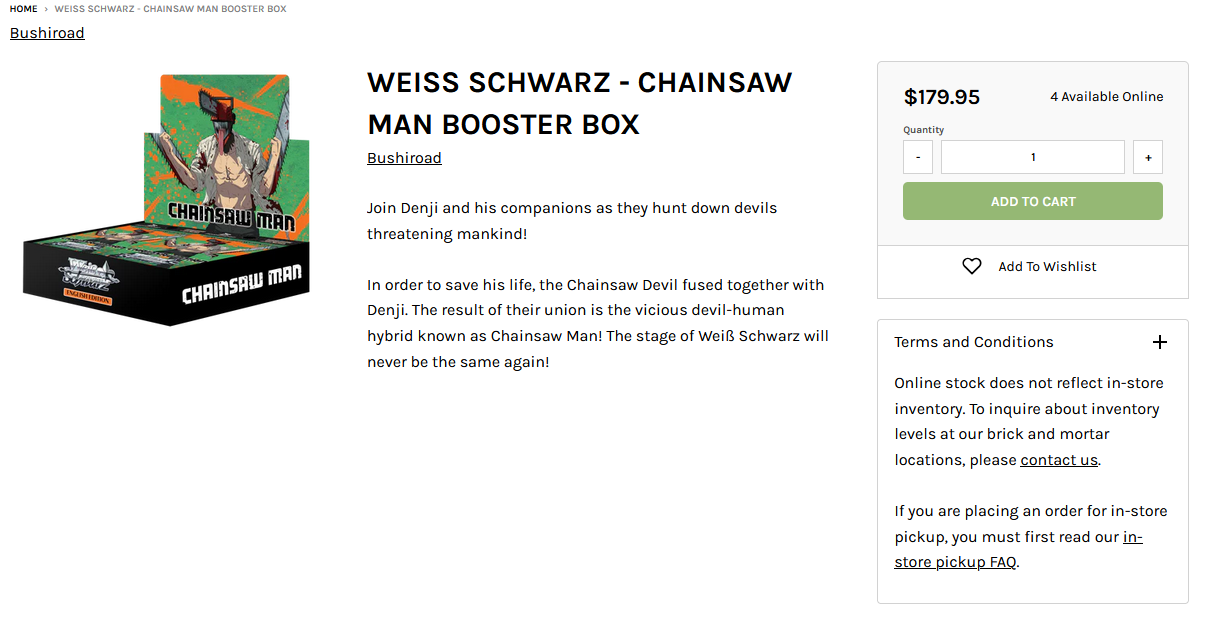
So we need to address the elephant in the room. Even though my local markets sell the two different languages’ boxes at around the same price, we need to actually look at the general costs of these two products at their average. From Bushiroad’s own online store, the EN product is about 94.2$ CAD. While not the same product, we can analyze the pricing of a similar product on the Bushiroad online store for JP product which is around 46.15$ CAD. This is where you start seeing a bit of a disparity and not a small one at that. The Japanese box product is half the cost of the English version. What does that mean? It means that singles can be heavily reduced in price.
For example, if you were to pull the same RRs as were outlined in the example before, in Japanese prices, you’d be hitting around 4360 yen (this includes either the Kana 0/0 or the Kana 1/0). You’d be hitting around 83% rounded up of your estimated spending. That is a 13% increase in terms of value compared to the English version. At the lowest, you’d be getting a much worse rate too at 9% of your estimated total. Sure, the numbers for the low are worse than that of the English box return, but remember, you are spending less than half on average for the box. So even at a loss, you’ve already spent much less than you would if you were buying an English box.
Now, before we continue, we also have to address another issue. As spoken about earlier, there are not a lot of sellers for singles where I live. 401Games is, luckily, a store willing to sell singles to begin with. In Japan, even from online sales, there are several retailers that are more than happy to compete for product. As a result, you can get even more varied values depending on which store you go to. This isn’t the case for English product, at least where I live. And this gets even worse if you live in a remote region compared to my metropolitan area. Also, take into account the costs for shipping, which can rapidly rise depending on area and especially if you purchase from multiple different sellers. Localized shipping in Japan can be very cheap and sometimes free depending on your purchase amount (sometimes between 200-600 yen per package). While these auxiliary fees vary, I think it is important to take into consideration as they can cut into the purchase costs as well. But due to the randomized and unique nature of each account, we’re going to leave this as a one-off paragraph.
Deck-building:
Okay, so now, we have to take a look at deck-building. This is one of, if not, the most frustrating part about getting into this game financially. Unlike some other games, Weiss is a purely constructed game. You cannot meaningfully draft Weiss Schwarz. Despite the random mini-games that Bushiroad shares that often ignore or modify rulings to allow for flexibility like two-pack Weiss, the main format that is played makes it very difficult to build a deck off of boxes alone.
Much of the power cards from the game come from higher rarities, and even if you could substitute them with some other cards in lower rarities, this isn’t exactly a task that can be consistently accommodated. Some cards call for other specific cards, and if you miss those requirements, these cards don’t function. Furthermore, Weiss is a game that heavily incentivizes building with consistency, meaning you’ll want some near playsets or full playsets of cards (four of each). Add to the fact that you cannot mix cards from different series, and it makes it even more important that you acquire cards from a specific sets. This is impossible to accomplish with a single booster box. Like many other games, you are highly recommended to get singles for your deck. Now this is a problem, especially if no local shops are willing to open product. And the reasons for this can be heavily varied.
Firstly, not every card is treated equal. This is just how card games work. Meta builds suggest for more popular cards, and those popular cards will just have higher prices as more demand piles up for those cards. This can lead to other issues. There are only so many of x specific card available on the market. And each time a shop opens a box, they may or may not even pull that specific card. They are also left with a ton of bulk that has to be moved at some point. Granted, shops do know that opening boxes is almost always a loss in profit compared to selling the product directly. Singles are relatively low returns compared to full product. Furthermore, you cannot predict what you will get from a box. Shops can open many Oshi no Ko Vol. 2. boxes and fail to grab many copies of Ai which is a main driver of the value for a booster box. Remember, Ai, as seen from 401Games’ pricing, is around 23$ which is about 23% of the total value of a booster box. If they do not pull Ai, they will be losing significant value from the booster, as would the player in their shoes.
Secondly, and I’ll just be honest and admit it here. Weiss is a niche game comparatively to the bigger games of Magic and Pokémon. There are just not that many players comparatively and opening product comes at a risk. Unless the product sells, it just sits there at the store. Ideally, over time, the product will eventually move which isn’t a guarantee. Furthermore, prices are always best at debut since there is player hype that carries sales for the cards. After a certain time period, that hype will fade and the values will either plummet or cards will be left unsold. The bottom line is that selling singles is a big risk. Many stores can just opt to free up that space and dedicate it to more thriving and profitable games instead.
Now, for the average price of a deck, we have to really crunch the numbers here. So, let’s use Oshi no Ko. Vol. 2. as an example again. We’ll take the champion list from Worlds 2026 as shown here (courtesy of WeissTeaTime).
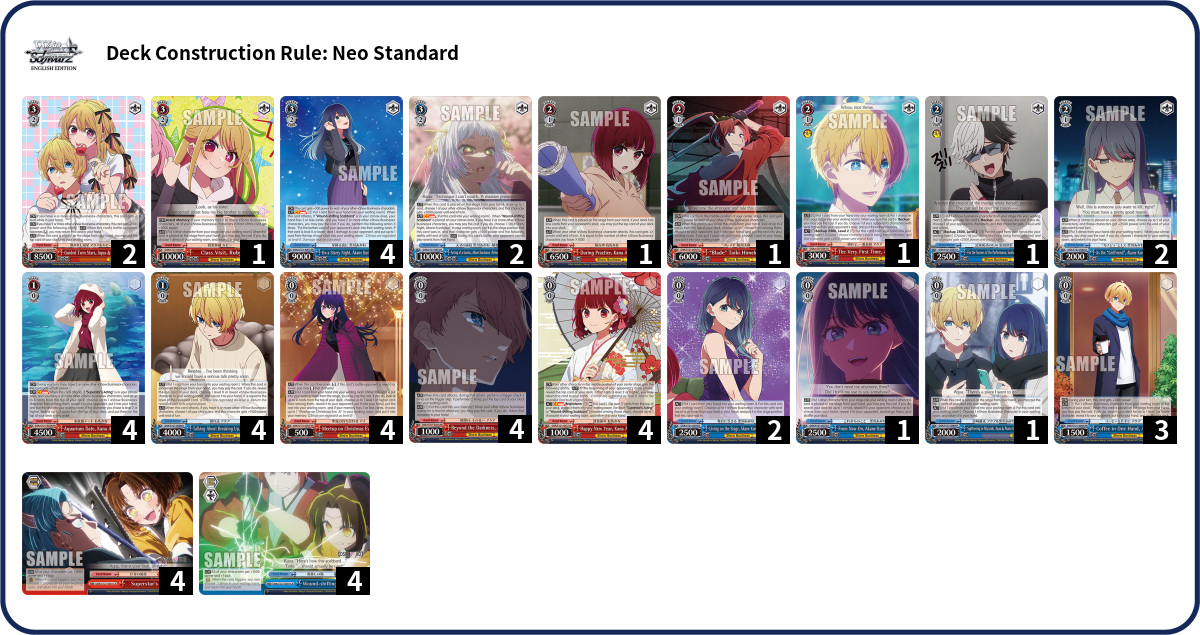
Compiling just the most expensive rarity cards alone, this deck will top at a whopping 280$ CAD just for the RRs. This includes the following:
- Meetup on Christmas Even, Ai x4 (23$) = 92$
- On a Starry Night, Akane Kurokawa x4 (19$) = 76$
- Coffee in One Hand, Aqua x3 (18$) = 54$
- Aquarium Date, Kana Arima x4 (10$) = 40$
- Guided Twin Stars, Aqua & Ruby x2 (9$) = 18$
That is a total of 17 RRs required for this deck. And as you can see, there are multiples of all of them, which means that none of this is easily accessible through even a handful of boxes. If we were to theoretically pull five RRs in each box and get exactly one of each, you’ll still be spending 100$ x 4, so you’ll need 400$ alone to potentially magically pull all these RRs. That is assuming you hit the perfect ratios as well. You may be thinking that you can offset costs by selling your singles, but anyone with experience can tell you that can be hell itself and values often dip compared to store prices when selling as an individual.
In the Japanese format, to build this deck without considering the Rs and below, the average cost would be 16800 yen (146.83 CAD). The breakdown is as follows:
- Meetup on Christmas Even, Ai x4 (1980) = 7920 (69.22 CAD)
- On a Starry Night, Akane Kurokawa x4 (680) = 2720 (23.77 CAD)
- Coffee in One Hand, Aqua x3 (1280) = 3840 (33.56 CAD)
- Aquarium Date, Kana Arima x4 (420) = 1680 (14.68 CAD)
- Guided Twin Stars, Aqua & Ruby x2 (320) = 640 (5.59 CAD)
The Japanese price for the same deck is roughly half with the RRs. Now for some numbers that are truly mind-boggling. The same conversion in boxes ideally would be half the price of English at 200 CAD, less than the basic costs of all the RRs combined.
The Foils:
So, as any experienced player will tell you, most of the value for a box is tied up in its foils. That is pretty much universally true for any card game. The shinies bring in all the money. But this is where the numerical range increases even further. Now granted, the situation with singles and opening boxes does cause a lot of disparity between the EN and JP versions. To put it simply, there is a much higher supply in Japanese than in English due to the amount of opened product. But it can be staggering as to how big the difference can be.
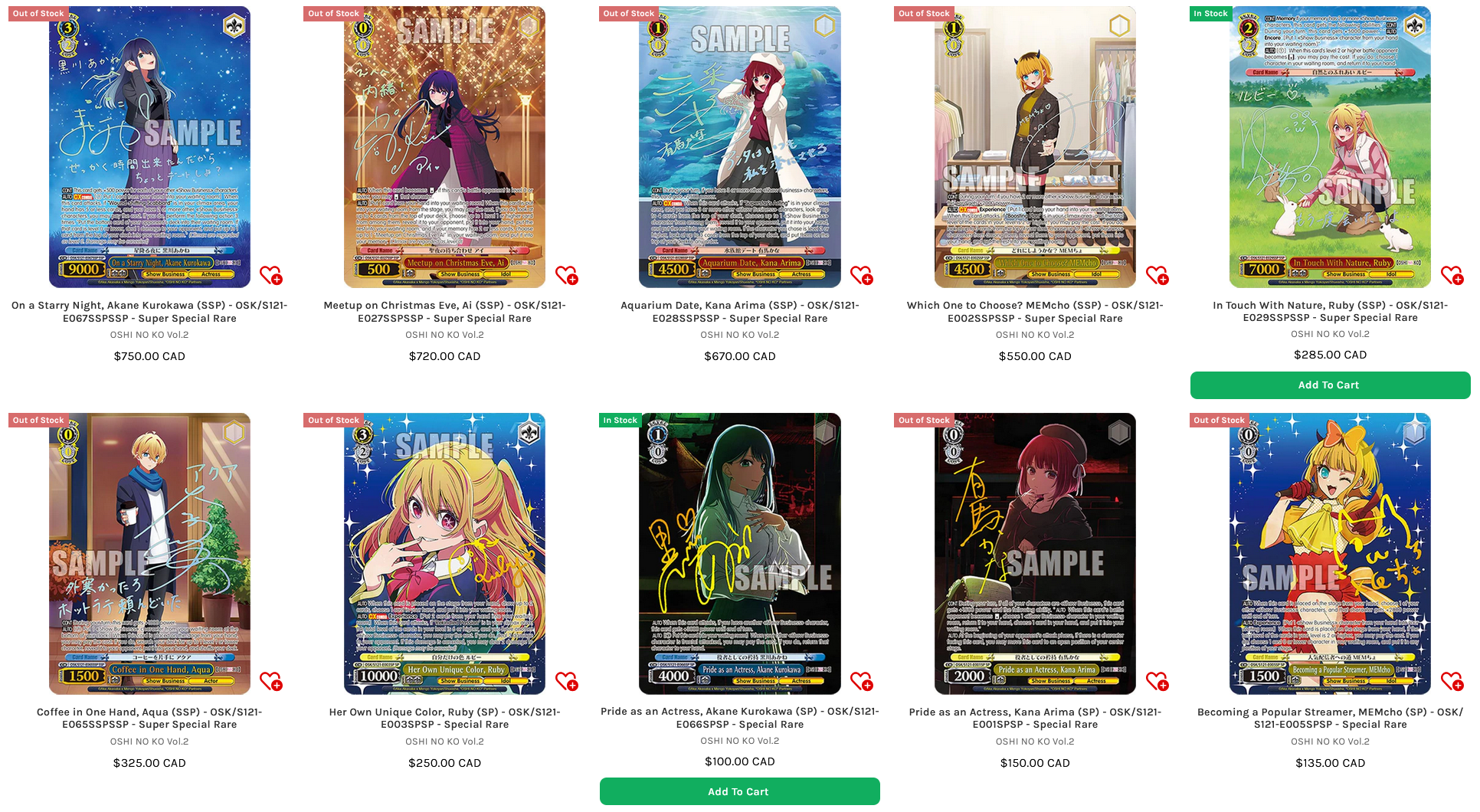
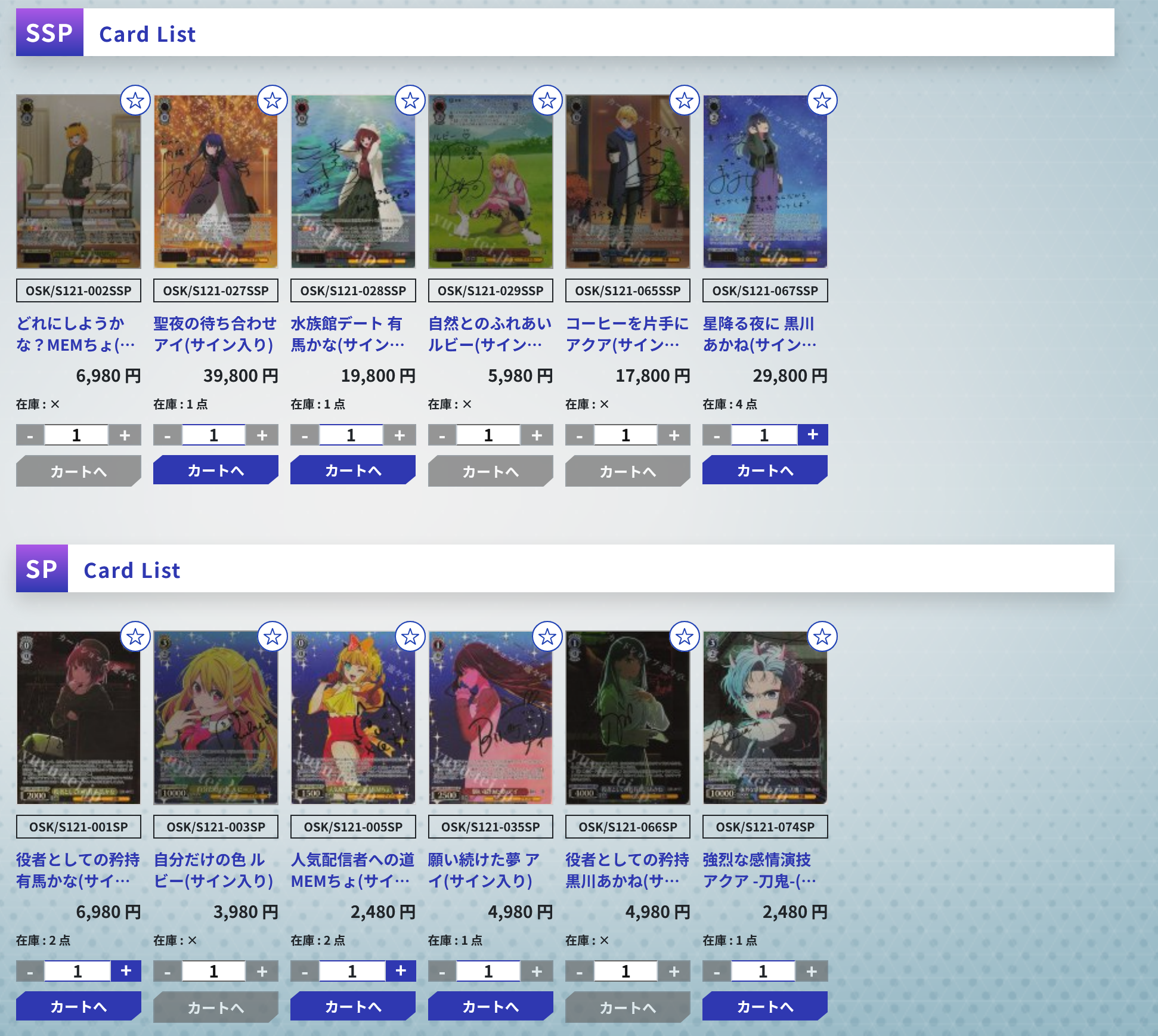
I apologize as Yuyutei doesn’t have a sort by price option, so I just gave a screenshot of similar rarities. I think the first thing to note is the average double dollar difference in pricing comparatively in English to Japanese. Akane, the most expensive foil in English sits at 29800 yen (260.45 CAD) in Japanese compared to its 750 CAD price tag in English. That’s a markup of nearly 300%. Ai is almost double at 39800 yen (347.85 CAD) compared to 720 CAD. Even lower rarity foils are at a huge markup due to language differences with Ruby being 3980 yen (34.79 CAD) in Japanese compared to 250 CAD in English.
Now, why is this the case? So, as I mentioned before, costs for boxes are much lower in Japanese in Japan, and as such, boxes are more opened. Therefore, more product is available. Is this a defence for the extreme markup in English? Not really. But this part is just to highlight some of the cost differences in Japanese versus English. I do want to transition this topic to pull rates which will highlight and showcase part of the problems with foils, and yes, this does apply to both languages.
Pull Rates:
As stated before, the average box contains four-to-five RRs and two-to-three foils. However, Weiss ratios, at least in the master cases, are mapped. What that means is that there’s a guaranteed set of foils and whatever cards that are within the cases. And what is that ratio for the highest rarity? On average, it is a total of a singular SSP (or highest rarity) with two-to-three SPs (depends on set). We’ll use the pricing from TCGPlayer as a sample converted to CAD (1560.19$). This is roughly 65 CAD a box.
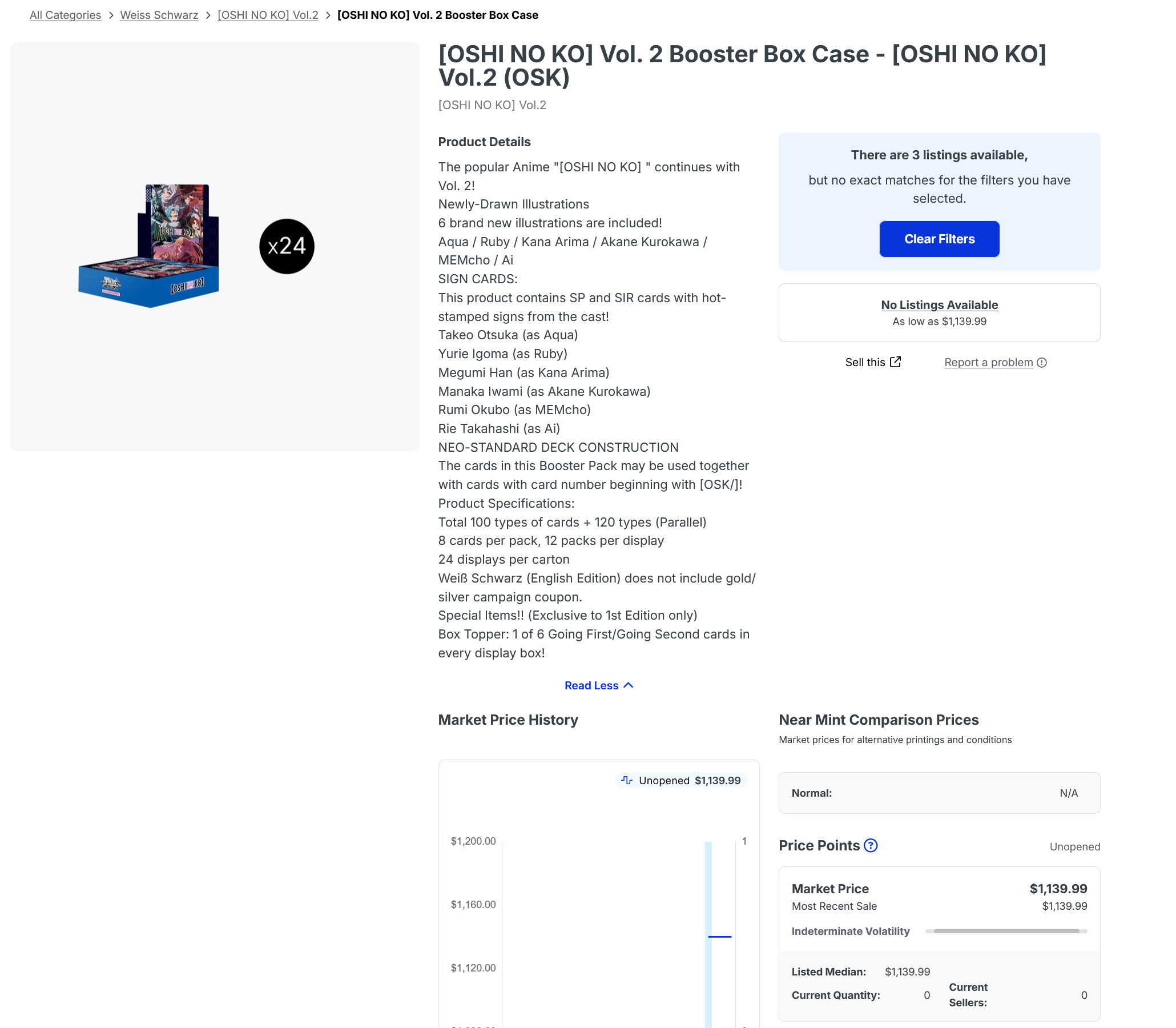
If we were to pull the best SSP and the two best SPs, assuming we are lucky, we will get Akane SSP at 750 CAD, Ruby SP at 250 CAD and Kana SP at 150 CAD. These are the highest totals of the cards we can get from the booster. That will equate to roughly 1150 CAD when combined together, 73.7% of the total case value. Now we are relatively lucky that the values for the SSPs in this set are roughly the same in terms of value. Because, this is not the case in every set. Furthermore, we are actually doomed in terms of value if the pulled SSP ends up being Ruby at 285 CAD. Remember that you get a singular SSP from the pull pool of six. And that singular card determines the highest value individual card you can pull from the boxes. With Ruby considered in the equation, a case’s value plummets with the highest values dropping to 43.9% of the total costed value (Ruby SSP at 285 CAD + Ruby SP at 250 CAD and Kana SP at 150 CAD).
Remember, although the ratios are guaranteed, the actual cards pulled in each rarity are randomized from that set pool. Your highest rarities account for most of the value when it comes for the case. As for lower rarity foils, this gets very random in both languages with Japanese cards typically having a lower range overall. To put it simply, Japanese foils range from 120 yen (1.05 CAD) to 1480000 yen (12935.2 CAD). Do note that latter number is for the AGR which is very rare. The reality is, you’re more than likely to pull one of the 120 yen foils since these are the more common SRs which go from anywhere from a foil common to a foil rare. 401Games lists their foils with the cheapest at 1.50 CAD but the average is 3.00 CAD at minimum.
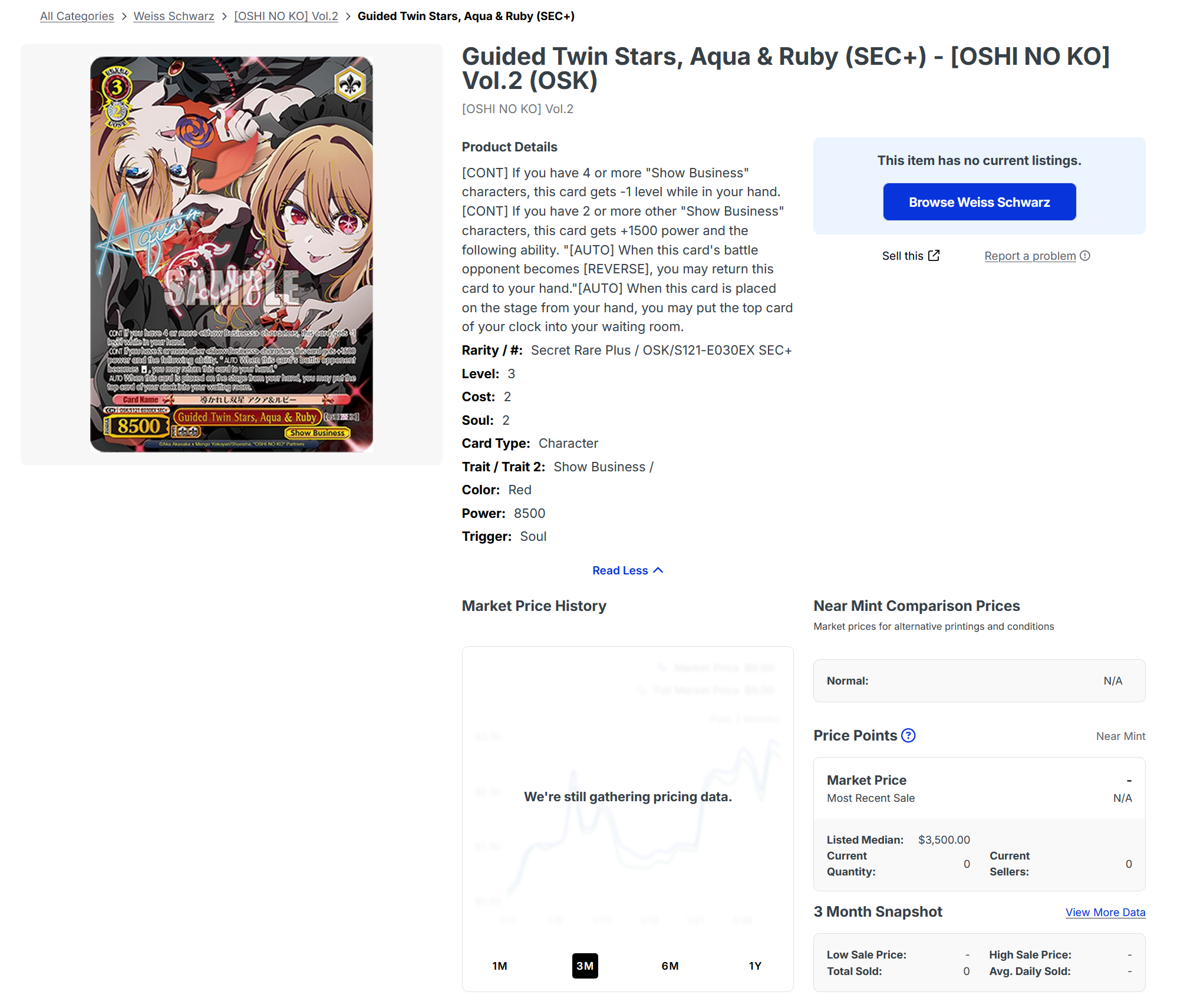
401Games doesn’t have a listing for SEC+ and higher, so we took a look at TCGPlayer which doesn’t actually have a single card sold. However, the shared median is already 3500 USD (4790.1 CAD). This doesn’t bode well for the highest rarity at AGR which will probably, assuredly, hit into the very-high five digits. As can be seen from this data, essentially, your entire value for your boxes can be summarized through the foils. While foils carry multiplicative values, Weiss Schwarz foils can hit quite absurd numbers even comparatively with other card games.
Cherry-Picking and Oddities:
I want to also address something that was lightly mentioned before and not really put into the limelight. Prices in Weiss Schwarz are very strange because Weiss Schwarz carries an odd phenomenon that not many other card games carry. As an anime card game, part of what drives sales comes from fans of the IPs being sold. What that means is that, aside from power, people will buy a series because of fandom which can greatly affect prices.
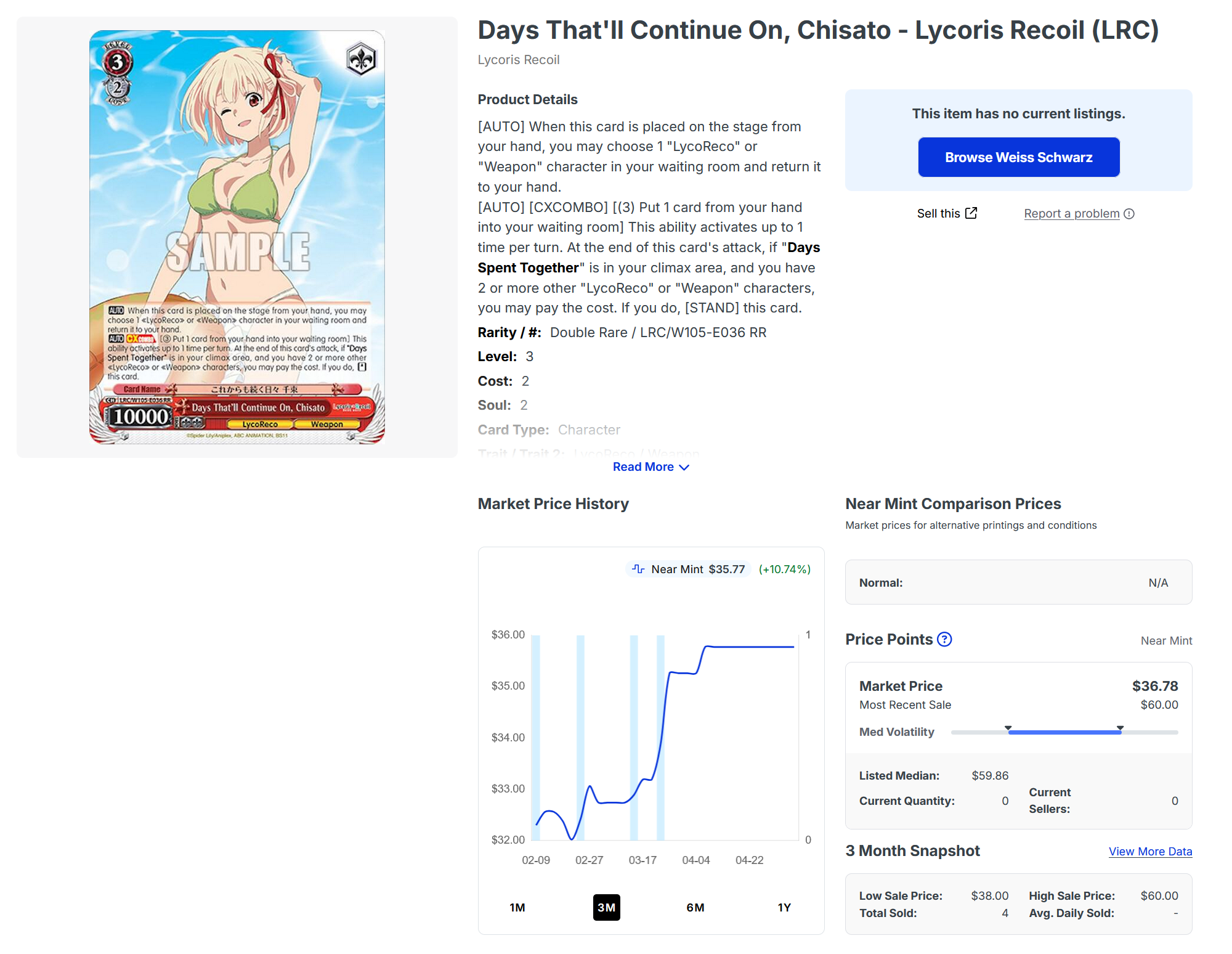
Take for instance, that of the Chisato card shown above. It is technically 12 CAD on 401Games, but the card has been sold out for a long while. On TCGPlayer, the card sits at 36.78 USD (50.34 CAD). Lycoris Recoil has been long out of the meta even with the premium booster. However, to get a playset of Chisato(s) which is essential for its deck, you’ll need around 200 CAD just for a playset of it alone.
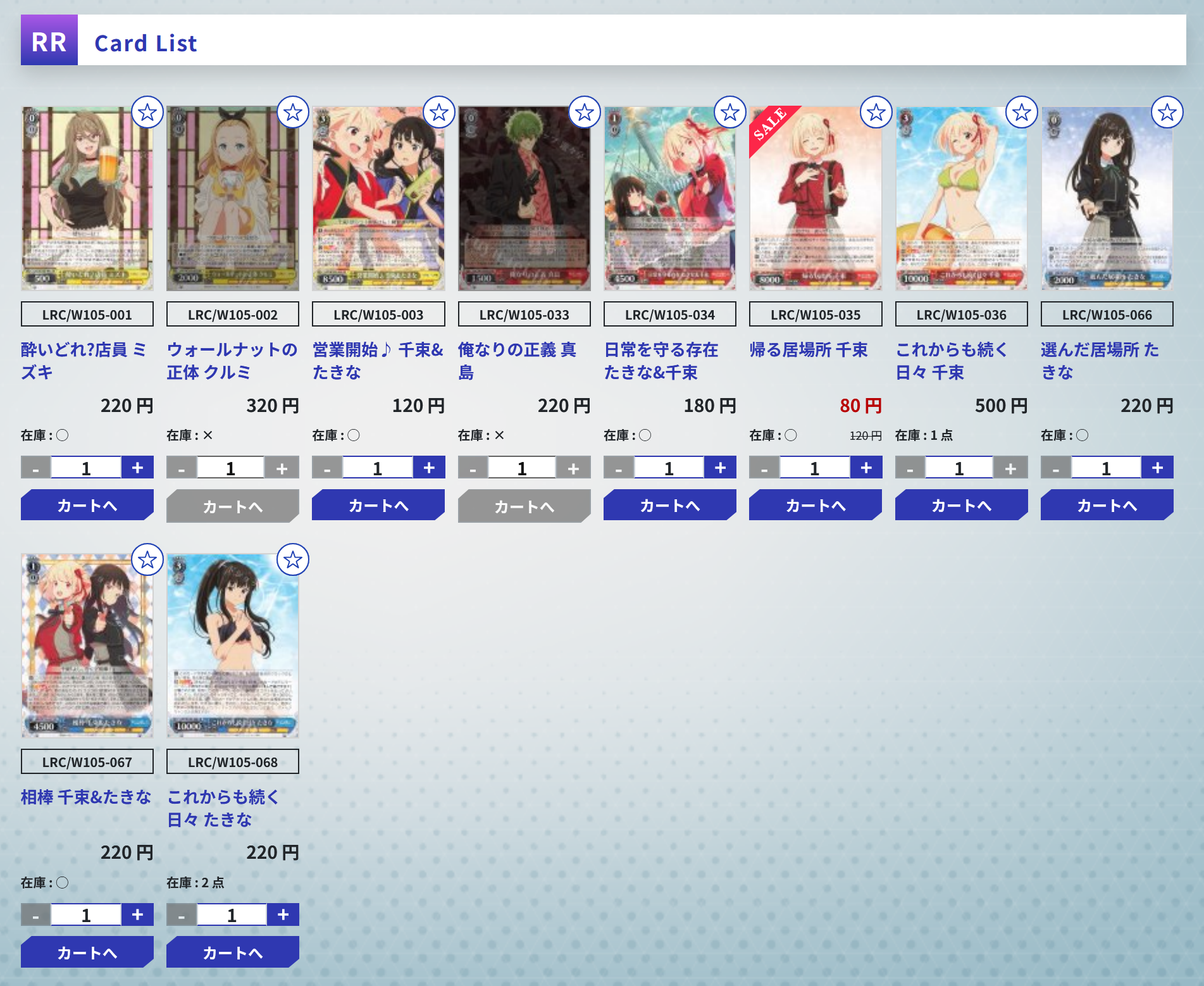
In a Japanese store overseas, the same variant in Japanese is 500 yen (4.37 CAD) each. One thing to note is that Chisato’s case isn’t exactly an outlier by any accounts. Older series in English are almost impossible to get a hold of and the prices for cards can be some astronomical value. This makes trying to build old sets pretty abysmal and extremely expensive. Furthermore, these series can already be outdated, making them essentially dead to the meta but still hold incredible individual values financially.
Due to this, even product from long ago hits some absurd values as the singles market runs dry and players are forced to open product to get cards.
Conclusion:
Ultimately, what is the point of this post? Am I trying to brag that the Japanese market is superior to the English market? No. The bitter reality is that English cards cost almost double that of their Japanese counterpart, and almost all of this has to do with the basic price of the average product set by Bushiroad. I do not blame the stores for what they do. They need to make a living and profit too. The Japanese barrier to entry is significantly lower than that of the West for a number of reasons that I won’t dive into immediately in this already extremely tiresome post.
It is very difficult to get into this game financially speaking when you look at the costs and compare them to the values you get for your money. Often, players have no choice other than to open product to get their singles. Stores are under immense pressure and risks to open singles for players to invite them to the store. As a result, many stores, I find nowadays, are opting out of selling singles for the game entirely, which is a sad truth to note. Many friends I know and find are struggling to get their cards, and the inconvenience of going through multiple sellers online and in-person can lead to disappointment and annoyance.
There are also some mini-issues, particularly when it comes to pricing as the wide range of prices and heavy tilts for some cards in sets cause a spike in terms of value. This may not affect the average player, but this can heavily influence the market as product becomes more and more of a gamble. I want to highlight this fact with Ai in Oshi no Ko Vol. 2. as that RR simply carries the value of any box she is available in outside of the random foils. Distributed value of RRs just feels terrible if you so happen to open any RR beyond Ai. I have mixed feelings about this as I do think part of the issue is too much of a meta focus on certain cards. I think players should look at the larger bulk of cards and consider building from that pool as a way to reduce the amount of bulk available at stores, average out the costs for each RR, and allow for more creativity. But that only solves part of the issue. The best fix is to lower the rarity of cards like Ai to rare or lower, allowing more of them to be available in the market for anyone hoping to get their hands on a playable version.
I can’t even fathom what players getting into the game who are fans of older series are feeling. To have a series you enjoy priced out of the game because you weren’t around to buy that series at launch is unfortunate. And, as of now, there just isn’t as solution until Bushiroad acknowledges this and makes a move. Once again, I am not saying you shouldn’t support your local game stores. This post was meant to give an observation about the finances concerning product and singles with a very limited case study.