
Weiss’ set designs have been rather awkward for a long while now. Contrary to recent designs, and by recent, this encompasses several years of designs themselves as this has been a silent existence which hasn’t been much talked about by Bushiroad. There are four colours in the game of Weiss Schwarz outside of the one rare use of the purple colour. Historically, each colour was fairly expressed within each set which each having it’s own distinct pool of cards and potential building pool. However, within the last few years and to some extent, even when I started this game, this was more of a general expectation rather than a hard set rule.


IMC/W115-126Co-Co ステージオブマジック 渋谷 凛 (center)
IMC/W115-T58TD ワンダーエンターテイナー 本田未央 (right)
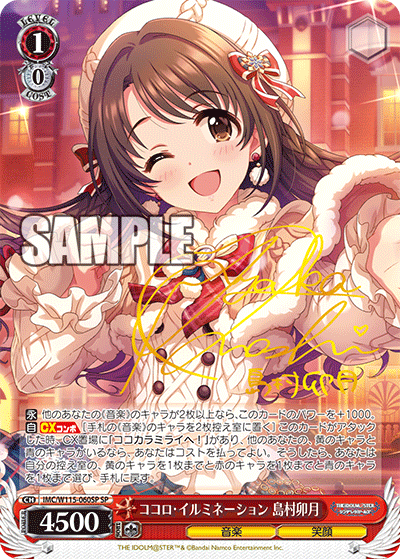
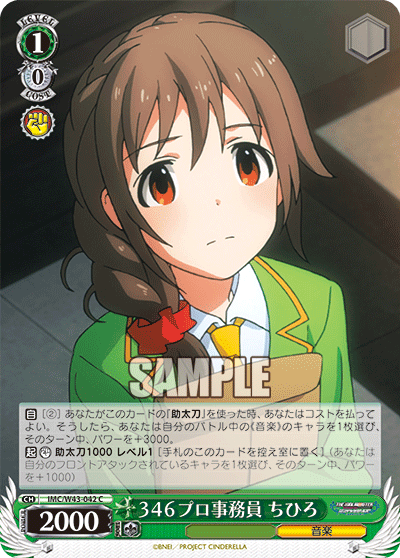
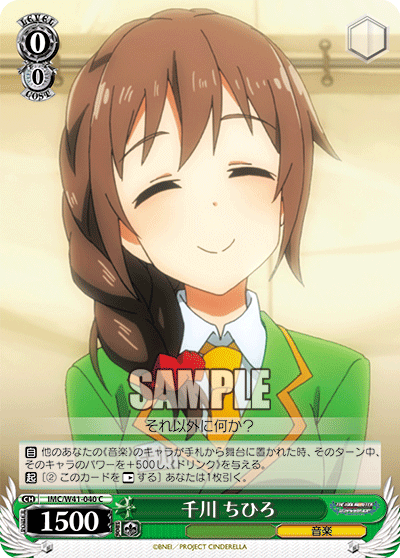
To my own experience and knowledge, sets have occasionally been limited in colours due to how the depiction of the original IP was expressed. My most earliest example comes from original Cinderella Girls where green was basically missing outside of the one or two cards featuring Chihiro. This was clearly a nod-off to Cinderella Girls itself where the girls were separated into three colours each representing a general typing of said character: red for cute, blue for cool, and yellow for passion. Chihiro was an extra staff member, being the assistant was just relegated to green since she didn’t have any typing to begin with.
For some series such as Kaiju No. 8, I can’t foresee any reason why certain colours would not exist. In that example, there are no blue cards in that series. Bocchi the Rock does not have any blue cards whatsoever either. It’s not typically that common for series to lack an entire colour, and I am not entirely sure why this is even done in the first place. I can’t find any thematic reason this is the case by any measure either, but there are no long term consequences of this to speak of considering that the extra slots are just relegated to other colours instead.
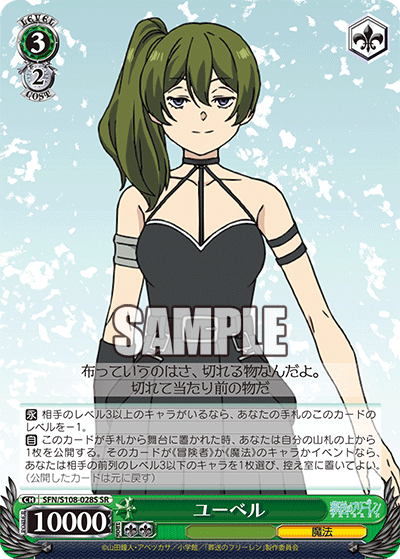
SFN/S108-028S-SR ユーベル (center)
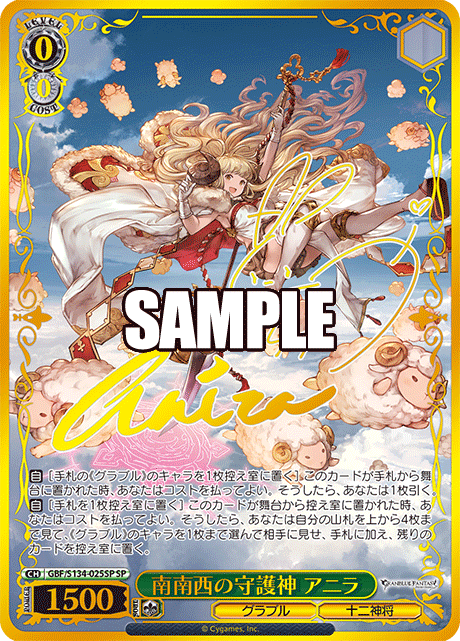
GBF/S134-025SP-SP 南南西の守護神 アニラ (right)
I’m more interested in investigating what is often considered the “off-colour” or the niche colour that is obvious to anyone deck-building that is clearly different from the rest. And by that, I don’t mean that the cards in these colours are foreign to the set’s design by any measure. These cards often still maintain the same global trait that the set carries. What marks them as unique is that these cards are often parasitic in nature, relying almost exclusively on their own colour and don’t have any direct synergies with any other colour.
You could put them in any deck, but they won’t feel as good. Even among their own colour at times, they feel odd in place from both a narrative standpoint, visual outlook, and gameplay designation. And I’ll be exploring this through all three examples showcased above.
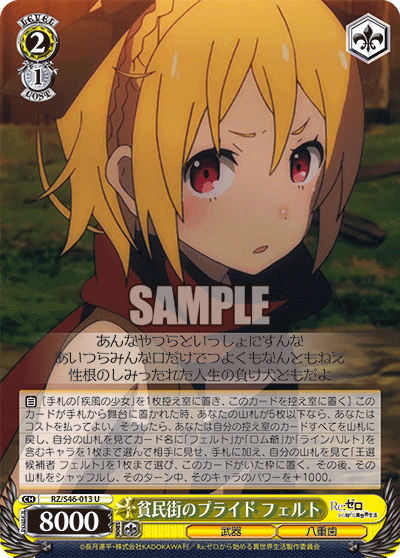
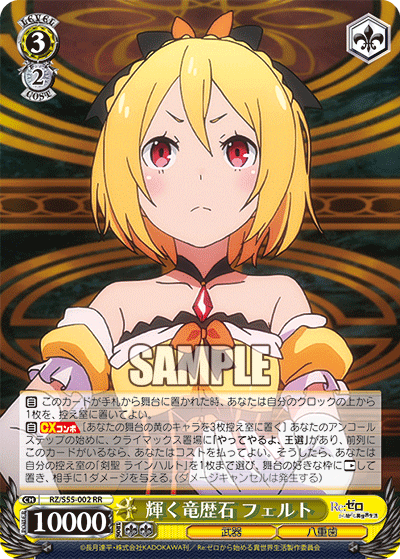
RZ/S55-002RR 輝く竜歴石 フェルト (center)
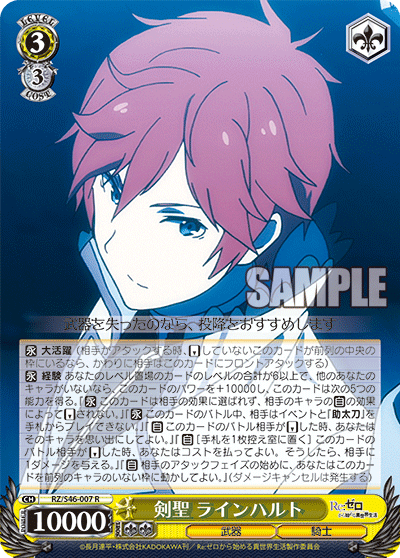
RZ/S46-007R 剣聖 ラインハルト (right)
Originally speaking in Re:Zero, yellow was an off-shoot colour to the far more popular blue and red builds. This was because the more popular characters, namely Rem and Emilia, were within those colours. Furthermore, those cards had far more synergy in the fact that they clearly supported each other in builds such as the maids or that of Emilia and Puck. Yellow, since green did not exist until the OVA set, was where all the “other” characters resided for the most part with a few exceptions. And as such, yellow was and is still, to some extent, quite a big mess comparatively to the other two main colours.
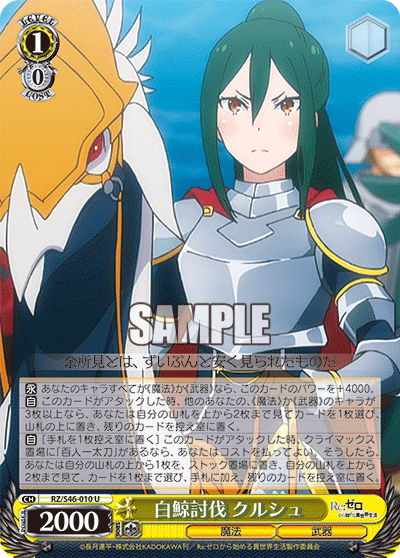
RZ/S46-010U 白鯨討伐 クルシュ (center)
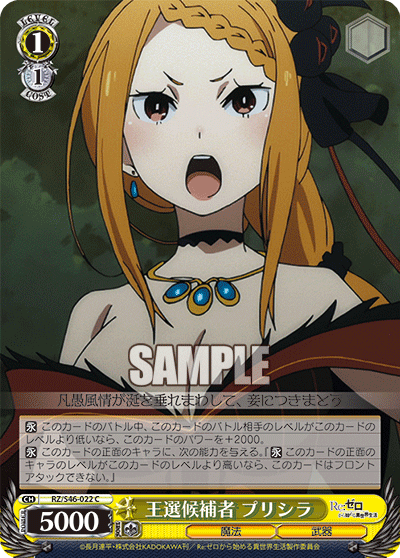
RZ/S46-022C 王選候補者 プリシラ (right)
Original Re:Zero placed all the other three royal candidates in yellow: Anastasia, Priscilla, and Felt, along with their companions like Reinhard. Furthermore, given the tight spaces of the cards in this colour pool, none of them were ever fully supported. Priscilla had around three cards if I remember as an example. Furthermore, these candidates did not work very well together. You could, in theory, stuff all the candidates together, but they don’t do much of anything as they all contest for space on the board. It was very unequal in terms of card strength and even character distribution.
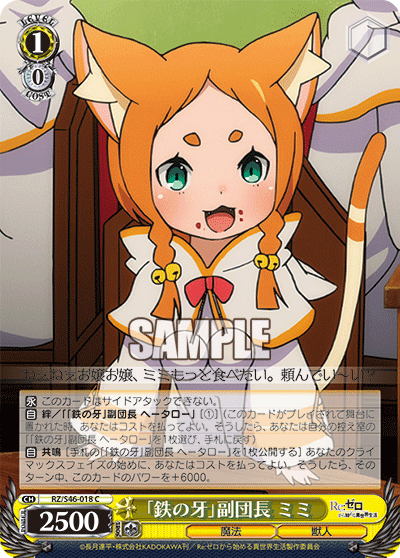
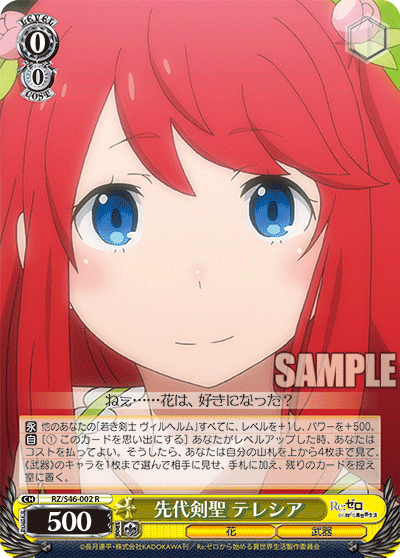
RZ/S46-002R 先代剣聖 テレシア (center)
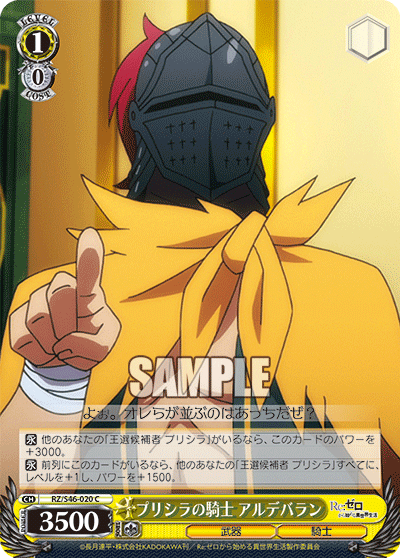
RZ/S46-020C プリシラの騎士 アルデバラン (right)
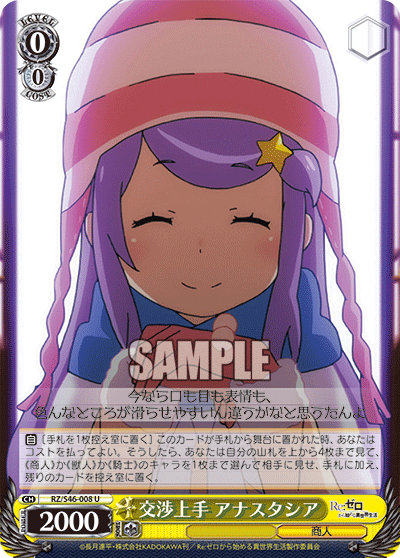
As an example of this, Anastasia’s camp which was mainly held by the beast traders and Julius consisted of a total of three cards. The beast-men twins relied on having copies of each other and did not work with any other card within the colour. Anastasia had a rare Akatsuki profile, but it was limited in scope, only able to grab Beastmen (獣人), Merchant (商人), and Knight (騎士); hilariously, this meant she could fetch some of the other candidates’ knights but she would fail on almost any other card including that of fellow candidates and any of Felt’s related characters.
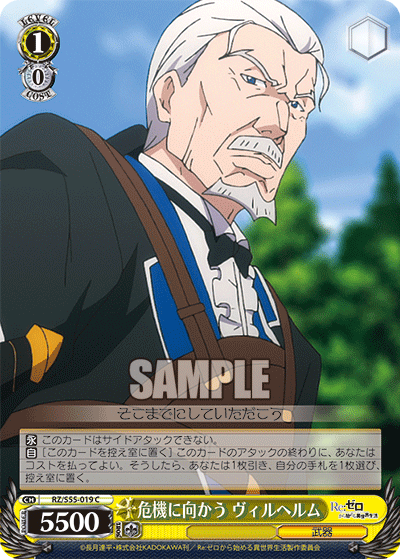
And speaking about Felt, Felt carried the one of the only two level threes in the colour (the other being Reinhard). Her design was awkward when considering the space of yellow characters. While Anastasia checked for certain traits, Felt’s cards seemed to solely care about Weapon (武器) trait which was shared with Reinhard and his family. Bushiroad also seemed keen to include just about anyone who had some partial appearance in the show and Reinhard’s entire family line that was depicted in the first season received a card. Outside of Reinhard, neither his grandmother Theresa or Wilhelm carried the knight trait, making them ineligible for Anastasia to fetch.
Priscilla received only three aforementioned cards. Featured above is her knight Aldebaran which is already one of her few limited cards. Aldebaran cares solely of having a very specific Priscilla on field in the front row to have his continuous abilities. While being a knight is a boon making him a relevant trait for Anastasia, without Priscilla, he’s essentially a vanilla card with below average stats.
Due to the page’s themes, I can only limit three images per block, but, back to the main point, Crusch had probably one of the more interesting combos at the time, having an ability to read ahead (probably a nod-off to the character’s abilities in canon). While the climax combo was interesting, her singular support came from Felix which only supported Crusch if she was in the middle of your stage, meaning your other Crusch combo cards would not receive his heavy boon. While Felix’s healing magic was a great reference to the show, Crusch’s cards stopped there with only Felix and the Felix himself having no other support for any other characters.
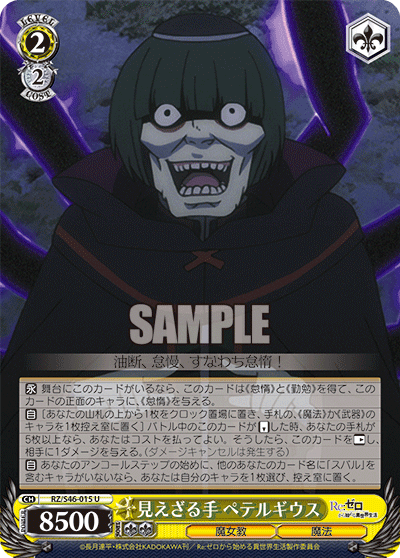
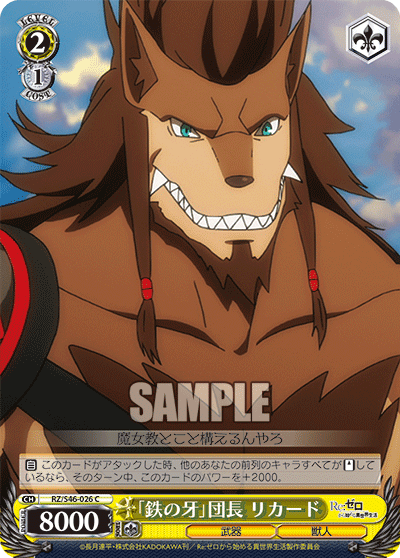
Yet somehow, Bushiroad believed there was still some slots for occasional one-off random character inserts and that of the witch cult which somehow also fit here, and the colour really felt like a dysfunctional grab bag of sorts. This was never really fixed or improved too much upon in the second set either. Sure, characters had more cards now, but the functional core of their decks were still quite a mess.
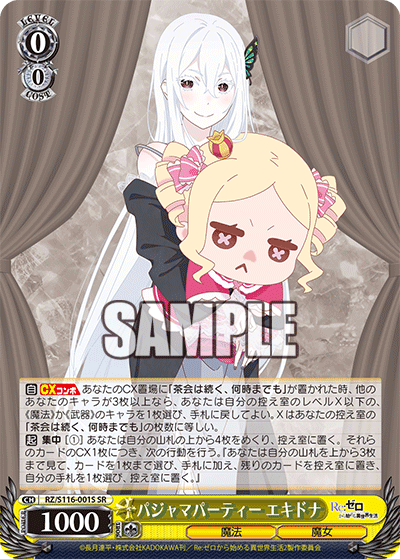
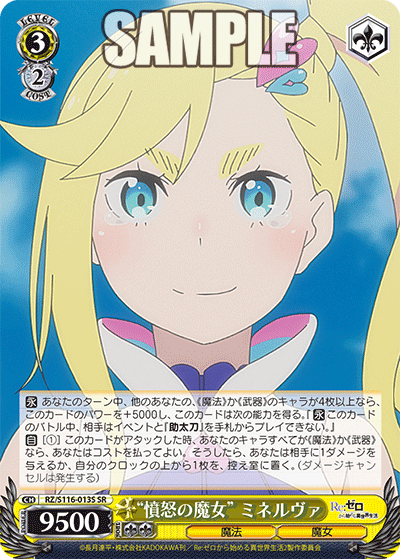
RZ/S116-013S-SR “憤怒の魔女” ミネルヴァ (center)
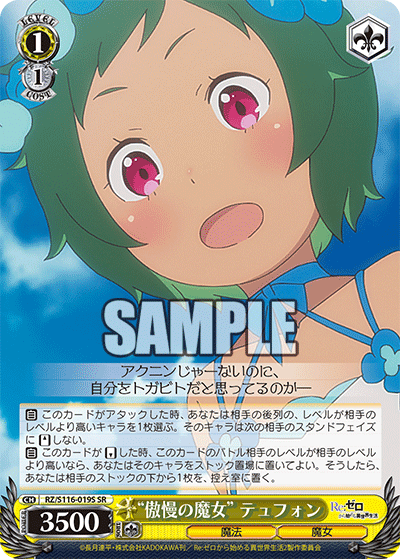
RZ/S116-019S-SR “傲慢の魔女” テュフォン (right)
By the time of the latest set (ignoring Memory Snow and the upcoming set), yellow had also transformed into a completely different deck too with relatively new traits. The witches officially joined the colour and were now playing among themselves. The newest set didn’t have any reliance on the old cards whatsoever and barely provides them any support. They are obviously playable, but the theme has clearly changed and warped into a singular-set design built on itself without any adherence on its past.
And this is kind of the problem with these strange added colours. They are part of that series being released. Yellow in Re:Zero is fundamentally depicting cards from the series of Re:Zero built into the yellow colour, but these cards feel and act as outliers to the rest of the series in terms of card design. And this isn’t a one-off event by any measure. This design has been commonplace for years as mentioned in the introduction.
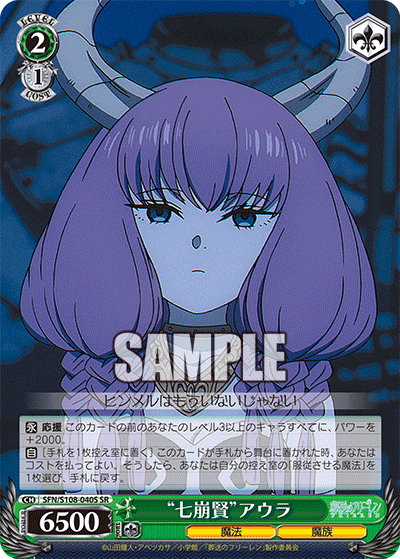
SFN/S108-040S-SR “七崩賢”アウラ (center)
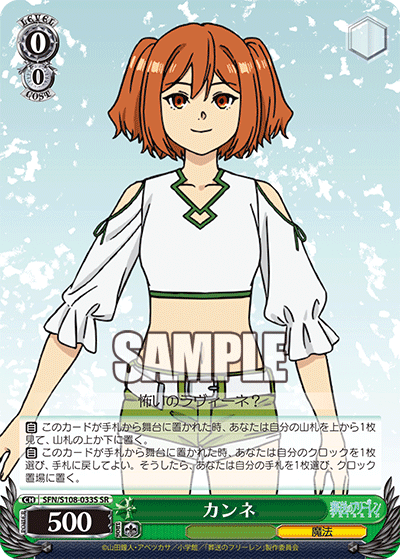
SFN/S108-033S-SR カンネ (right)
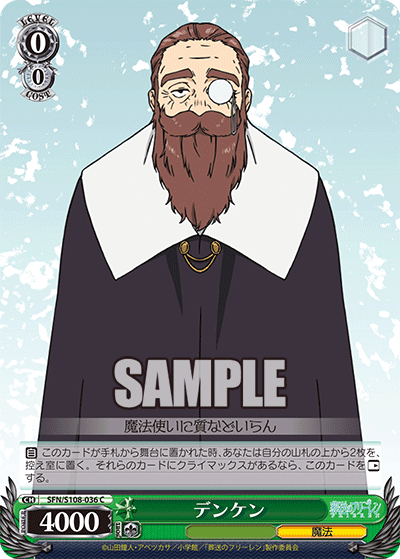
Green in Frieren is another very good example of this. Thematically speaking, this one is even more strange and awkward than that of Re:Zero’s yellow cards. While Re:Zero’s yellow cards depict characters that have some amount of interaction with one another or could be traced to say royal candidate and loyal servant (excluding the minor themes and the recent witches), Frieren’s green colour depicts the mage exam applicants and that of Aura and her demonic army. What is very strange about this is that these two parties have never, as far as the series states, ever met one another.
Lore-wise, the candidates do have a history of fighting demons, but, as far as the narrative is depicted, none of the candidates ever interact or comment about about Aura by any measure. Yet, because there is no unique specific trait requirements in green, and due to a lack of any direct synergy, you can just elect to put all the green cards together. It works, but it’s not particularly interesting nor rewards you in any functional sense.
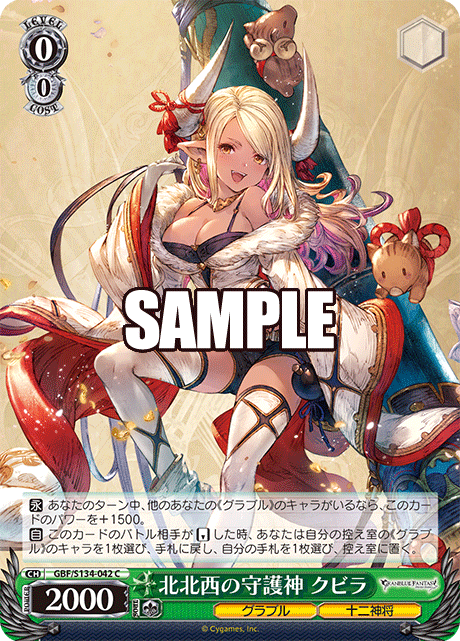
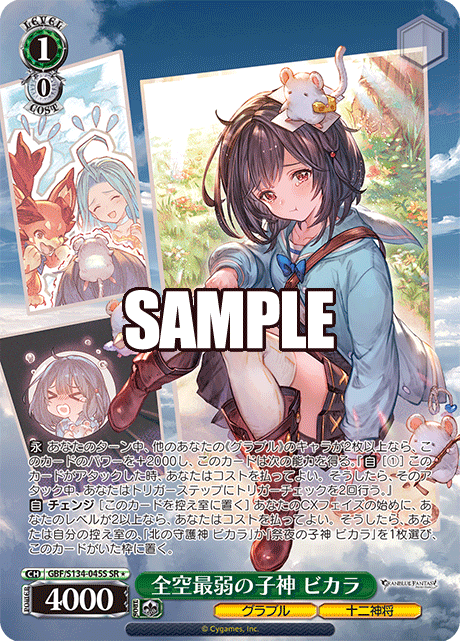
GBF/S134-042C 北北西の守護神 クビラ (center)
GBF/S134-045S-SR+ 全空最弱の子神 ビカラ (right)
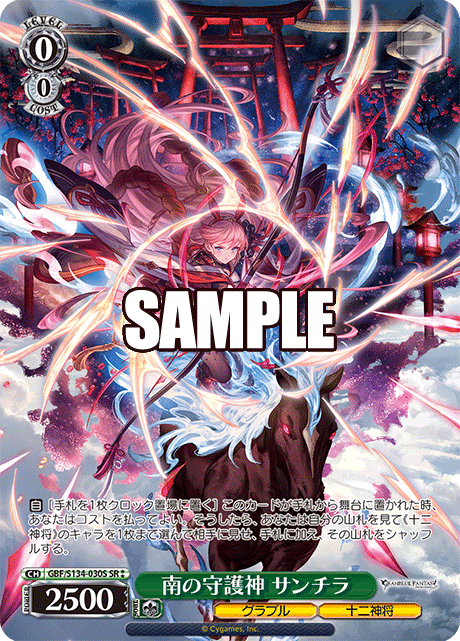
On the other extreme end, we have the full synergy package. In the recently released Granblue set, all the divine generals have an obviously tailored deck predesigned or packaged for players. That’s not to say that you are not allowed to add other cards to break said synergy; it is more or less the fact that these cards clearly call out to one another. In this case, many of the cards call out secondary traits that only exist within this colour.
There isn’t much flexibility within this core either since all the cards only exist within this specific colour block, meaning, outside of manipulating ratios, all decks that are built on this theme will use the exact same cards with small leeway pieces should you bother to break the theme. That’s not to say that playing the deck as it was designed is bad by any means. The deck feels solid, but it just feels like it’s lacking any player agency in terms of its deck-building.
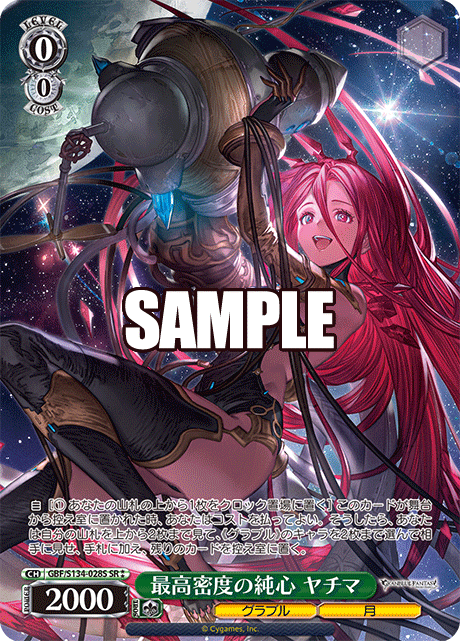
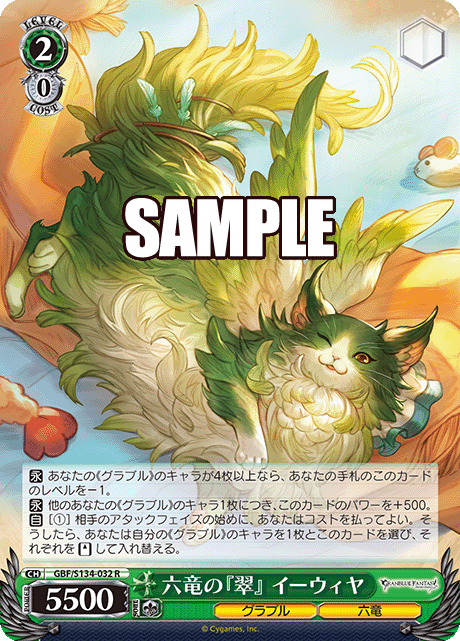
However, to add to the above dilemma, another key part of the problem lies in the lack of dedicated slots to this already preplanned core. Given how much is already dedicated to the above deck, why is it that we have these random one-off cards in the same colour that don’t contribute to that game plan? And this is a very common question that I keep asking. Since the plan is so concentrated, why not give players some additional options to vary their decks within the same core theme? Instead, we have these other characters slotted in at random rarities for “diversity” I guess. It just doesn’t make much sense to me in general. There’s arguments that it’s because there’s limitations for how many cards can exist under a certain colour, but Bushiroad has printed sets that are strictly mono or duo-colour. Furthermore, with cards like Chihiro from Cinderella Girls depicted before, they printed a singular card in some of the sets in a more obscure colour. Why can’t they just import these other cards into the other colours instead then?
So ultimately, what are the consequences for this?

In terms of competitive design, this would probably affect nothing. Considering that competitive players are always on the look for the most efficient and optimized profiles, having an obscure colour that contributes very little to the “main” colours won’t change deck-building dramatically by any measure. Where it does impact players is for those who look through these sets, find the semblance of a cool idea, only to find out it feels half-baked in the oven. Alternatively, like in the case of Granblue, they may be bored instead, realizing that there’s very little agency in terms of deck-building decisions, considering that the deck definitely feels already premade for them.
What is the solution here? Firstly, we must identify and admit that this is an existing issue. Without even acknowledgement, there’s no step moving forward. Secondly, instead of looking at these cards and their respective colour as foreign or “other” comparatively to the other colours in their respective sets, we need to create and find synergies to connect these cards together. Looking back earlier with Re:Zero, we can’t just be looking to create one-off effects and callbacks, slapping a multitude of these into the colour, and then calling it finished. Cards need to be inherently related and have some sort of tie-in to both make decks cohesive, consistent, and functional. Lastly, we should be redesigning off-characters to fit in more neatly within the confines of the sets or have more functional bearing on specific characters or themes. To put it simply, no more random vanilla or vanilla-ish~ cards like 2/1 Ricardo that solely exist for the singular purpose of giving a character a reference within the series. These cards need to be better integrated both thematically and purposefully within set design. And given Bushiroad’s nearly twenty-year history on working on card games, this should be more or less of an expectation at this point.