
If you were to tell someone that they’re making a LINK design almost half a decade ago, they’d be looking at you weirdly or assuming that you’re making some obscure deck. Originally debuting in the second set of Grisaia with Grisaia Vol. 2., LINK was a prototype keyword added to climaxes that would not make resurgence for several sets later until the arrival of D4DJ.





Side Note: This article was actually designed almost a year back. And I’m informing you, my readers, because, since then, there’s been a potential return to the mechanic with the most recent spoilers regarding Re:Zero Vol. 4.
We’ll begin by defining what “LINK” is. There isn’t a direct word for “LINK” within the text of the climaxes as evidenced by the climaxes above for Grisaia Vol. 2. Link is actually the keyword referenced in the small chain “link” featured above the standard text for the climax’s effect. In essence, link is the literal symbol. As far as how link works, link doesn’t actually have much meaning on the cards themselves and serves as a reminder text. It is always followed by a specialized name; in the case of Grisaia, it was called “ブランエールの種” (Seed of Blanc-Aile) which is in itself a reference to the final “arc” of the Grisaia anime series in Eden of Grisaia.
Thematically, the girls are all on the hunt for the missing Yuuji (main character of original Grisaia) and all the scenes reference moments and memories shared as the girls are seeking out to help him with his final mission. This is also how link is generally depicted as well. Link represents the bonds or connection of these climaxes to one another. Functionally speaking, the climaxes themselves do not actually have any bearing in gameplay until referenced by other cards that refer to said link.


In Grisaia, in order to activate and provide the LINK’s “linkage” effect it would come to be known for in later sets, you needed the above enablers. Essentially, when these cards performed their necessary abilities, they would grant the ability for all your cards to treat any climax with the link symbol as the same climax for any associated climax combos. To put it in a simpler example, you could use Amane’s level three combo with that of Kazuki’s gate climax, since, despite Amane requiring her standby climax, with Kazuki’s cards above in memory, Kazuki’s gate climax could “imitate” Amane’s climax’s name through the shared “linkage” ability. This is essentially a replacement effect.


GRI/S84-080U 後悔のない選択 天音 (center)
GRI/S84-049U お別れの校門 蒔菜 (right)
As for the payoff for the Link mechanic, they weren’t particularly great. All cards that were clearly direct synergies with that of link felt rather vanilla and weak. Furthermore, given the requirement of running all these climaxes in odd scenarios and having only six unique climaxes left two strange open slots. There was also no finisher that directly benefited from the link mechanic either which left the mechanic feeling less of a cohesive idea and more of a prototype concept.



DJ/S97-004RR 太陽のような明るさ 愛本りんく (center)
DJ/S97-008S-SR どっちが欲しい? 明石真秀 (right)
It wasn’t until D4DJ’s arrival that we see the return of link, but this time, it as much more pronounced. This time, it had a dedicated core which was focused around the group of “Happy Around!.” Synergies were more direct with characters also gaining the link effect now. Cards like Mahiro gave genuine benefits to running a deck with link synergies. Having finishers that did reflect the usage of link did give a feeling of link evolving into a more coherent mechanic overall. But there was still one key problem: link didn’t particularly feel unique. Link was essentially just another trait to bring a deck together. It felt more flavourful than impactful in terms of direct gameplay.
The issue with this use of link made it feel as if link was just a check condition rather than something that gave a larger advantage or changed gameplay. In short, link remained a gimmick, a gimmick that was much easier to facilitate compared to its time with Grisaia, but for the most part, it felt more like a background mechanic than anything else.
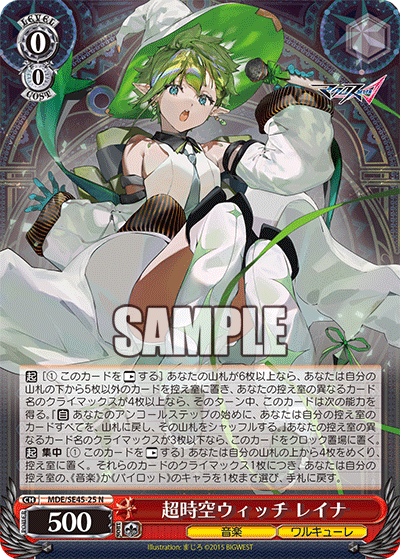

Perhaps the most powerful development concerning link came in the set of Macross. Macross’ premium booster’s big ticket face mechanic was link, and, comparatively to cards in the past, effects for link had very much improved. Take for instance, Reina’s brainstorm that gave an optional free refresh as an alternative to the brainstorm ability. This card also showcases a slight change in link that had a massive impact. The number of differently named climaxes in your waiting room as a requirement for her effect is lowered, meaning you don’t need to turbo mill your deck as much anymore. However, to get the link name effect, you would need the associated event in memory. The benefit of the event is that it was modular and provided much wanted cantrip effects that you could use throughout the game at a lowered cost. There was even a bonder to said event to make it so you could consistently get it into memory in games.
Many players opted to use Kaname’s early combo in conjunction with that of Mikumo to provide you double the value with two different climax combos during the same turn which was a cool design that you could perform.
And while this had become the most famous use of link in general, some problems before that I have brought up haven’t changed. The pay-off for link is still highly limited. None of the finishers used link in any meaningful capacity. Link has the potential for multiple applications, mainly because it enables the use of multiple combos at the same time. It feels reminiscent of Mother’s Rosario.



SAO/SE26-10R 《絶剣》ユウキ (center)
SAO/S100-008S-SR 想いを重ねて アスナ&キリト (right)
Yes, all three of these cards do indeed combo off of the same exact climax. So, theoretically, you could end up in this similar scenario with link and be able to perform something similar. The issue with link is while link allows climaxes to mimic the names of other climaxes, it doesn’t change the requirements of your other combo characters. You still need the associated stock and other requirements as stipulated by your finishers and other cards.
I do think Bushiroad has been relatively careful with link in general, fearing potential abuse by cards in the future. I don’t think they are wrong in this regard, but I do think there needs to be some smaller payoffs. Looking at the original Grisaia “link”, many of the payoffs shown only give you power (and only for the turn) with the only one giving card advantage being that of Makina for a relatively harsh condition (you need to be out five or more climaxes with different names). I think lightly relaxing the requirements like in Macross for Reina is a step in the right direction. I’m not expecting any sort of game-breaking payoffs, but even something along the lines of “tap to give a character the ability to get extra stock on reverse” would be fairly decent in my books as long as it still carries the check for x number of climaxes with different names in your waiting room.

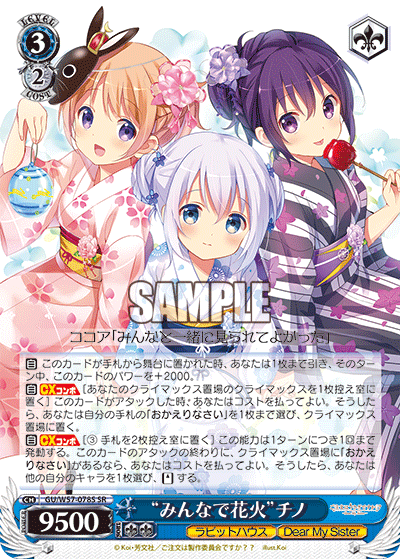
There aren’t many combos in the game that let you use multiple different combos during the same turn and during combat. Two of the pairings I know that perform this are already shown above. However, these are all replacement effects, requiring you to play over the climax in play with a different climax from hand. Still, I think this best mimics what link should probably be able to achieve, of course, with more requirements and specifications.
Link exists in an odd place in the game at the moment. It’s not like a side theme that you can just casually insert in your deck either since it heavily affects your climaxes and how they play throughout the game. Currently, as it stands, link feels more or less like a glorified and more specific form of climax swapping. As I mentioned before at the beginning of the article, link is making another return with Re:Zero, but only time will tell how link may change in this newest iteration.