
You know what? I’ve kinda had it. I just want to speak my mind, so I’m just going to do so here because I can. I want to make it extremely clear that I do not carry any catered or especially favoured opinions towards Bushiroad. Over the years, it has been very clear to me that they have been pushing the game with fewer brakes and less testing before releasing cards. They’ve been making questionable designs and worse-off products for players, spiking rarities upwards to make a quick dime. Now this post isn’t solely criticizing Bushiroad; I do think the playerbase at large is also partially at fault.

To begin with, as a fair warning, the first issue I want to talk about is something rather arbitrary and does not affect you at all if you have no intent on collecting and/or buying foils. This section will be coloured in red, so if you want to skip, please start where the red text ends.
Now for a brief history lesson, many years ago, Bushiroad did not set the highest base rarity (the lowest rarity for any copy of a card) for a card at double rare. For some sets, such as the one above, Kantai Collection, they printed an even higher rarity at double rare plus and different named versions of the same rarity. These cards were incredibly difficult to obtain even at base rarity due to the card distribution ratios in products.
Thankfully, this type of design has long been tossed away in the past. Double rare is as high as base rarity will typically go. But that’s not to say that’s the only way Bushiroad has messed with rarities in their products. The old players will remember this but older series used to only have around eight double rares. That meant it was much easier to obtain a playset from opening boxes compared to the more common twelve to fifteen double rares in standard sets nowadays. To put it simply, and with changes to box ratios and singles, your chances of getting even a single playset with half a case is low.



ISC/SE53-53WIR-WIR Marry You? 鈴木羽那 (center)
ISC/SE53-53SP-SP Marry You? 鈴木羽那 (right)
On top of all this, the corporate greed has reached new levels unseen before. Now this shouldn’t surprise you if you’ve been playing any card game released or updated in the past five years. Weiss isn’t alone in this category. The problem is, to max a deck or to high rarity your deck, you’re now looking at an exponential increase in costs compared to when I first started a decade ago. And this isn’t because, like me, you are potentially looking for older cards. Newer sets themselves are full of these arbitrary over-inflated rarities with this strange in-between. More common in premium boosters, there’s always this strange half-rarity that may itself have a signed version with the secondary market cost of a new gaming console.



NIK/S117-110S-SR “ワード・オブ・キル”シン (center)
DAL/W131-016S-SR 皆の心のオアシス 四糸乃 (right)
On top of it all, everything comes foil now. Back in the day, your max rarity deck consisted of a few non-signed foil cards, some base rarity cards, and then the expensive signatures. But that’s no longer the case. Everything comes foil. Your chances of getting something nice for the foil slots in your booster boxes have a wide range of being anywhere from a rarely used or super niche common to that of the grand holy grail of the one or two secret rare cards available for the entire case, with the chances very likely to be the former. The foils feel less valuable and less interesting when the reality of your pulls is likely limited to some scrappy elevated common with more than likely the same art but foil backing.


And to add the chaos of it all, there’s nothing that raises even more arbitrary value and pushes players to open boxes than the release of exclusive serial cards. If signed cards weren’t already enough of a lottery, we can go even deeper and make exclusive cards whose arts are completely unavailable to players without a fortune under their belt. We also still have the issue of promotional cards being hard to obtain or available only on the secondary market through promotional distribution. Best of luck any of you players trying to get your hands on some of these “exclusives.” I sure hope you considered or bought the Blu-ray or CD for that one of only PR card.



AGS/W108-038S-SR 暴走 のどか (center)
SBY/W114-049ABR-ABR 君と過ごした一年間 桜島 麻衣 (right)
An Open Letter to Bushiroad:
Onto the biggest boogieman in the room: Bushiroad, have you ever considered pressing the brakes for even one second? This last half a decade has been arguably the most turbulent and controversial tide I’ve seen for Weiss since. And I’m not just speaking in terms of glory days or remembering feelings of nostalgia. The game has genuinely kicked its powercreep up in levels unforeseen compared to my first five years of the game.
Now, as I’ve said before, powercreep is inevitable. It is a part of game design as a core. Cards will need to be powercrept at one point to allow for more futuristic designs and new avenues of play. However, there’s a very big difference between subtly increasing the power of a card and then slamming the gas pedal to see how far it can go before the car inevitably crashes.
These past few years, in terms of powercreep, have been, and I daresay, unfun. The meta has shifted wildly to the point of changing once every six months. Now I understand that new series and sets bring about the winds of change but not at this ridiculous level. Even at a locals level, it is hard to get used to the new series only to get slammed a fresh one off the press the moment you are finished reading the card list of the most recent series.



CSM/S96-029RR 公安対魔特異4課 早川アキ (center)
PJS/S109-060RR アウトドアクッキング! 青柳冬弥 (right)
Your designs suck. Your finishers are overpowered and unfun to play with or against. Either the endgame is limited to some absurd finishing combo that may as well spell death for your opponent unless they pull a “hail Mary” or you’ve got these designs that just spin the dice whose finishing power is left to the complete will of the gods, making your plays throughout the game feel meaningless and obsolete.
I especially hate how uninterruptible these cards are to play against from your opponents. When they come out, your opponents have no choice to but to essentially put their hands down on the table and pray for a miracle. Some of your finishers here fulfill their own conditions themselves and have self-protection designed into the card to prevent opposing interaction. And to top it off, because of the sheer amount of power you’ve designed for the endgame, we can’t go back to a simpler time. With how powerful these finishers are, a single turn usually spells death, making any late game preparation pointless.
Decks now have to be hyper-focused towards the ending turn to stand a chance competitively. Defensive play feels like a joke outside of a few niche scenarios. Nothing about the endgame is enjoyable. It’s just a coinflip without any chance for your opponent to respond as you just seek to obliterate them before they even get a chance to deploy their finishers.



DDD/S118-022RR 私は選ばれたんだから アイラ (center)
GIM/W124-036bRR Boom Boom Pow 花海咲季 (right)
Granted, the lack of any real requirements has abandoned deck identity. Since cards don’t have anything preventing them from being used together outside of the base rules of colour and level restrictions, nothing matters. The absurd abundance of level zero utility plagues every single deck design as the only thing stopping you from stuffing the most powerful utility profiles together is personal choice.
There does seem to be some form of reprieve from this mundane design as some of your new series and sets are reintroducing trait-locks and other mechanisms to provide incentives for larger varieties of decks rather than the singular deck for each series. But this is only an attempt, and given the past mistakes and lack of rigid uniformity in design, any such attempts to do so signal the creation of a “weaker” series by default.
Trying to do so is like trying to relive the past. You done f*cked it up, and if you want to fix it, you’ll have to do far more than that if you want to change the format for the better.
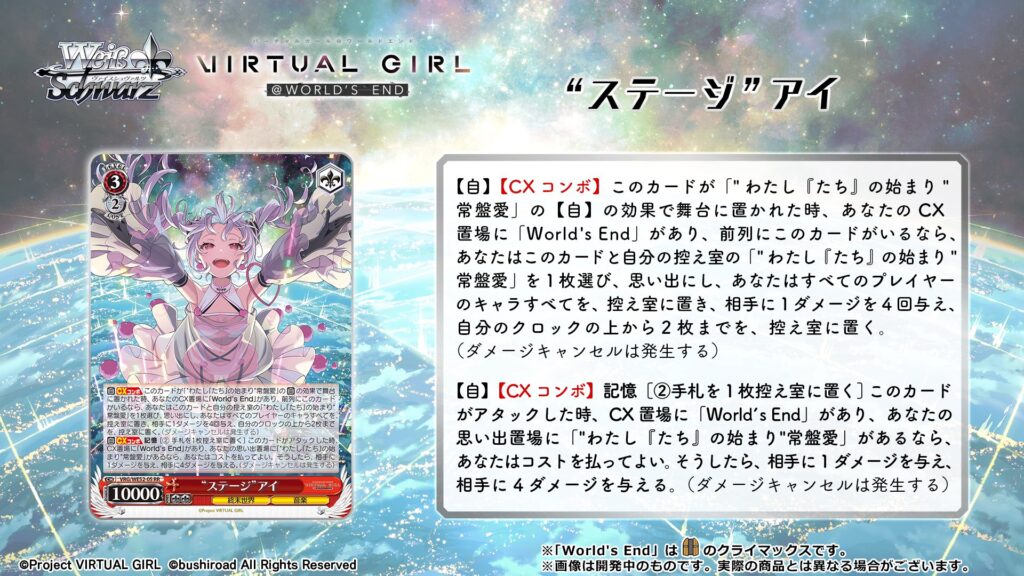
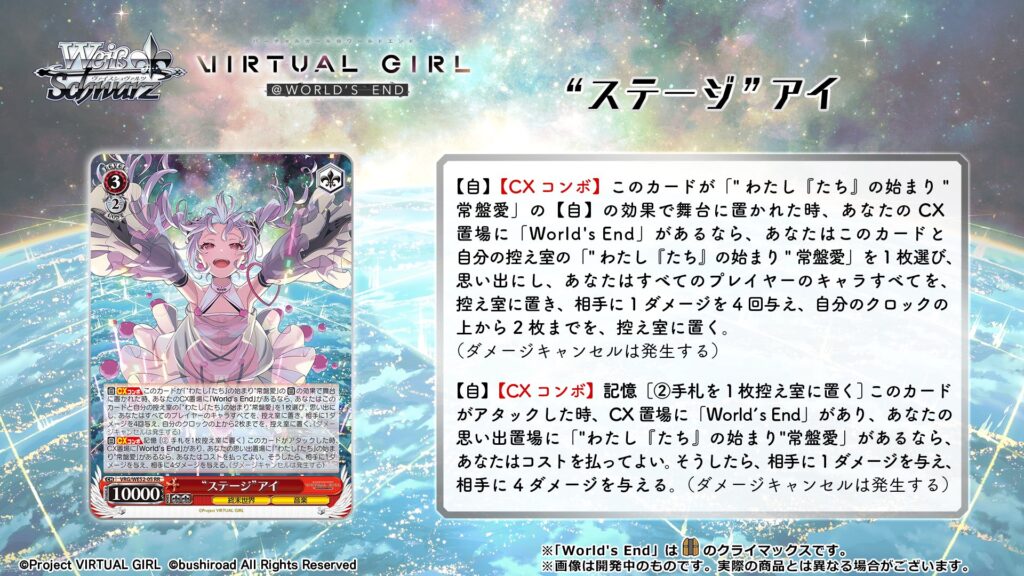
Even as of this posting, your development team is already crafting some new finisher that makes the game even more miserable, capable of ending players from as early as level one with a bit of luck and nuance. Furthermore, to make things even more hilarious, after posting the questionable card, there was a follow-up errata for that same design during the same week.
So my question for you, Bushiroad, is how do you plan on fixing many of the persistent problems within the game when your designs are actively pushing for the opposite time and time again?
<End Letter>



NIK/S117-T21SP-SP “新世界”モダニア (center)
NIK/S117-066S-SR “お散歩トレーニング”ビスケット (right)
Don’t get me wrong. This post isn’t solely meant to be criticizing Bushiroad. I sure am railing on the conscious decisions and choices the company has made, but by no means am I sparing the community either. While the company does take a fair share of the blame for their choices in the past few years, the community is also responsible for helping facilitate and supporting these designs.
Beyond buying product, the open discussion on online forums is clear proof of the mentality that some players have towards these designs. Players are constantly advocating for a continual push towards a cookie-cutter template for deck building. Players just want to keep the same core utility profiles meshed with some kind of overpowered finisher. There’s no uniqueness. There’s no creativity. The irony of which comes from the community when they cry for change. If the misquote of Gandhi is “be the change you want to see in the world”, the community is the complete opposite: “stagnate and do nothing; Bushiroad will save the game.”
If there’s anything the common man can recognize, especially in the last decade, is when have corporations ever openly done things to benefit their consumers out of the goodness of their cold, metal-plated shareholder hearts? Bushiroad will continue to do whatever makes them profit, not what benefits or supports its communities.



UMA/W106-035C 学園理事長 秋川やよい (center)
UMA/W106-131U ブリュニサージュ・ライン メジロブライト (right)
Over the past few years, I’ve seen the formulation of a hivemind, a conglomeration, an aggregation of individuals, that have become absorbed into a singular identity with their mindset. It is very obvious through the general speech patterns of such individuals. I apologize to say this, but the average competitive dialogue and lexicon feels like the disgruntled mumbling of a toddler uttering their first few words.
When discussing the individual cards and ideas in a set, rather than looking for unique plays and designs within the set or series, players tend to gravitate supposedly to the mathematically and defined perfect deck pile. Now I don’t particularly care if your passion for the game involves trying to input textual prompts into a LLM to create a deck for you, but not everyone is obsessed with this so-called singular deck design.
Some players have come to believe that a mass majority of players only speak in regurgitated decklists and online netdecking URLs. I have some news for you if you think this way. For example, using the Uma cards above, Uma is a series with well over two hundred cards. Uma isn’t 1/0 Satono Diamond, the 2/1 Yayoi event, and a coinflip between the finishers of Curren-chan or Agnes Tachyon. That pile that was just described is just a single deck among the many decks that can be designed and built by players. Uma also includes decks that may say use the 0/0 Mayano Top Gun combo or the Jungle Pocket focused deck where she is supported by Ines Fujin. You may not take these decks seriously or consider them decks at all, but players are allowed to play these cards and build them in whatever capacity they enjoy. A deck is just fifty cards assembled within the same series in any way or form. There is this whole competitive sentiment where players will simply look down on players who seek to build and enjoy decks that shift away from their competitive perspective of the game.
Samples of the low-hanging fruit dialogue include the following sample:
- Player A: Hey, you play Ayakashi Triangle?
- Player B: Yeah, I love the series.
- Player A: Ahh, so how do you feel about the Suzu combo?
- Player B: I don’t play Suzu. I play the eight wind deck with level one Matsuri instead.
- Player A: I know, but don’t you have the real deck?
- Player B: I feel like I enjoy the eight wind deck; it’s pretty good.
- Player A: No, I mean like, the playable deck you know. The competitive one.
If your conversation sounds anywhere remotely like the above, you should really consider changing how you speak with others.
Anyways, you know who you are. More egregious is that sort of scoff or elitist dismissal through behaviour or vocalizations when these players encounter supposedly “weaker” or “casual” people. I don’t think players quite realize how damaging this is to the community at large. Individual behaviour aside, this type of thinking and behaviour limits and reduces the growth of communities. This whole social agreement on arbitrary nonsensical deck restrictions in terms of building and design is disappointing to say the least. Players should be allowed and accepted for whatever design they come up with and bring to the shop and let the tournament itself decide what is considered competitively viable. The whole dismissal of a non-meta deck as weak or not viable is childish thinking, a perpetuation of elitism, and behaviour unbefitting of any grown adult. The bottom line is: it’s time to grow up, mind your own business, and stop deciding for others whether their deck should be taken seriously or not.
This is a mindset that continues to create arbitrary boundaries between what is considered to be the competitive elite and the casual bottoms.

Now don’t think that I’m just giving out shots at the competitive players only. Some of the casual crowd also perpetuate their own set of issues. The biggest difference, if any, is that the competitive crowd just seems to be more vocal.
The casual groups tend to think of Weiss as nothing more than a complete joke of a game. That is to say that there is not point in trying hard or being serious in terms of deck design and gameplay. The most common phrase that they may say that truly embodies their spirit is along the lines of: “forty-two cards and eight two-souls.” This is endemic of the idea that the game is meaningless and that it’s just shoving random nonsense together and slamming climaxes for fun. This creates the perception that there is no meaning to deckbuilding and there is no meaning to trying to take the game seriously in any capacity. This is especially rude to anyone who genuinely tries to play the game with any amount of seriousness.
Ultimately, the playerbase has gotten lazy and complacent. Creativity is at a low point as players have adopted the concept of “discovering and identifying the best deck.” As such, players don’t look to innovate. Players are not looking for better, relying solely upon online guides and netdecking to provide for all their needs. This creates a stagnancy in gameplay which Bushiroad capitalizes on. Players continue to show that they’ll buy the product and build the exact same repetitive designs again and again masked under different IP images.
The fault doesn’t lie exclusively with Bushiroad. Players perpetuate the same generic patterns and remain enthusiastic about powercreep design that quickly eats away at the fun of the game as player agency continues to be reduced as cards essentially “play” themselves. The playerbase is advocating for this, and Bushiroad just simply delivers.
UMA/W106-035C 学園理事長 秋川やよい (center)
UMA/W106-131U ブリュニサージュ・ライン メジロブライト (right)
A while ago, a friend of mine told me that the series above in the images shared was solved. I questioned him and asked him what it meant to solve a series. He explained to me that the perfect solution to the series had been found. The perfect deck has been completed. But this gave me another thought in my mind. As you may or may not know, I don’t believe in the idea of a perfect completed deck for each series. I think that deckbuilding is an open space to be explored by the players whom develop, alternate, discuss, and change their ideas of what should be in a variety of decks. And furthermore, if a singular solution to a series can be found, then that begs the question: is the concept of deckbuilding itself a literal problem?