
I want to ask you, the viewer, a simple question: What does it mean to be a “hero”? The identity of a hero is someone who supposedly does the “right” thing and upholds “justice”. But this is where we start seeing the grey lines for what defines a hero. To understand what a hero is, we must be able to recognize what the supposedly “morally good” alignment means that is expected of the hero. On top of this, a classical hero is one who never wavers, meaning their stances and beliefs don’t change. They are of a golden heart which remains true from birth to death.
Warning: This deck profile contains heavy spoilers for Fate/stay night and its accolades.
Back in university, I had a friend who was incredibly passionate about his beliefs in Shirou as the definition of the ultimate hero. Shirou, to him, was cool, flashy, and extremely likeable. He was kind, and he talked in words that shared and resonated with all. It was as if Shirou was a god, a form of humanity sculpted by the powers above, an untouchable angelic being that was cursed to be in human form. I’m here to argue the opposite. I don’t think Shirou is anything remotely close to a hero by any means, and on top of that, I want you, the audience, to remember that every hero is just another man’s villain.
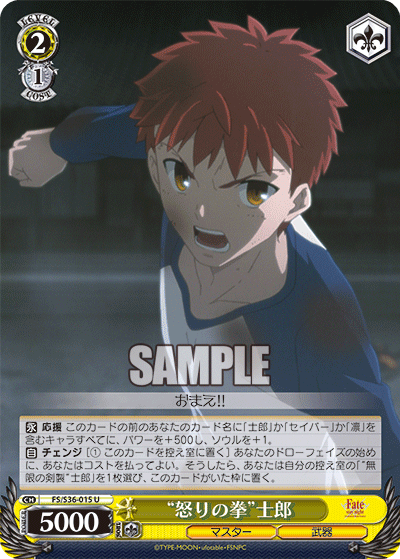
FS/S36-015U “怒りの拳”士郎 (center)
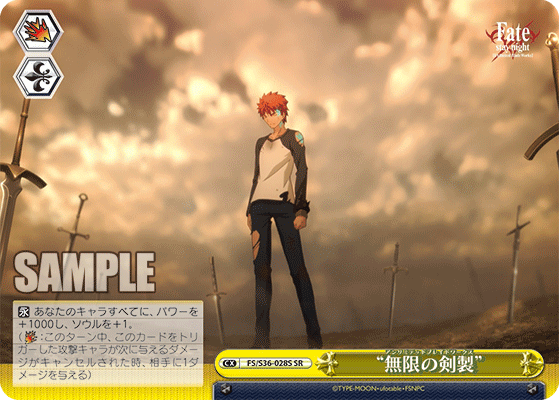
FS/S36-028S-SR 無限の剣製 (right)
I’m sure most of you have heard of the “hero’s journey”, a literary framework from antiquity that provides the idealizations of the typical tale of the generic hero. It is a story that begins with humility and goes full circle, running the initial adventurer through twists and turns, combating a terrible horror, and returning them back to their beginning position.
While the framework gives us a general direction to follow in terms of an expected narrative for the classical hero, there is one fatal flaw with that of the hero’s journey. The existence of a hero indicates a failure within the world itself. While the more modern takes of the hero’s journey draw upon a variety of characters ranging from a ragged thief; or criminal looking for redemption; or the simple townsman seeking the call for adventure, there is one important note to be mentioned. The existence of a hero denotes that there is a crisis within the world itself. With the existence of a hero, a flaw must also exist. The two are inseparable. This then begs the question, if the two must coincide in reality, would it not be better if heroes did not exist at all?
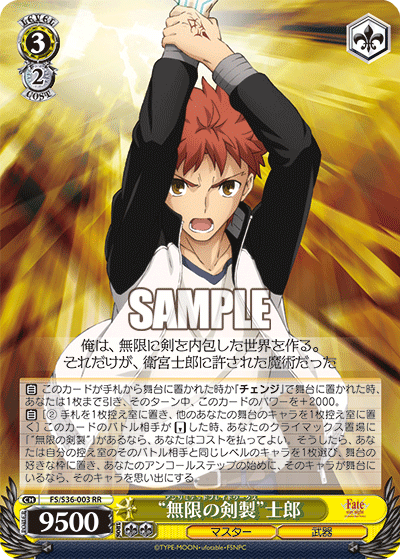
Our classic redhead boy here is not anyone special to note. Sure, his adoptive father was essentially a war criminal who tossed his life away in pursuit of bringing around a “better” world. Shirou, in kind, tried to seek that same idealization, wanting to copy his adoptive father and “complete” the mission. However, what does it even mean to better the world? And even if one were to cure or fix one issue, will not another pop up just as quickly? In that sense, wouldn’t the mission essentially be endless and unrealizable? As we can see here, the flaw already existed long before Shirou took up the mantle to take on the hero’s journey.
In his form above, Shirou has reached his apex and stands at the revelation point of his adventure. Having gone through all the experiences of his journey, he stands tall and proud, ready to defeat the impending evil, the truthful monster that haunts his every existence. And no, I don’t mean the King of Heroes, Shirou is, in essence, staring down straight at a mirror. It is his very own conscience that acts as the final barrier to “completing” this so-called journey to heroism. It is here that he recognizes that his own ideals, the very thing that brought him up to this very moment, is the thing weighing him down, preventing him from being whole and reaching catharsis within himself. He must strike himself down.
Shirou’s finisher draws upon the hidden arsenal of “Unlimited Blade Works”, a scam of a design that reflects his failing attempts to recreate the very weapons of past heroes. Each blade is an artificial version of a weapon of old, a pretense and mimicry as he tries to emulate those same heroic acts. When he reverses his opponent with those same weapons, he draws another blade that mirrors his opponent for a second act. As proof of his failure, Shirou sends the weapon he spawns thematically to memory at the end of turn, a reminder of his capacity to dream but never bring about reality, a faker that will only ever achieve the notion of heroism and nothing else.
His 2/1 changer grants soul and power in front and will transform into finisher Shirou at the beginning of the next draw step.
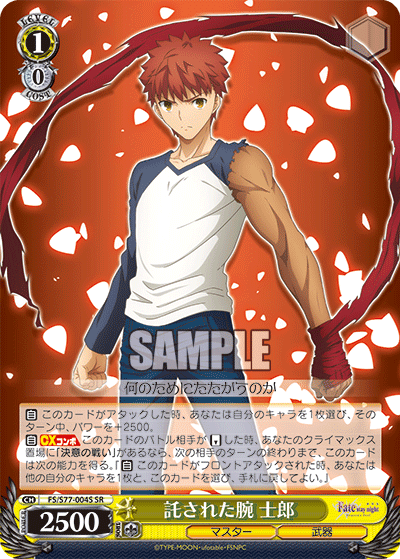
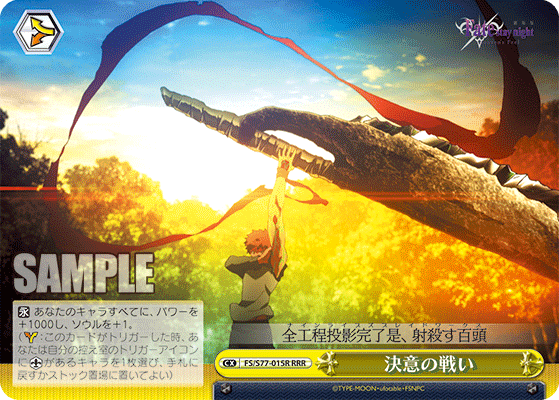
FS/S77-015R-RRR 決意の戦い (right)
The selfless hero must put themselves in front of danger. That is the essential duty of any hero: they must be on the front lines and be ready to sacrifice themselves to protect those behind them. Here exists another one of Shirou’s fatal flaws. He is the perfect hero by ideologies and ideologies alone. Shirou holds no fear of holding back or sacrificing himself in the line of duty. But, with that in mind, he neglects a couple realities. Firstly, he forgets that without his existence, who will be there to protect the weak and innocent in the wake of his absence? Secondly, his own death will create further mourning and grief. His own defeat will inspire others to take up his mantle, failing to break apart the very cycle of destruction, malice, and evil. Each hero’s death brings about even more heroes with their stories of heroics. The story never ends. Evil will always prevail at sustaining and renewing the cycle. There will be those that will mourn his death, and just like Shirou’s admiration for this deceased adoptive father, the same suffering will drag on eternally.
Shirou exemplifies this with his combo above as he valiantly puts himself in the front row for combat. When he attacks, he grants someone power, including himself, and upon reversing his opponent, Shirou gains a double Oboro effect the following turn, returning himself and another on your field back to hand, symbolizing his understand that self-sacrifice is not the only answer.
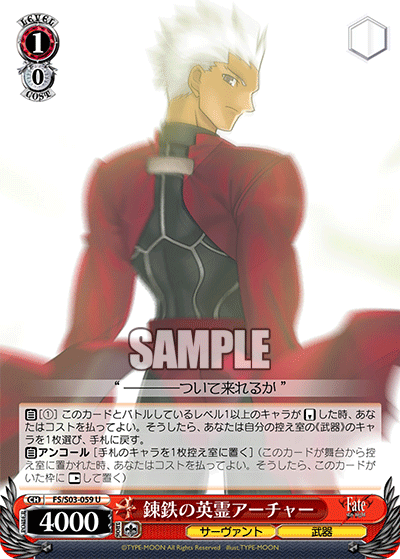
FS/S03-059U 錬鉄の英霊アーチャー (center)
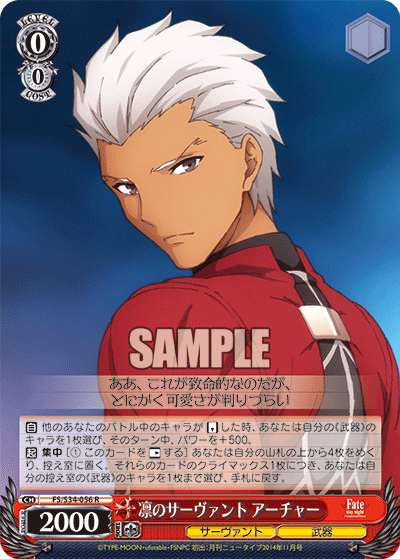
FS/S34-056R 凛のサーヴァント アーチャー (right)
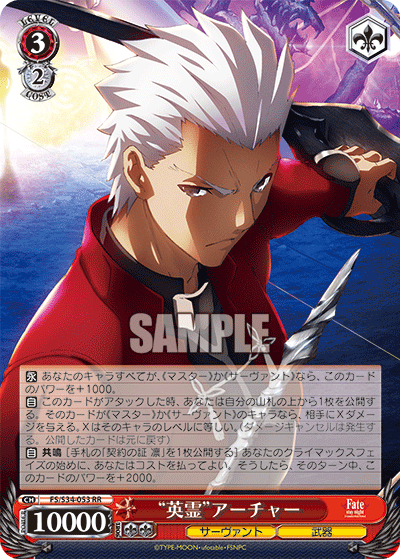
The irony of Shirou’s ideals is fully realized with the arrival of his future self. In an alternative timeline relative to Shirou’s, Archer represents everything Shirou had imagined himself to become. As Archer, Shirou has achieved perfection. He has become one with the definition of the world’s “justice”. Aligning himself with “heroism”, his body has morphed and become that of the red devil himself. Archer represents Shirou’s naivety and failure in his relentless chase to become humanity’s saviour. In the future, Archer has achieved everything Shirou imagined himself to do, but in that way, Archer had also realized that he himself had become the ultimate evil. Blind justice and nondiscriminatory evil is essentially one in the same. As I said before, every hero is just another man’s villain. In an ironic twist of fate, Archer returns to the past in order to confront himself and prevent his disastrous future by simply preventing his own existence from forming, killing the root of it all, Shirou.
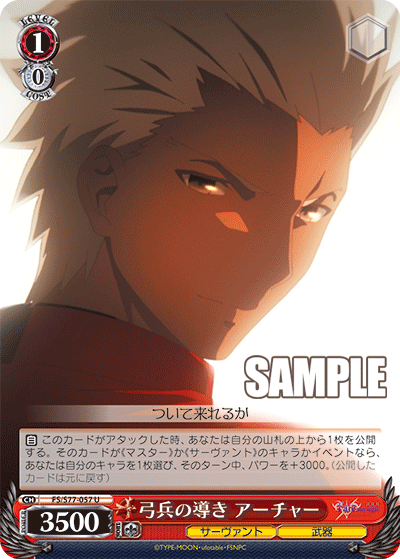
Archer is Shirou’s composite self. As such, as the main reflection of Shirou’s ideals realized and manifested, Archer acts as the perfect backdrop to Shirou’s onslaught against his enemies. Archer’s finisher on the left deals additional damage on attack equal to the level of the character revealed on his swing. Archer in the center is a cheap way to gain additional hand if it reverses a level one or higher opponent, allowing you to salvage any Weapon (武器) character by paying a cost (most Shirou and Archer cards have weapon trait). Lastly, Archer on the right rewards you for defeating your opponents and is the brainstorm for the deck as it salvages any weapon character.
FS/S36-004S-SR “令呪による召喚”士郎 (center)
FS/S34-103PR SDアーチャー (right)
A hero without a weapon is like a scabbard without a sword. It’s an empty threat. Heroes, regardless of whether they’re filthy fakes or not, need to maintain the impression of a hero. Since heroes mainly exist as ideological concepts, the power of a hero is greatly determined more so on the appearance of the hero rather than what is on the inside. Simply, the sheer image of a hero is what strikes fear into the hearts of evil, and no hero can thrive without raising the blade of victory, a flag that rallies common folks to their side.
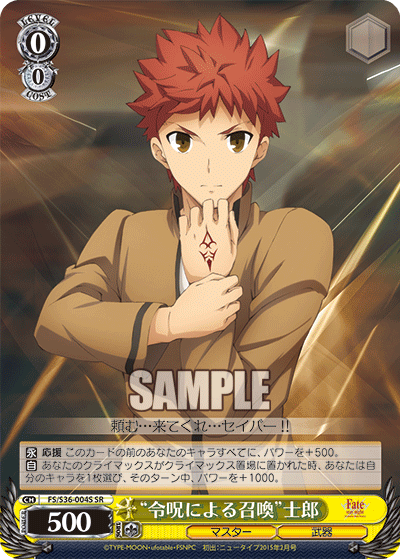
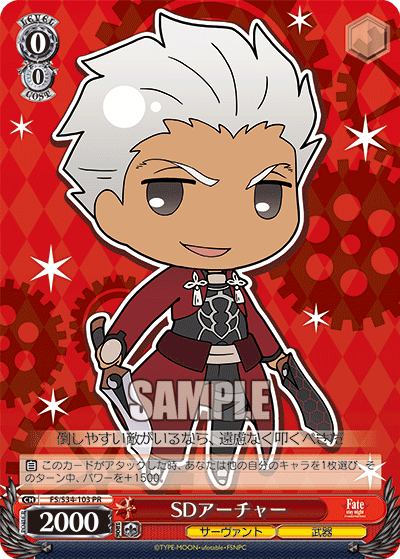
Archer demonstrates this and aids our combo by granting additional power to Shirou. The Archer on the left checks the top of card of your deck when he attacks and grants power to one of your characters as long as its any of the traits listed or an event [Shirou is Master (マスター) and Archer is (サーヴァント) trait]. Center Shirou grants power in front of him, and when you play a climax, you can assign additional power to one of your characters for the turn. Mini Archer on the right grants power to a character when he swings.
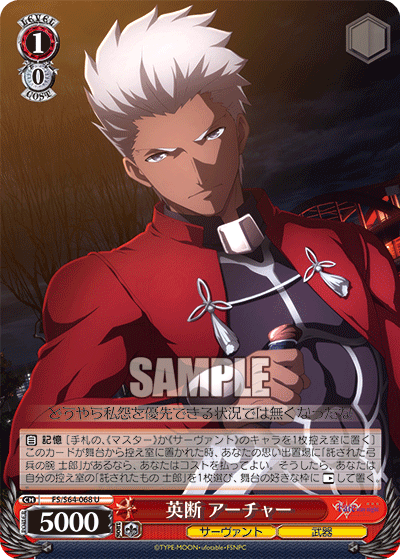
FS/S64-068U 英断 アーチャー (center)
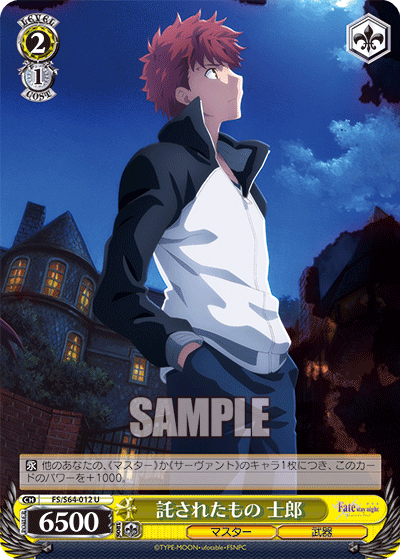
FS/S64-012U 託されたもの 士郎 (right)
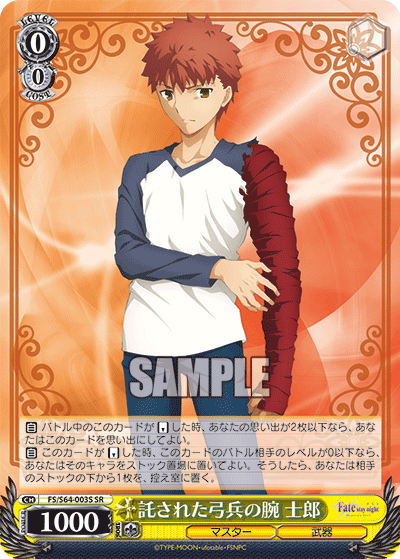
There is some reprieve for Shirou. In one of the timelines, Shirou’s actions, choices, and decisions he makes through the bonds of friendship formed with those around him changes the mind of his future variant. Archer, nodding and recognizing Shirou’s changes, realizes that his future will not exist within this timeline. With that in mind, Archer willingly sacrifices himself, knowing that his sacred duty is fulfilled, and his existence no longer bears any meaning in the existing world. With this in mind, he slices off his own arm to replace that of Shirou’s lost arm, granting him a piece of his own power, entrusting the fate of the world in his younger self’s hands.
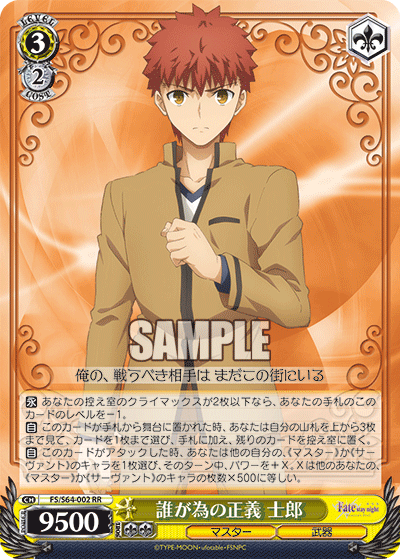
This is greatly symbolized by the interaction within the three cards above. In the early game, Shirou willingly sacrifices his left arm to protect those that he loves and sends himself to memory. Archer then, recognizing his younger self’s service and determination to protect those that he loves, pays a cost to spawn a copy of 2/1 Shirou from your waiting room onto the stage, ready to beat down on his foes. Shirou himself is a large sized Taigei profile that has received the blessing of his future self.
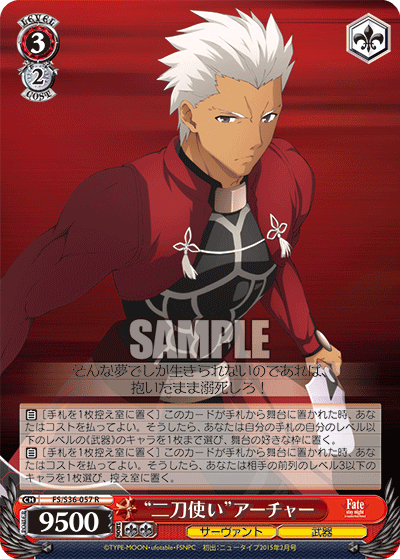
FS/S36-057R “二刀使い”アーチャー (center)
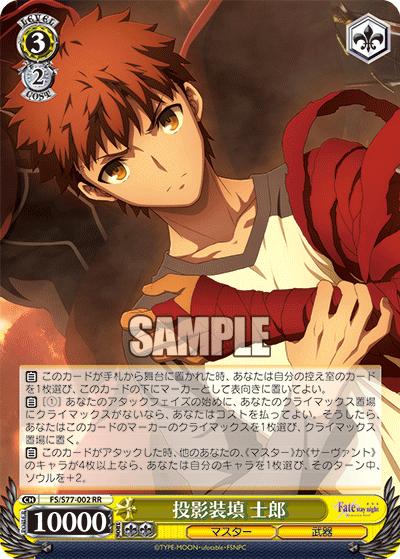
FS/S64-002RR 誰が為の正義 士郎 (right)
Over a lifetime of fighting has allowed Shirou to create a collection of weapons ready for any kind of combat. As a warrior himself, Shirou must be ready to deal with any kind of situation, having the appropriate equipment needed for the task. As such, his unique skill allows him to call any weapon as needed, and not just replicating the weapon, Shirou replicates the literal memories of its user, recalling every moment of its creation and use, honing and mastering the weapon based on its original owner as he wields it for combat.
As such, these cards represent the diverse arsenal by which Shirou carries. As chosen by the consciousness of the world itself, Shirou’s diverse skill set allows him immense versatility in facing the foes in front of him. Shirou on the left markers a card of your choice from waiting room on play (ideally a climax), and at the start of your attack phase, you may pay his costs to spawn the card underneath him if it is a climax. In addition, when he attacks, if you have a full field, you can grant any character a large chunk of soul. Center Archer is a versatile fighter that can both spawn a character of your level or lower onto stage from hand and/or delete an opposing character in your opponent’s front row. Lastly, Shirou’s early play on the right helps filter for cards and gains power for your board when he attacks. He does have his own event which lets you fetch a climax from deck for a cost, but that is up to your choice if you want to play that.
FS/S34-017U お人好し 士郎 (center)
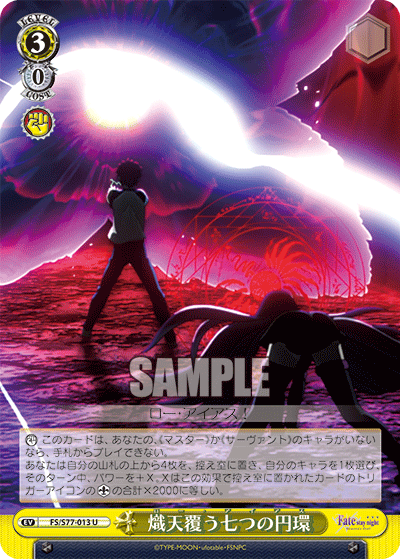
FS/S77-013U 熾天覆う七つの円環 (right)
The primary purpose of a hero is to protect, and both Shirou and Archer understand that duty very well. In Archer’s numerous years facing off against evil, it was at this time where he was able to copy the infamous technique, Rho Aias, a seven layered shield that can block almost anything at all. In the series, even after Archer’s demise, Shirou takes up the mantle and no longer deploys the shield to protect solely himself. This barrier of his represents his all and undying effort to truly defend the world and make it into a better place as evidenced by the seven petal blossom.
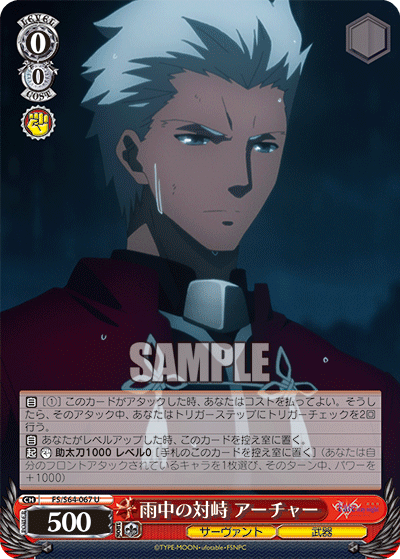
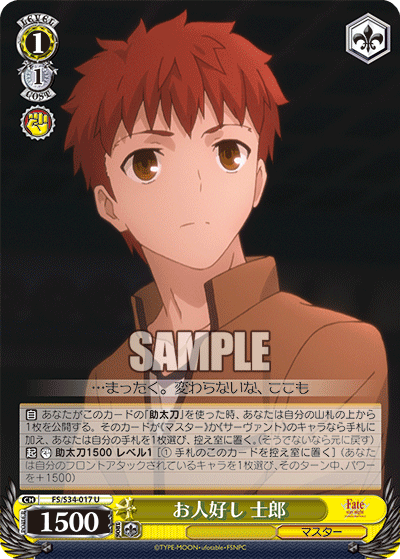
Given the low power of both Shirou and Archer on the defensive side during your opponent’s turns, defensive power doesn’t really help all too much. However, their utility can be phenomenal in just the right situation. Archer’s backup comes with the benefit of being able to be used at level zero, sneaking you some reversals on your opponent’s turn. It also has the ability to trigger twice, which can be useful if spawned by Shirou’s finisher. 1/1 Shirou is a Leafa backup to filter your hand and get you closer to your cancels. Lastly, Shirou’s defensive Rho Aias is a last-ditch effort to mill your deck and also empower your characters based on soul triggers milled.
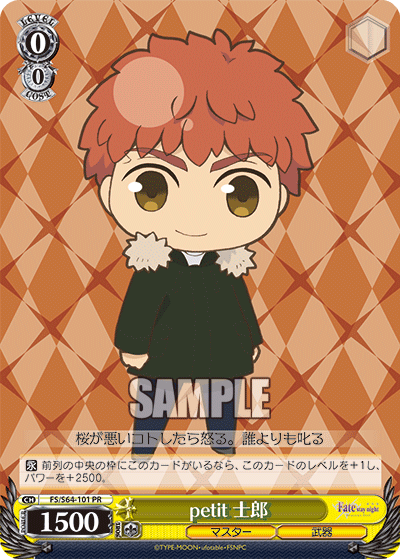
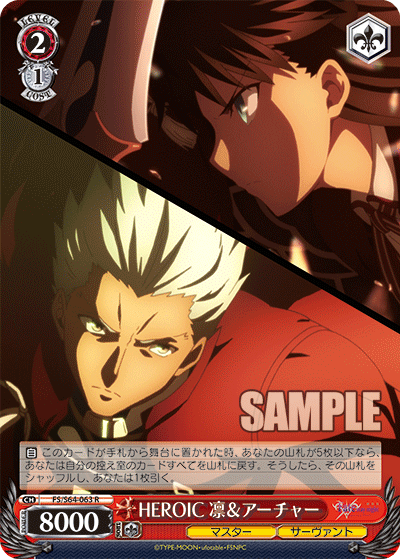
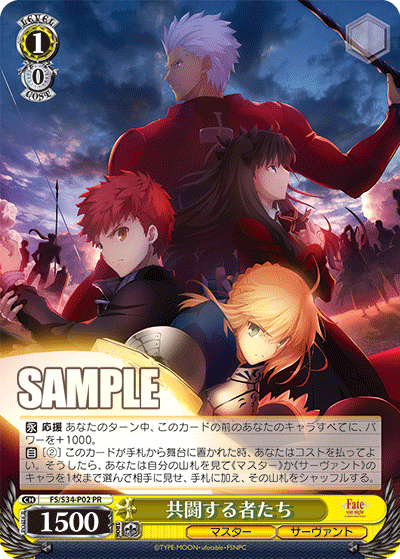
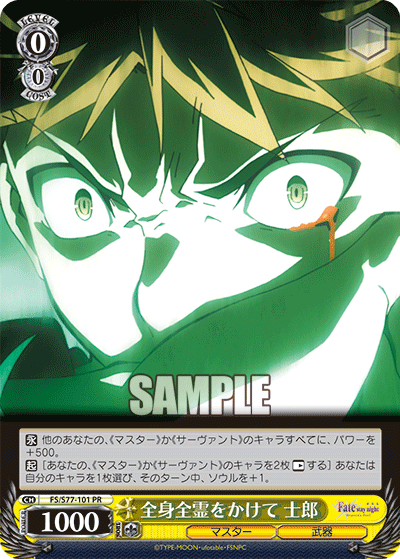
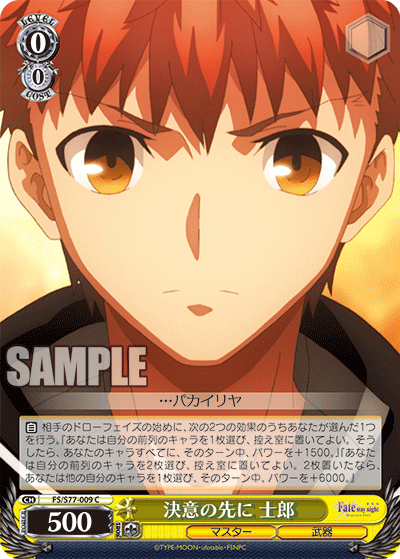
As for some suggestions to round up this post, petit Shirou gains power and a level if he’s in the center stage. 2/1 Rin and Archer is a freefresh profile that also draws you a card (keep in mind that this doesn’t have weapon trait). The 1/0 featuring Shirou, Saber, Rin, and Archer is a front row support during your turn that you can also spend an expensive amount of stock to search out a character from your deck to hand. 0/0 Shirou bleeding from his eyes grants global power and can also tap two to grant a character an additional soul. Lastly, 0/0 Shirou looking confident can sacrifice one of your front row characters at the beginning of your opponent’s draw phase to grant your board 1500 power for the turn or sacrifice two characters to give another character, typically the remaining character in front 6000 power instead.
I think the story of Shirou isn’t one of heroism or anything remotely close. Shirou, by all means and definitions, is an absolute failure. Misguided by fate and his own naive ideals, Shirou’s view of the world is shaped into too much of a basic misunderstanding of the plight of good vs. evil. Shirou’s journey is a rejection of his own very ideals, a recognition of the realities that surround him, and an accepting of those that truly care for him. While, in the beginning, more than ready to commit self-sacrifice in order to preserve morality, throughout his adventures, Shirou realizes that his life is worth more than chasing after this so-called “perfect” good. In order to prevent the cycle of heroism from continuing, he rejects the time-honoured duty and cuts off the sacred rite, preferring to live on, thus stopping the wheel of despair and renewal from spinning. By choosing to live out the rest of his life as a failure, it is here that Shirou finds inner peace and brings about a brighter future.