
If you haven’t heard of CHANGE, I wouldn’t be surprised. You’d quite literally have played for at least a decade to have ever even come close to encountering CHANGE in a consistent manner in terms of set design. CHANGE (チェンジ), unlike profile terms such as Akatsuki and Chiyuri, is a literal keyword printed on cards.


CHANGE is a relatively simple mechanic to explain. As CHANGE suggests, the card transforms into a different card version. Most commonly now, as far as the recent years of card development have gone, CHANGE often swaps cards of similar levels or provides a temporary advantage such as a swap from a level one to a level two that changes back after. This wasn’t actually the case for most of Weiss’ history.


CHANGE used to be more of a one-time exchange. Furthermore, CHANGE was considered relatively expensive mainly due to the general costs of the CHANGE card itself either on its entry requirements or the actual CHANGE stock needs. They most commonly appeared on level two cards, making it a way to cheat around the level limit rule and spawn your finisher relatively early. The value was, for most CHANGE cards, the target was in your waiting room, removing the necessity of having to hold what was potentially a dead card in hand for your current level.



CSM/S96-081S-SR 公安対魔特異4課 姫野 (center)
BFR/S78-068U ノーダメージ メイプル (right)
There are two main reasons as to why CHANGE isn’t really seen as much and most CHANGE really occurs almost exclusively within two cards of the same level. The existence of multiple answers to cheated targets have been long introduced and standardized within the game. Currently, I personally would say that most early played combos in the late game are struggling due to the improved double-Adachi profile, a relatively new advancement but is quickly becoming normalized within new sets and series.
Anti-change, or the arsenal of it, was not a very common design space back in the older days. Very few sets had access to it, especially in the form of a backup. CHANGE could be better facilitated and its targets had a higher chance of sticking on the board. However, that is long in the past now.

The other killer and likely the main reason why CHANGE is no longer around is the existence of the standby mechanic. With CHANGE, it naturally bypasses many traditional limits of game rules mainly because it was formally balanced by its costs. Most CHANGE cards are traditionally expensive from their on-play requirements, typically at two stock. Initially, it was appealing to “standby” CHANGE targets into the front because of the high raw base power of having a level two on board as early as level one, but, with powercreep and the fact that most offensive power beats out defensive options in today’s games, most CHANGE cards were relegated to the backrow. However, since CHANGE works regardless of which position on the stage the card is placed, assuming you could cancel away at level one, you could potentially spawn a level three the following turn and begin railing finishing damage on your opponent immediately.



AW/S18-014U 本当の強さ 黒雪姫 (center)
VR/W22-057U すれ違う心 れい (right)
it is a pity since CHANGE is such a great flavourful way to signify advancements and evolution of characters throughout the game. It was predominately shown through characters who would have transformation sequences into different costumes or forms. However, mainly due to standby, it’s far too easy to potentially abuse CHANGE, making it very unlikely for the keyword to return. Furthermore, CHANGE has also relatively been relegated to a legacy status since many cards essentially do the same level-cheating with a lowered cost or higher efficiency.


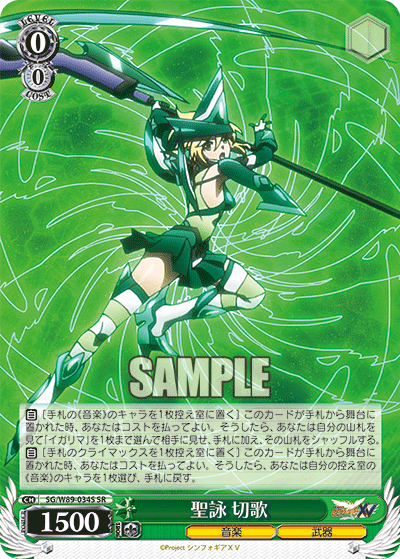
KNK/W132-019R 星空の下 墨 (center)
SG/W89-034S-SR 聖詠 切歌 (right)
With so many characters and designs having their own ways of cheating levels and bringing out their own characters with much lowered costs or other requirements, despite CHANGE no longer really circulating in designs, the concept of early-playing has really evolved, and dare I say it, for the better.
There’s less of a need to run these rather clunky cards that do little-to-nothing unless you have their respective requirements in waiting room. Modern ways to cheat cards into play through self-designated early-play conditions far supersede the old CHANGE. Other cards like Sumi and Kirika above have value beyond being early-play initiators throughout the early game, something that many of the old static CHANGE vanilla cards from before don’t really do.
But, does that mean that we should bring back CHANGE in its entirety, simply due to powercreep? My answer, and from what Bushiroad is also showing, is the same, no. With the way that CHANGE works, it bypasses many traditional checks since it operates on its own rules. With the above examples, they do require other effects to procure and more nuanced conditions. The only requirement for CHANGE is the cost listed for the effect. It can be very openly and quickly abused, especially thanks to the generic design of standby. While safeguards usually limit finisher playing at level two at the earliest, CHANGE ignores this and can lead to degenerate games where your opponents could be employing three copies of a finisher as early as level one with you having no way to respond whatsoever.

Imagine staring three of these down at level one. Furthermore, many of the old CHANGE targets themselves have healing abilities, letting you potentially stall out with some luck. While unlikely, it just produces the potential of degenerative gameplay and souring the Weiss experience overall. I think that’s the likely reason why CHANGE is “dead”. There’s an argument that CHANGE with standby is fine since the sets with CHANGE are old and have not kept up with the times. However, that still doesn’t remove the possibility and the overall degenerative loop that exists with CHANGE and standby. And as such, that’s also why series with CHANGE typically also do not possess any standby triggers at all for this same reason.
As for now, if you really do want to experience CHANGE for yourself, your best bet and for a good time, is to just reach out to a fan of an older series and see if you can make a time machine match yourself, bringing out two same decks from the similar period with your own balancing rules to keep it fair and enjoyable.