
I feel like, each time I make one of these posts, a bit of my soul is getting pulled out. Now, there’s something I do want to mention as a preface. I don’t really know what “other” communities are like, and to be fair, I may be living within an outlier of a community compared to others. Each of these posts, assuming you’ve been keeping up with my site, is essentially a string of ideas that develop from each other. I’ve talked to death about the meta, but there are some real points and conversations that have to be had.
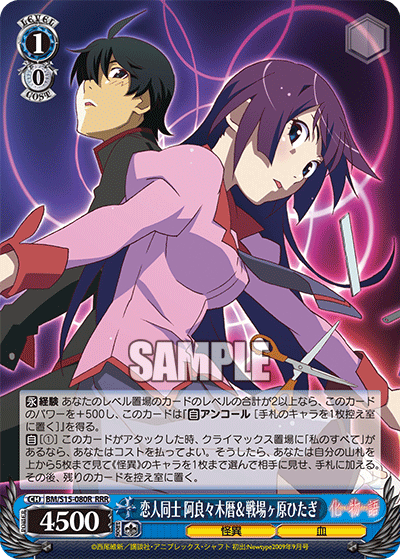
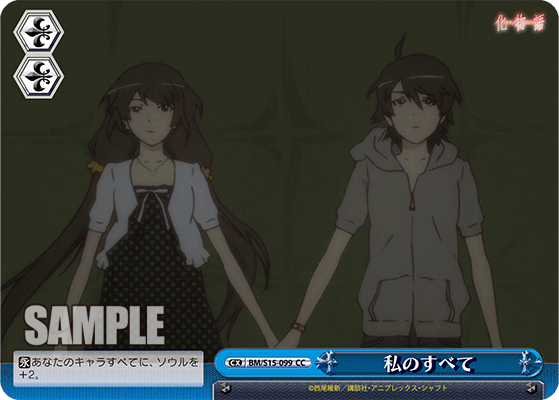
So, before I continue, I want to share a bit of a story. My first deck was from a set called Bakemonogatari. This was longer than a decade ago, and I’ve realized that my story isn’t exactly unique by any measure. After attending an anime convention, I picked up a trial deck and a couple packs and off went my journey with Weiss. I was new to the game and had no direction to really pull from. I didn’t know exactly what I was doing, and I had never even step foot in a card shop. The only references for information about the game that I could pull from online were that of the Pojo forums.
Just like many of you, presumably, I didn’t know what I was doing and sought advice when it came to deck-building. I picked up a very generic deck list that someone gave me and just ran it, assuming that this was good advice. It’s a bit low resolution, but the basic general deck is shown below. Mind you that this was in English and several years before Nisemonogatari came out.

I won some games and lost some games. I feel like it was more in the latter case, but either way, I had a good time. About a year after playing with this deck, I stumbled into buying Japanese cards and the rest was history. That’s to say, there isn’t any need to feel shame for running a generic pile or netdecking. Back in my day, netdecking was still a somewhat new phenomenon, especially for a niche game like Weiss Schwarz. In fact, for much of my time playing this game, I was really just copying decks I saw online for the most part.
So this is where our story departs. Up until a few years or even during the same year that I built this site, I had a change in my philosophy and approach for Weiss Schwarz. It had been obvious for a long time now, but it was getting gradually and increasingly dull to observe decks at my local stores. Every deck didn’t feel unique. It felt as if every player was playing the literal same deck but with slightly differing flavours. You may be saying that is how Weiss was and always has been, but hear me out, there was some very common observations that I had come to see.

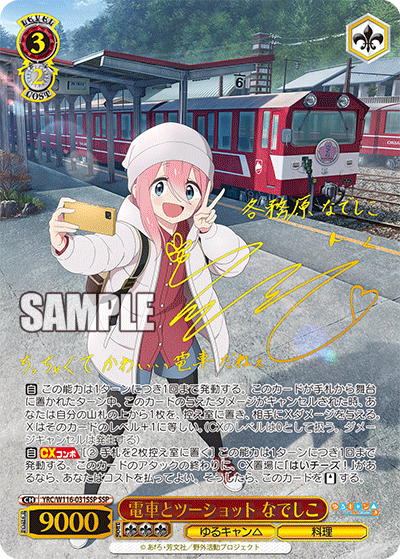
YRC/W116-031SSP-SSP 電車とツーショット なでしこ (center)
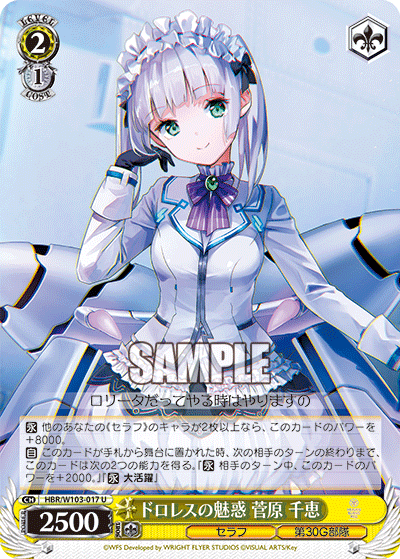
HBR/W103-017U ドロレスの魅惑 菅原 千恵 (right)
Now before you pull out the pitchforks, let me explain myself. I don’t mean that decks are the same because they simply run the same generic profiles that are considered good stuffs. I will get back on that in another moment. Now, as far as competition goes, it’s only natural to run the “strongest” things possible in a deck. But this is where the conversation becomes more convoluted. We must first address what it means to be the “strongest” and also how to facilitate that game plan.
In essence, for the vast majority of Weiss’ past and history, the “strongest” decks in the meta were always just piles of good cards that generated immense value or were able to carry out your game plan with little to no resources. This is mathematically logical. If you have more hand and stock than your opponent, typically, you would win since you would be able to out-value them and do more things, i.e. taking more game actions. For the latter, if you can win the game without using much of any resource, then your game plan is very difficult to interfere with, pushing you onward to victory. Nowadays, I would argue that the top meta decks do both at the same time.
But that isn’t what I’m trying to get into here. The fact was that decks in the meta have very little identity to them, especially if you follow the generic deck builds to a fault. Some of these decks, I would personally argue are egregious, given the amount of bricks (cards that fail conditions or ruin set-ups) that some of them ran. I mean, the argument was simple: just win the gamble. I wouldn’t be surprised if there was some amount of nomenclature calling out these decks as simply “meta slop” pertaining to the mixture of generic cards that have very little flavour connection that are just piled in for a higher mathematical probability of winning.
Competition-aside, this is where the real problem truly expands to. From my experience, there is this floating idea that every set has a perfect answer. By that logic, it means that there is a “correct” design that must be fabricated and guessed together by the community to assemble the “strongest.” Now, once again, this is an aside. This isn’t the main point I want to address, but everything I’ve listed above, will lead to my point below.
See, as players are continually convinced by this “correct” design idea, they tend to overshadow much of the cards within a series itself. Now I want you to understand that this has both theological and practical repercussions. For one, this skews the attention of a series and fixates the identity of a series on a small subset of cards. Rather than expressing the full idea of the series, the characters, the world-building, the callbacks to scenes and ideas from the original material through the use of mechanics and references, players associate series with a singular meta idea. This is not uncommon for many card games. However, this is something that is crucially problematic with a game like Weiss. Because, unlike other card games, Weiss’ entire gimmick as a game is that callback to an original series. In my opinion, and based on what is provided by Weiss Schwarz EN’s tagline: “Relive the climactic scene once more on your stage!”, the game is truly trying to reference its original material and have you live out those exact moments in card game form.
Weiss, at its core, is that reference to anime and whatever content its series are based upon. When you move away from that reference, the game becomes rather empty. Now whether the base mechanics of the game interest you or not is not my concern, but without this identity, the game just feels boring. There isn’t much to talk about at all since the game then just boils down to mashing numbers together and probability checks. To simply put it, Weiss without the anime references is just like any other generic card game. It is the anime and art blended with the mechanics that make Weiss what it is.
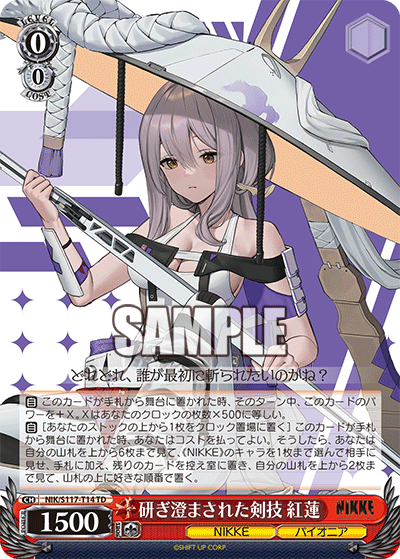

NIK/S117-035R “魔界黒龍波”ギロチン (center)
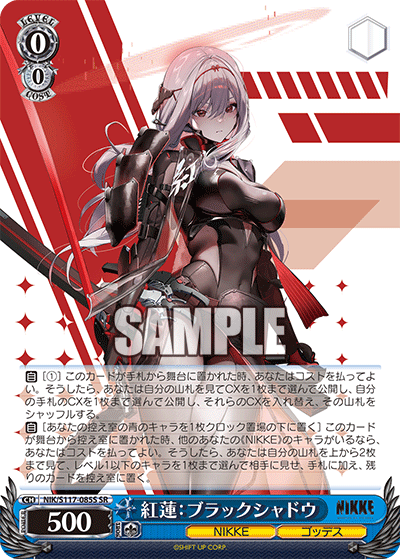
NIK/S117-085S-SR 紅蓮:ブラックシャドウ (right)
Going back to a previous point, I want to highlight the overabundance of staples and generic cards. I will say that the level of generic card use has reached a new peak for me that I can’t even really comprehend at this point. The larger issue is that these staple obsessions leak into deck-building of any stage or situation. With staple effects such as that of the Riki and Riko profiles, cards that you’d probably want in any deck, there is an emerging problem with players being far too obsessed with singular “best in slot” options. In the past, I would be more likely to agree with players. When I first started the game, you were lucky if your set had even a singular brainstorm which would be ran in virtually every deck due to lack of accessibility to that same profile. But nowadays, that’s not the case. Take NIKKE for example. The most commonly ran Riki profile is that of Scarlet over here. Granted, this card is a very powerful card for what it can do, but it isn’t necessary in every single NIKKE build. The set is bloated with similar profiles such as that of Guilloutine and even the other blue 0/0 Scarlet (sorry, yellow doesn’t have a Riki profile as of yet). Depending on what deck profile you are building into, those other options may be a better fit or at least more on flavour.

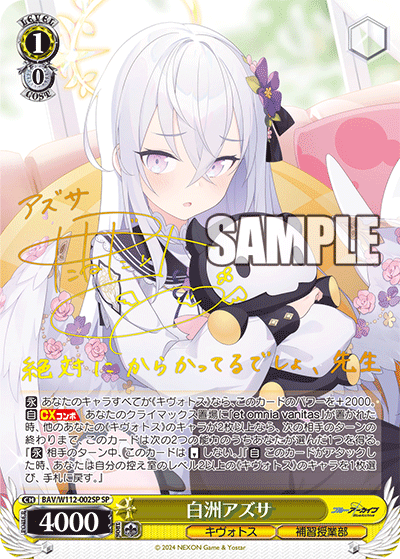
With Shiroko as an example, we also have this bloated idea of the best in slot combos. Now this is even more egregious to me than that of running very generic card profiles. With generic profiles, you can dump them anywhere, but for most combos, especially since they are usually level one or higher, you actually do have to commit some sort of building requirements. A lot of players I noticed ran Shiroko since Shiroko was simple and gave you generic value. I mean, that’s not something I can disagree with. But, granted that many players, at the time, were running 3/2 Hifumi, you may as well just have ran 1/0 Azusa instead.
In this comparison, while Shiroko grabs any character, you do need that random level two experience and a commitment to blue, an off-colour for Hifumi. Azusa offered you modality with either the ability to not be reversed (preventing certain combos and an attacker for next turn) or grant you the ability to salvage any level two or higher character, the pieces needed for Hifumi. I say that, in most games, players should opt to grab Azusa instead is because most players I saw whom played this very deck would only grab Hifumi pieces from their waiting room anyways. This meant that the generic salvage from Shiroko would not matter almost all the time. Sure, she gave you an option to salvage something for next turn if you were stuck at level one, Azusa staying alive would essentially do the same thing while not needing you to commit much else to the board. Furthermore, their triggers do matter. Shiroko works with an arc trigger so you can more easily grab your climaxes while Azusa was with a choice so that you can either salvage parts for Hifumi or stock in advance. I’m not saying that one is significantly better than the other. I’m saying that there are options and alternatives compared to the seemingly globalized statement of “Shiroko is the right play.”
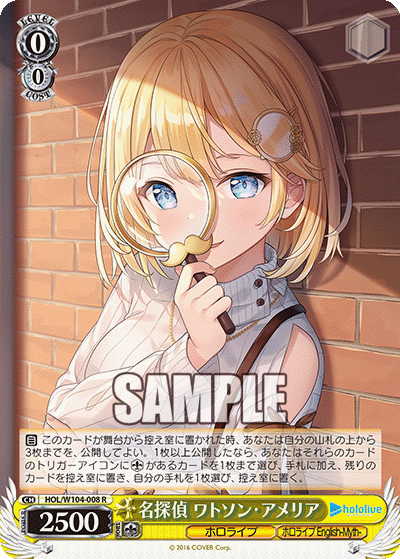

HOL/W104-008R 名探偵 ワトソン・アメリア (center)
WTR/S85-001RR 激しい剣撃 太刀川 慶 (right)
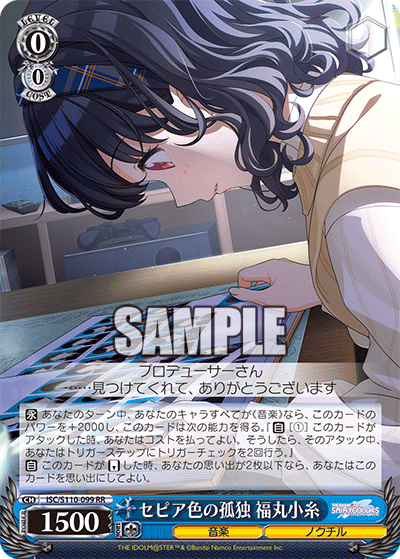
What comes weird to me is the “staples” that other players argue are needed within every deck. With generic cards, I can see the logic behind that, but some of these cards above and others need more clear justification. One common justification is simply that the card goes to memory and that memory is efficient. I wonder to myself many times whether the new players or players around me are old or the world has gone mad, usually both. I’ll probably explain this further in a different post, but memory really doesn’t matter until you start garnering some significant amount. Koito’s argument is that she’s a large beater than can trigger twice and disappears from the Earth shortly after she dies. You don’t need this card. Especially in the modern game where games are way faster and that there are so many options around, playing a card solely for a single point in memory that really doesn’t do much of anything else is just not worth it.
It makes sense if you are building Noctchill (ノクチル) whose entire unit is prefaced on having cards in memory, but otherwise, this is, to me, one of the weakest value cards that people just randomly fixate on. Some of these get even more random with players justifying cards like Ame into their deck, citing that, even though they aren’t on Holo-Myth, it is possible for them to mill a climax with a soul icon and treat Ame as a pseudo-Koume profile. I mean, that’s cute, but, given that this card literally has no other effect, is there nothing better you can do with that slot? One excuse I’ve heard for Kei is that he’s yellow and lets you play yellow cards and is a clean cut profile. That doesn’t mean anything, especially if your deck has nothing worth saving to begin with and you’re playing a singular yellow card above level zero that has very little impact on the game.
Now how does this even relate to the meta thinking ideas? Many of these cards have shown up in the meta decks. While the meta decks have particular purposes or certain play patterns for them, they’ve become associated and universalized as cards that belong in every deck in their particular series. This doesn’t make sense. You build decks with synergy with each other, not forcing a random card into your deck because you saw it being used in another deck.
The last minor justification is this constant need to replicate “professionals” or the Japanese. There’s this new wave or phenomenon with obsessing over Twitter posts and other social media links that depict decks that win in tournaments. It was existing back when I was younger, but since, social media has only grown larger comparatively as access and connectivity in the world has never been bigger. Despite this, players have this common trait of replicating one another, which by itself is not a problem. The problem is players don’t evaluate the cards or deck they are copying, preferring to keep it identical to its origin without any criticism or modifications to compete within their own locals.
None of this is organic deck-building. While discussions online are good, replicating and reciting lists and cards without explanation doesn’t promote thinking or engaging the community whatsoever. This creates communities devoid of thought process, reliant solely on netdecking support and incapable of developing their own unique ideas or portraying their fandom.
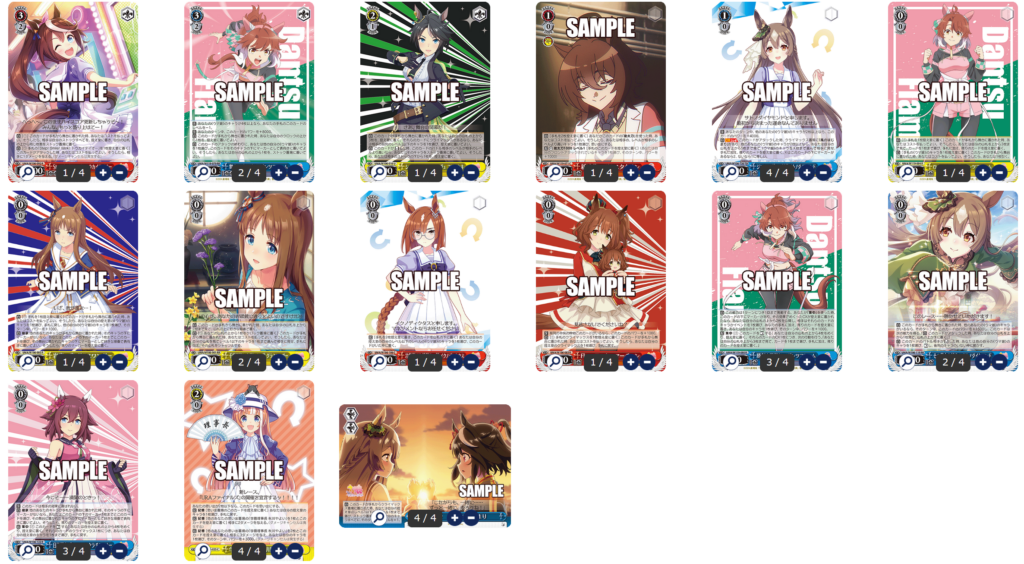
Arguably, the most visual proof I have of a lack of creativity in players is the series known as Uma Musume. Don’t get me wrong. I do own the horse girls myself, and I do enjoy the series. However, this series is probably the least creative by design and a deck-building standpoint as I’ve seen from players. If you are a veteran to the game, you are probably not surprised when I dumped the image above. You may know a majority of the cards because they appear in most Uma deck lists.
Uma has, what could be described in the community, a set core. What that means is that structure above is the necessary framework for every “meta” deck going forward. Now, I don’t particularly care about the meta implication, but I am, however, worried in the fact that this core extends beyond meta deck-building. Essentially, because of this pile’s dominance in the game from a competitive viewpoint, many players, even outside of the competitive setting, are drawn to this pile and, as a result, look away from the rest of what Uma can offer.
This is most evident if we have a conversation about the second set released for the series, Beginning of a New Era, where the noteworthy cards with a price tag are mainly amendments for the deck above with Dantsu Flame’s early play and a choice end game between first set’s Curren-chan versus Agnes Tachyon. Either way, the diversity is not seen in this set as a large chunk of decks compiled visually online are fixated on this core.
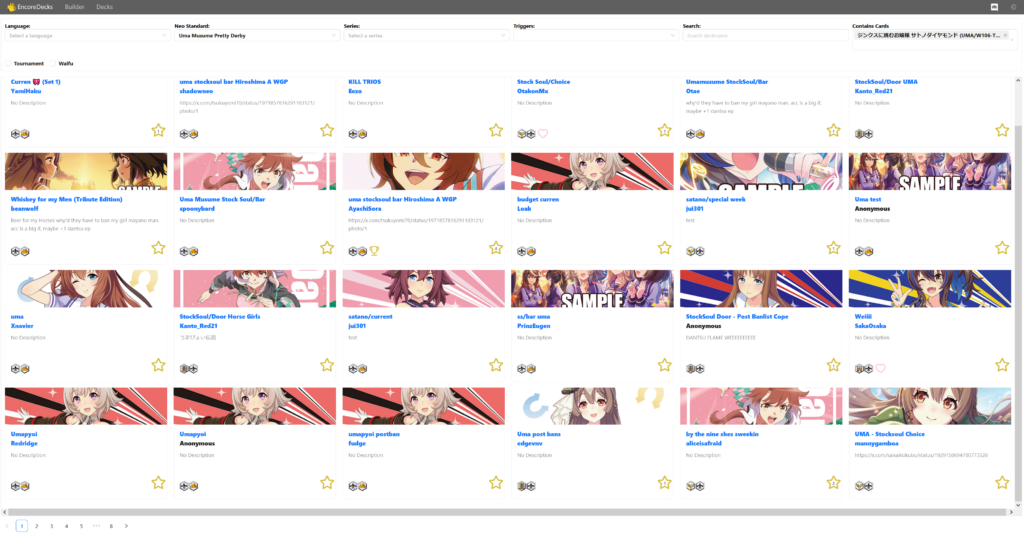
I know this isn’t empirical evidence, but hear me out. On the fan deck collaboration site of EncoreDecks, if you were to look up Uma decks, within the existing twenty-two pages of Uma decks available, eight of them alone are carrying the 1/0 Satono Diamond. Now this data should be taken with a grain of salt since it is likely that the same player could be uploading multiple variants of their own deck. But, from just a numbers standpoint, does it not sound rather insane that one singular combo is responsible for about a third of the number of available deck designs made by players?
Uma is a series with so many different cards. By the time this article is published, it just received its third set in the series. And on top of this, Uma was a series that released with well over the standard number of cards as it was released featuring many of its gacha game characters. The original set was already over-inflated with cards, but at the end of the day, why would a series that diverse devolve into a singular core of cards that outline more than half of your deck. In a logical way, there should be much more diversity than this given the multiple profiles that exist and overlap with one another.
Lastly, from a practical standpoint, I want to speak about the problem of pushing creativity away and embracing this limited design. This is more of a problem when it comes to the English format and in the West in general comparatively to the Japanese side. To put it bluntly, when a series showcases a singular deck design, players will obviously flock to buy out those exact cards. Now I question you to think what happens to the other cards that were opened to invite players to the store. As it stands, this is a common commotion that I’ve been noticing while speaking with others. Players often buy out those specialty and popular cards while leaving a trail of bulk at the store. While this isn’t uncommon for other games either, the problem is how concentrated this buying pattern can be. Whereas, in most games, bulk rares and lower rarity cards will remain sitting on the shelf for some time, for Weiss, many of the double rares (highest base rarity) will stay in inventory and accumulate dust. These cards don’t move at all. Whereas other games have alternative formats or have designated ways to make use of these cards, but with the whole obsession on a singular concentrated build or core, there is virtually no home for these cards to go to. And this is where I encourage you as players to really think about this for a moment.
If anything at all strikes you in this post, let it be this last point. Time and time again, I’ve talked around, and this whole purchasing of strong cards and ditching the rest leaves the stores with unchecked boxes of unsold inventory that won’t go anywhere. Furthermore, remember that stores do have to open boxes to get you your singles that you want. I’m not implying a curse here, but it’s not a sustainable model for stores to continue to open boxes just to sell only the shiny cards and high-peak valued cards as well. The other cards have to go somewhere. And if the store cannot maintain its model, well, you probably can guess what will happen to your specific locals.
I’m encouraging you all to genuinely take a look at the entire set list and look for things that can interest you. Try challenging yourself to build without limiting yourself to staple cards. Try to determine and look for synergies, or, as fans of a series itself, genuinely try to “relive the climactic scene once more on your stage!”